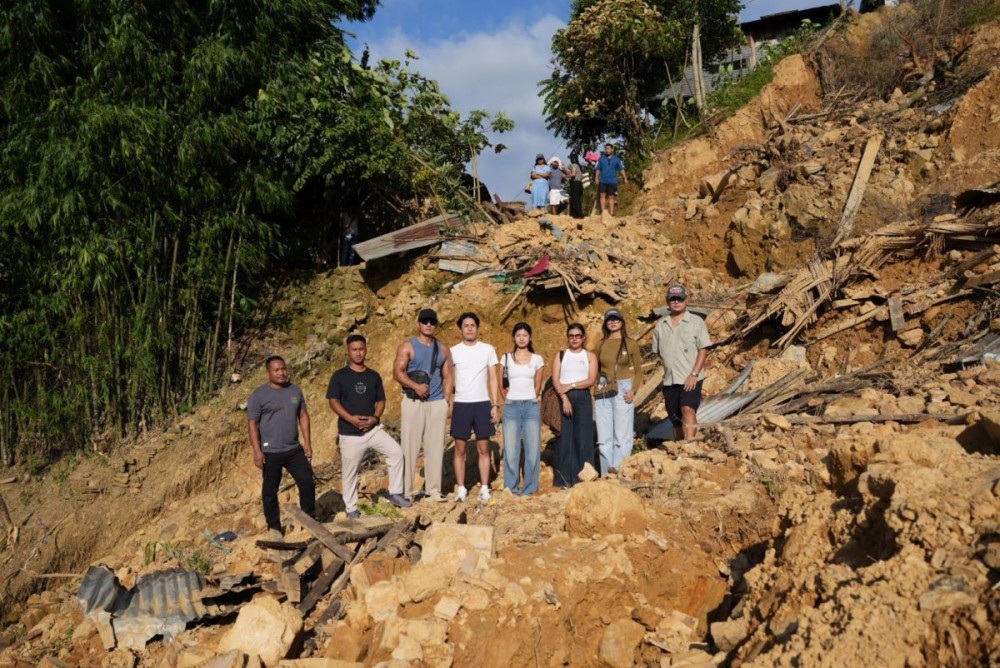
From Left: David Wanghra and Nokong (MDBFA members) along with NIS Creators, Kenny Soru, Koko Imchen, Anon Wangshu, Naga Nuna, Nikali Shohe along with Filmmaker Kohdi Jings, at one of the affected sites in Defence Colony, Mon Town on August 10. (Photo Courtesy: @NagaNunaVlogs)
H Anguvi Chishi
Dimapur | August 11
In an era dominated by algorithmic metrics, digital influence is frequently reduced to a transaction of likes, shares, and superficial engagement. Content creators are frequently stereotyped as a detached demographic, isolated by their screens from the harsh socioeconomic and infrastructural realities on the ground.
Yet systemic crises have a unique way of cutting through superficiality. When catastrophic landslides devastated Mon in mid-July, an entirely different narrative emerged from Nagaland’s digital ecosystem. Operating under the structural mandate, “Beyond Influence, Creating Change Together,” the state’s digital youth initiated an organic mobilisation of local talent.
Transcending the traditional boundaries, the organisers of the Nagaland Influencers Summit (NIS) 2026 turned their platforms into an emergency relief mechanism, raising Rs 7,48,000 for affected families. Driven by an automated framework designed for social intervention, local creators managed to pivot from a standard industry convention into an active humanitarian operation.
The strategic mobilisation
Long before the mid-July rains caused mass displacement in Mon, discussions regarding structural civic engagement were already underway within the NIS 2026 organising committee. The committee established the Creators for Community Initiative to allow artists, digital storytellers, and technical professionals to contribute directly to regional causes. The creators organised themselves into four distinct regional teams, each granted the autonomy to identify and support localised causes.
The Phase II team was initially exploring fundraising interventions for underprivileged families across the Dimapur and Chümoukedima sectors. “We were still looking at different options when the Mon landslide happened,” explained prominent content creator Chumchano Ngullie, widely recognised online as @NagaNunaVlogs.
As authenticated photographs and videos detailing the scale of the destruction in Mon began surfacing after July 10, the team executed an immediate strategic pivot. “The tragedy did not create the initiative; it showed us why the initiative was necessary,” Ngullie noted, emphasising that a pre-existing flexible framework allowed them to deploy aid rapidly without getting bogged down by bureaucratic delays.
Curating a mission-driven lineup
To mitigate the risk of a humanitarian crisis being utilised for individual profile-building, the organisers enforced a strict, non-commercial mandate for their guest lineup. Reaching out through personal networks, the core team brought together prominent local cultural icons, including Abdon Mech, KL Pamei, Big Dane, Eva Jamir, and Rovi Metha.
The criteria for inclusion were intentionally decentralized, utilising the term “talents of Nagaland” to encompass individuals outside the traditional definition of an online influencer—bringing together musicians, comedians, and speakers. Regional prayer warriors were also scheduled to anchor the collective program, though severe last-minute internet connectivity issues ultimately disrupted their digital feed.
The underlying mandate to all participants was uncompromised: the initiative was entirely decoupled from individual branding and centred exclusively on the affected population in Mon.
Technical obstacles and financial accountability
Behind the camera, the live broadcast presented significant logistical challenges. Maintaining a multi-hour livestream required the hosts to navigate short digital attention spans, balancing high-energy entertainment with the profound gravity of a disaster that caused loss of life and property. When the live conversations naturally drifted due to host fatigue, the backstage production crew acted as an operational anchor.
Filmmaker and production specialist Kohdi Jings monitored real-time audience metrics, signalling the hosts to redirect discussions, introduce specific cultural performances, or recalibrate the tone. To maximise financial efficiency, the NIS office rejected third-party e-commerce payment gateways that levy mandatory processing fees.
Choosing a manual ledger system over commercial convenience, the team encountered significant financial chokepoints due to the daily transaction ceilings imposed on standard UPI accounts. Donors reported continuous transaction failures mid-stream, forcing the team to dynamically rotate its financial infrastructure, deploying alternative bank accounts and utilising more than ten distinct QR codes throughout the campaign.
A dedicated administrative unit within the NIS office worked continuously to cross-reference bank statements with dynamic Excel sheets, establishing a completely traceable digital audit trail to account for the final sum of Rs 7,48,000.
Structural scrutiny and on-ground reality
The campaign's success brought long-standing systemic tensions regarding the role of digital creators to the forefront of regional discourse. Ngullie highlighted a previous systemic failure where content creators mobilised public awareness for a union protest, only to be sidelined on the day of the event by an unrelated political agenda, ultimately becoming the primary targets of public criticism.
“Why is it that, every single time something happens, the first punch seems to land on 'the so-called local influencers'?” Ngullie questioned, citing a spectrum of unresolved regional crises, from flooding in Dimapur and fatal landslides in Mokokchung, to severe road cut-offs in Longleng, Shamator, Tuli, and the critical Kohima–Dimapur highway.
The organising team maintains that a digital platform does not shift civic obligations away from the broader populace. “We are citizens first. The responsibility to care about what happens in Nagaland belongs to every citizen—not only to people who happen to have followers on social media.”
Avoiding conventional political or corporate sponsorship networks, the campaign relied strictly on a youth-driven micro-donation model labelled #150ForMon.
The objective was to enable ordinary citizens to contribute small denominations of Rs 100 or Rs 150, which yielded significant cumulative impact. This model proved effective on the ground; a subset of creators operating in Kohima successfully generated Rs 24,500 within a single hour by conducting direct public collections across the city's streets.
With the digital phase completed, the Phase II core team transitioned to direct distribution, navigating the mud-blocked road networks leading to Mon on August 10. The team explicitly clarified that this travel was not designed for content generation or promotional purposes.
A major focus of the deployment is to ensure that aid delivery is conducted with deep sensitivity toward the grief of the recipient families. “Money alone is not necessarily hope,” Ngullie stated. “Sometimes hope can be sitting with a family, listening to them, sharing a meal, praying with them, giving them a hug or simply showing them that people care about what they have gone through.
The true definition of influence
The true baseline success of the #150ForMon initiative cannot be measured solely by the finality of its financial statement. Its true value lies in the standardisation of decentralized public empathy. By proving that a sustainable fundraising model can be built entirely on small-scale contributions from ordinary citizens, the youth of Nagaland demonstrated that meaningful social intervention does not require institutional gatekeeping or corporate backing.
This campaign marks a critical evolution in how digital platforms interface with regional crises in Northeast India. It establishes that real-world influence is not determined by an online profile, but by a willingness to utilise that profile to support the community when physical and infrastructural foundations give way.
As the Phase II team advanced along the unstable roads toward Mon to deliver these audited public resources, they carry a clear message: civic responsibility is a shared obligation, and sustainable change is achieved when small, collective actions are executed with transparency and purpose.