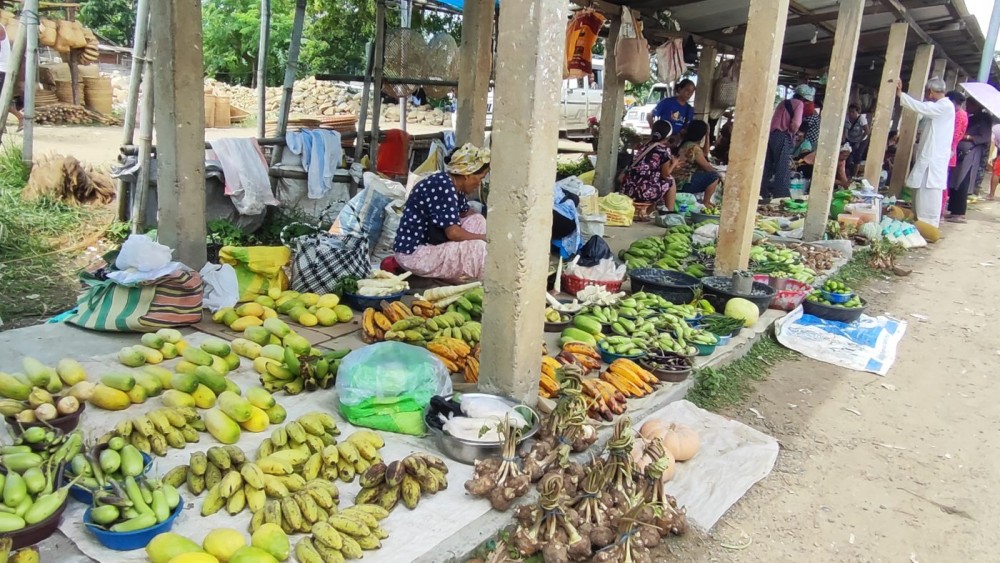
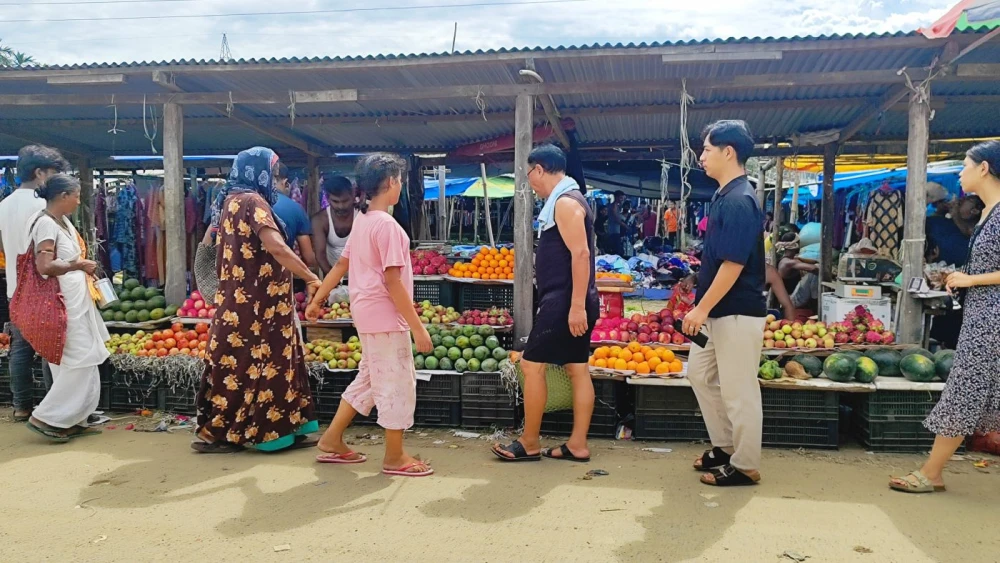
Local vegetables and fruits on display at a section of the Chümoukedima weekly bazaar. According to an official, more than 800 local and non-local vendors operate at the market, with trading continuing throughout the day each Saturday. (Moarula Pongen/ Morung Photo)
From farm produce to cross-state trade, Chümoukedima weekly Bazaar is an economic hub connecting vendors, workers and shoppers across the region
Moarula Pongen
Chümoukedima | August 9
By 5:00 a.m., the Chümoukedima Saturday Bazaar is already coming to life. Vendors arrive with vegetables, fruits, groceries, second-hand clothing, street food and other daily essentials, unloading their goods and preparing their stalls for the day ahead.
Commonly known as Chümou Bazaar, the weekly market is one of the busiest in the Chümoukedima- Dimapur area, drawing vendors and shoppers from across the region.
More than 800 vendors, both local and non-local, operate here, with trading continuing throughout the day, informed Market Management Committee Chairman Kengulie Shuya.
The market also drew shoppers not only from Chümoukedima and neighbouring Dimapur, but also from Kohima, Peren and Assam.
A wide range of goods, coupled with relatively affordable prices, draws both traders and consumers to the market.
The market is laid out in sections, with stalls selling groceries, vegetables, second-hand clothing and other goods grouped together.
At the heart of the marketplace is the office of the Market Management Committee, which oversees stall allocation and the day-to-day functioning of the bazaar.
The market also has basic facilities such as parking, lighting and toilets. Food safety and hygiene are monitored through periodic inspections, particularly on Saturdays, involving government departments and the Chümoukedima Town Council (CTC).
Maintaining cleanliness, however, requires regular attention.
A caretaker is engaged from Monday to Wednesday for cleaning, while waste generated at the market is collected by the CTC for disposal, Shuya noted.
He said the market generally runs smoothly, with occasional theft and money-lending issues among the minor concerns.
From village farms to wholesale markets
Behind the stalls is a supply network that stretches well beyond Chümoukedima.
Most vendors source their goods from wholesale markets, while some bring fresh produce directly from villages in Peren as well as Phek districts.
Prices are generally influenced by prevailing wholesale rates, while demand, transport costs and the perishability of goods also affect what consumers pay.
Bargaining remains a familiar part of the market experience. Vendors interviewed said negotiating prices is a routine part of their dealings with customers and has remained a regular feature of business over the years.
For sellers of perishable goods, however, the day’s sales can determine whether a business makes a profit or absorbs a loss.
One vendor said the market is an important source of household income, although fluctuating sales can make it difficult to maintain a stable income, with unsold products often sold at reduced prices to minimise losses.
Many vendors have been trading at the marker for six years or more and continue to depend on the weekly market to sustain their livelihoods.
Livelihood across borders The market also reflects the movement of people in search of economic opportunities.
A vendor from Bihar said he moved to Dimapur in search of better livelihood opportunities, leaving his family behind as he started his business at the market.
He has since made Chümou Bazaar his place of work, joining traders who travel from different parts of the country to earn a living.
Others vendors interviewed generally expressed satisfaction with the market and its business environment with one describing it simply as “the best market in Dimapur”.
For shoppers, meanwhile, the attraction lies largely in the variety and prices.
A shopper from Kohima visiting the market for the first time said she was impressed by the quality of the products and the reasonable prices available.
The combination of choice and affordability has helped the market develop a customer base that extends well beyond its immediate locality.
Despite the overall positive experience, some pointed to specific challenges.
Sofikul Islam, who has been trading at the market for seven years, identified the mandatory ‘bio-friendly’ carry bags as one such difficulty.
“If I could change something, I would change the carry bag because it is a struggle for both me and my customers,” he said.
He said the plastic bags previously used by vendors were more affordable, while the current carry bags have increased costs and added to the financial burden on both sellers and customers.
The market as a marketplace
The economic network extends beyond the vendors themselves. Drivers transport goods to the market, while helpers assist with loading, unloading and carrying products.
Beyond the rows of goods, the market has much of what vendors and shoppers need for a full day of trading and shopping.
Dozens of eateries and open stalls provide meals and refreshments, while a sizeable second-hand clothing section draws shoppers looking for affordable options.
Tailors working within the market also offer quick alterations, allowing customers to have clothes fitted on the spot.
More than a weekly affair
As the day’s trading winds down, the activity at Chümou Bazaar gradually gives way to the routine of clearing stalls and moving leftover goods.
What takes place at the market over a single Saturday, however, supports an economic chain that extends far beyond the marketplace itself, from farmers and wholesalers to vendors, drivers, helpers and consumers.
For hundreds of vendors and workers, it is where livelihoods are negotiated, one Saturday at a time.
Moarula Pongen is a fifth-semester B.A. student in the Department of Mass Communication, Tetso College, Chümoukedima. This report was produced as part of her one-month internship at The Morung Express.