

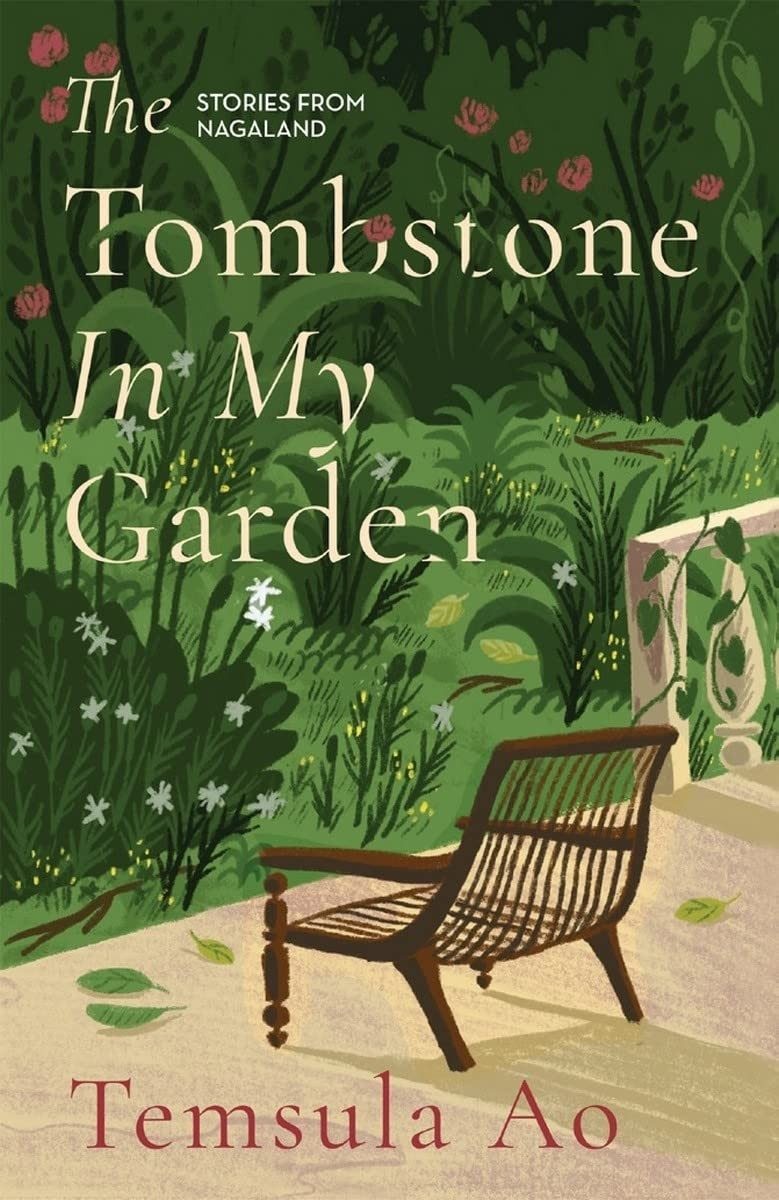
The Tombstone In My Garden -Stories from Nagaland- Temsula Ao Speaking Tiger, 2025.
Dr Rakesh Chandra
Lucknow, UP
Temsula Ao is widely recognized as Nagaland's most eminent literary personality. Her writings show an ample glimpse of indigenous folklore with a fair mix of contemporary issues facing India. She is an accomplished poet, and well-known academic too. Her present book is a collection of her five short stories written in the background of local Naga culture and traditions.
The first story of the book, “The Platform” is a heart-wrenching tale of a young boy who happens to be originally a Muslim but adopted by a Hindu who is a very popular and sought after railway platform porter amongst the daily passengers having friendly and amiable manners. He, like many others, does not belong to either Dimapur town or any part of Nagaland. He hails from somewhere in North India. The railway porters working on Dimapur railway platform coming from outside Nagaland are, by and large, termed as “Biharis” i.e. people coming from Bihar only. Undoubtedly, these porters work and live in unison, and vividly form a local pressure group. Besides them, there are Marwari businessmen whom the erstwhile British government called there to pursue business activities.
Later, people from Bangladesh, mainly Muslims, also reached there and gradually established a stronghold in different areas of activities including business and agriculture. But the most interesting thing is the presence of two small brothels at the far end of railway establishment which categorically serve the ‘'only Hindu” and “only Muslim” customers. These outfits are managed by the people belonging to that particular religion only. A few tough people from the porters' community are also actively involved in conducting such nefarious activities. One day, destiny spurs the boy Ajai with a false identity as Hindu, to a Hindu brothel where his real identity is revealed and he is done to death in a clandestine manner by the Hindu protagonists. His protector, Nandu is also spotted and he comes to the shelter of a prominent Marwari businessman who manages his escape from there to his native village. However, his journey is never completed, and he gets down from the train at a railway station where nobody knows him. In an alien place, he is left alone to deliberate upon the many facets of his life afresh. By adopting an orphan boy and giving him a Hindu name to protect him from the clutches of the cruel world, he had not committed a sin. But what did he get in return? The story is a poignant tale of a man trapped into a maze of many existential questions. The perennial questions of rivalry between Hindu and Muslim, good and evil and humanity and selfishness etc. have never ebbed though the growth of science and technology has widely opened new frontiers for socio-economic advancements. The writer has once again raised these basic questions once again before the readers as a ‘'food for thought” and she goads us all to find appropriate solutions to deal with these nagging problems.
The next story “The Saga of a Cloth” is melancholic tale of a woman who was deprived of her lady love, and subjected to live with a person she thoroughly disliked. Steeped into the deeprooted traditions of Naga society, the chief protagonists of this tale, a woman named Otsu who is an ageing grandmother also, takes revenge against her husband being the perpetrator of a crime she would never forget and forgive. She does it by cutting the tassels from the funerary cloth of her husband which is deemed to be a sacrilege and mortal sin in the folklore. However, she is not afraid or remorseful of her action which was directed not against the prevailing value system but against a wicked soul who symbolized for her anything which was bad and ugly. The writer in epilogue has raised several questions also in regard to what could have happened to the survivors of the tale, and probably the fate of moral and spiritual traditions continuing from the olden times. This is indeed, a poignant and heartrending tale of a woman's life whose only sin was to yearn for pure love from her prince charming. At the same time, by avenging her defeat, she also showed the effervescence of the spirits of a woman who could not be subdued by the whims and fancies of the evil forces roaming on earth in the name of chauvinistic males.
This is, indeed, a scientific fact that the plants too breathe in the air like humans do. In another story “Snow-Green”, this fact has been given a new colour by depicting that the plants growing in a particular colony or flower bed don't appreciate if they are unwillingly shifted to another environment which does not suit their growth process. So, when a particular variety of very beautiful Lily flower is dislodged from the normal bed in the garden to an ornate flower pot for the purpose of putting it in a flower show competition, it begins to wither in a changed atmosphere. In her natural habitat, her primary colour was snow white with pale green tinge around the serrated petals and stardust of the same hue that speckled inside of the petals that added to its crowning glory. But after its dislodgement from the flower bed, it refused to open her petals and buds remained closed for unknown reasons. Sensing the plight of the same Lily plant, the gardener took a bud of the emaciated plant and planted it somewhere else in the flower bed, and again the flower bloomed in gay abandon. After the incident, the mistress of the house started to lose interest in the garden and the old gardener was also discharged from his duties. He retired to his village where on his death, seven Lily flowers were placed on his chest including one Snow-Green flower which was so lovingly tended by the gardener himself in the soil of his village. However, seeing the pictures of her retired and dead gardener, the house mistress realized her mistake. She finally moved to the abandoned flower shed and embraced the empty pot in which the snow-green Lily was planted, and sang lullabies to her. A touching story, indeed with a message that even plants donot like displacement that restrict their space and curtail their innate freedom to breathe in an open atmosphere.
The plants not only breathe but they talk too! That is the message of another story “The Talking Tree” which clearly shows that the trees talk not loudly but in whispers, but that can be heard and responded to by the ones who possess a sensitive heart and alert mind. This interesting story revolves around a very old and huge tree which literally stands as “Grandfather” to other small trees and bushes around in the vicinity. Once a mighty storm uprooted many trees and plants in a jiffy. The next day a gang of greedy humans visit the site and they make a plan to cut the big tree also along with the fallen trees with the only motive of making money. They, however, disperse from the site that day with the intention of coming the next day with all the necessary implements and accessories. A little sapling having roots in a crevice of the big tree hears all this and becomes jittery. He makes best efforts to come out a little of the crevice and calls loudly for everyone to hear. At last, the denizens of the forest such as birds and animals come to know about their impending future, and they resolve to thwart this dastardly attack on their freedom to survive. A strategy is planned and everyone gets ready to throw their weight when the human teams arrive the next day. Finally, the chosen strategy succeeds and the drastic efforts of the humans are successfully thwarted. Hearing this news, many people throng the place and try to capture the photograph of the big tree. Only one intrepid photographer climbs the ridge and captures the images from a close angle. In many of such photographs, the same tiny tree looms large spreading out from inside the crevice of the big tree. Later, an exhibition of these photographs and paintings is organised in which the photograph of a misshapen tree is displayed with its branches spread out towards the river flowing nearby. The bending trunk of the tree had an opening out of which a little sapling was shown ‘as if it was asking a question of its host.’ The title on the base is written as The Talking Tree. When the villagers were asked whether they know or understand the language of the trees, they denied but added that due to their long association, ‘they have learnt from nature that we need only its spirit to make us intelligible to each other.’ An important lesson to be learnt by every human being irrespective of the place of his dwelling! A story well told by the writer with a message that is always relevant for the humans, at least.
The last story of this book, “The Tombstone in My Garden” touches upon a quite unique topic of colour consciousness prevailing everywhere, not only in India but in the whole world. The plot of the story is set in British India where a British officer gets enamoured with a native tea estate woman labourer and marries her. The progeny of this union nurtures black hairs on her head over a white body below. For many people, this was a matter of ridicule and derision too and the girl was the worst sufferer. After marriage, altercations and dog fights began to erupt. The father of the girl named her Lily Anne that would raise many eyebrows though she was called by a few people “Chhoti Mem” also. After the death of her husband, his tomb was constructed in her family garden which became an eyesore for her, now a matriarch. At last, when that tomb was removed and relocated to the family graveyard, some old roses were blooming in that place. Finally, she dies looking there while sitting on a chair. Now she was over and above any critique about her appearances or rationale behind her name etc. As the writer has beautifully expressed, “She finally realized that she was just an ordinary woman born under extraordinary circumstances which predetermined the course of her life.” A very pathetic tale of a woman with extraordinary looks which is brilliantly interspersed with patches of psychological inputs. Writing a story on this unique topic, a love-hate relationship between a native woman and a white man of British origin, required a lot of sensitive handling, and the writer has not failed the readers.
The stories in this collection are mainly women-centric which tend to explore the nuances of their mental approach. The writer has carved the structure of these stories with rare sensitivity. She has not alienated herself in the process with the prevailing ancient Naga traditions and practices to make the readers aware of them in a lucid manner. She appears to be a master of her craft and takes the readers along in her different journeys of life in search of meaningful stories. Apart from that, in her first story she has shed light on the wider scenario of communalism and factionalism prevailing in every nook and corner of the country which is showing a cancerous growth for the body politic of this great country, India. Undoubtedly, she is an aware and mentally alert writer who understands her responsibilities without any shades of doubt. This is, indeed, a welcome addition to the world of literature produced by a woman writer of repute from Nagaland.

