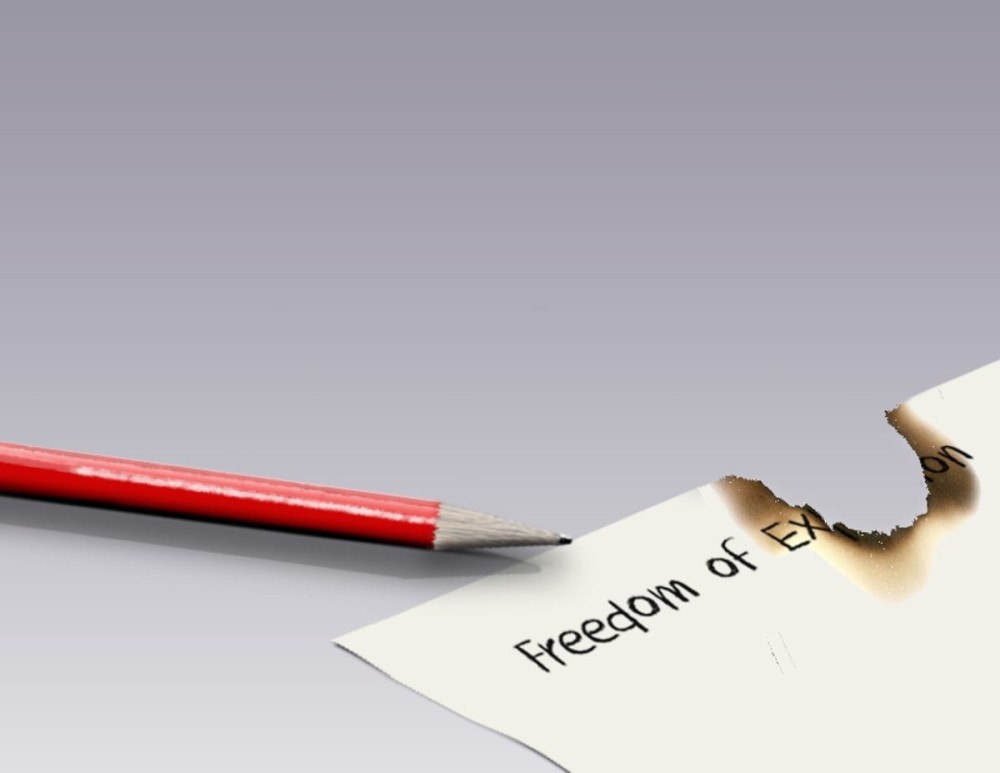
Photo Courtesy: Image by Joao from Pixabay | For representational purpose only
“In order to be able to think, you have to risk being offensive”—Jordan Peterson
Clement Bujem
Signal Angami Village, Dimapur
There is freedom of expression in Nagaland.
At least, that is what the Constitution of India says. It is a fascinating kind of freedom, though. You are free to speak, provided you say the right things. You are free to express an opinion, provided nobody important disagrees with it. You are free to criticise, provided the criticism is sufficiently flattering. And, above all, you are free to have a contrary opinion—until someone demands an apology.
Welcome to the peculiar Naga version of freedom of expression!
Here, apparently, the greatest threat to society is not corruption, incompetence, hypocrisy or bad governance. It is someone saying something we do not like. And when that happens, the great Naga democratic machinery swings into action: outrage, press statement, condemnation and finally a demand for an apology.
Democracy, Naga style!
What Does the Constitution Actually Say?
Article 19(1)(a) of the Constitution of India guarantees citizens the fundamental right to freedom of speech and expression. Article 19(2), however, permits reasonable restrictions on specified grounds, including security of the State, public order, decency or morality, defamation, contempt of court and incitement to an offence.
That distinction matters.
The Constitution does not provide a general exception called “Things My Community Doesn’t Like Hearing.” Nor does it say that freedom of expression is subject to the approval of a tribal body. And it certainly does not say that anyone expressing a contrary opinion must first apologise. Freedom of expression necessarily protects disagreement. Otherwise, it is not really freedom. If I am allowed to say only what you already believe, you have not given me freedom. You have given me permission. There is a significant difference.
The Naga Problem: We Love Consensus Too Much
The Naga people rightly take pride in community. Our traditional institutions, village councils, tribal organisations and customary systems have historically emphasised collective decision-making. Social cohesion has enormous value. But somewhere along the way, we appear to have confused unity with uniformity. Unity means people can disagree and still belong to the same community. Uniformity means everyone is expected to think the same way. The latter is increasingly visible in our public discourse.
Say something critical about a tribe.
Apologise!
Criticise a tribal organisation.
Apologise!
Question a political narrative.
Apologise!
Disagree with a prominent public figure.
Apologise!
At some point, we must ask ourselves: When did disagreement become an offence requiring repentance?
The Apology Has Become Our Favourite Political Instrument
There is nothing inherently wrong with an apology. If somebody makes a defamatory allegation, spreads a demonstrably false accusation, deliberately insults an individual or makes a genuinely harmful statement, an apology may be appropriate. But an apology should be connected to wrongdoing.
An opinion is not automatically wrongdoing.
A criticism is not automatically an insult.
A disagreement is not automatically an attack.
Yet in Naga public discourse, the demand for an apology often seems to be the first response rather than the last.
Instead of asking, “Is the criticism true?” we ask, “Why did you say it?”
Instead of asking, “Can you prove that statement is wrong?” we ask, “Who gave you the authority to say it?”
Instead of asking, “Where is your evidence?” we ask, “Will you apologise?”
This is intellectually convenient. Demanding an apology is much easier than answering an argument. If someone says your organisation has failed, produce evidence showing why it has not. If someone challenges your historical interpretation, produce the records. If someone criticises your political strategy, explain the strategy.
But why bother when a strongly worded statement demanding an apology can be issued? It is quicker, easier and produces excellent headlines.
Criticism Is Not Hatred
One of the most dangerous habits in our public discourse is the tendency to interpret criticism as hostility, particularly when identity is involved—Naga, tribal, village, clan, political, religious or institutional identity. Once an issue becomes connected to identity, the question quietly changes from “Is this criticism valid?” to “Are you one of us?” That is a disastrous transformation. Once belonging becomes conditional upon agreement, intellectual freedom begins to disappear.
A person can love his community and criticise it. A person can be proud of his tribe and disagree with its leaders. A person can care deeply about the Naga political cause and question the methods used in pursuing it. A person can respect an institution and still point out its failures.
In fact, that may be the very definition of responsible citizenship.
The recent controversy surrounding former Chief Minister SC Jamir and his views on the Naga political struggle is worth mentioning only as an illustration. Jamir expressed views on a politically sensitive subject, and Naga political organisations and sections of civil society strongly disagreed and responded publicly. They have every right to challenge his interpretation and defend their understanding of Naga history and politics.
But the larger question is not whether Jamir was right or wrong.
Why does disagreement so frequently escalate into demands for apology, condemnation and withdrawal?
Tomorrow it will be someone else. The names will change. The pattern will remain.
That is why the issue is not really SC Jamir.
The issue is us.
We Cannot Demand Freedom While Practising Conformity.
There is something almost comical about a society demanding political freedom while becoming uncomfortable with intellectual freedom. We speak passionately about self-determination. We talk about political rights. We invoke democracy. We defend our identity. We object when outsiders tell us what we should think. Yet within our own society, we sometimes become remarkably enthusiastic about telling our neighbours what they should think. Apparently, freedom is most desirable when we are the ones exercising it. When someone else exercises it against us, we suddenly discover the importance of “responsibility,” “community sentiment,” “respect,” “tradition” and “social harmony.”
These things matter, but they cannot become magic words used to terminate every uncomfortable conversation.
Respect cannot mean agreement.
Unity cannot mean silence.
Tradition cannot mean immunity from criticism.
Community sentiment cannot mean the majority’s right to silence the minority.
And “Naga interest” cannot become a universal trump card that ends every argument.
The Tyranny of the Majority
The danger is not merely legal. It is social.
A person may technically possess the constitutional right to speak while paying an enormous social price for exercising it. Freedom of expression can be suffocated through intimidation, ostracism, ridicule, threats, professional pressure and organised condemnation.
The Constitution may say:
“You are free to speak.”
Society may quietly reply:
“Yes. But remember what happens if you do.”
That is how self-censorship develops.
People begin calculating: Will my tribe object? Will my organisation issue a statement? Will I be called anti-Naga? Will somebody demand an apology? Will this affect my career?
Eventually, people stop saying what they actually think. Then something remarkable happens: everyone starts believing that everyone agrees.
They do not.
They are simply silent.
A Society Without Dissent Is Not a Strong Society
A healthy society needs criticism precisely because institutions are imperfect.
Tribal bodies are imperfect. Political organisations are imperfect. Churches are imperfect. Governments are imperfect. Civil society organisations are imperfect. Community leaders are imperfect. Ordinary citizens are certainly imperfect.
Therefore, every institution must be open to scrutiny.
The mature response to criticism is not:
“How dare you say that?”
It is:
“Show us where we are wrong.”
That single change in attitude could transform Naga public discourse.
So, how do we get out of this farce? We need to distinguish offence from harm. Not everything that offends us is harmful. Democracy cannot guarantee that nobody will be offended. We need to distinguish criticism from defamation. If somebody makes a factual allegation, answer it with facts. If it is false and defamatory, pursue the appropriate legal remedy. But do not automatically turn every criticism into a moral emergency. Organisations also need to develop the confidence to answer criticism rather than suppress it. If the argument is weak, demolish it. If the facts are wrong, correct them. If the history is distorted, provide the historical record. If the accusation is false, demonstrate why.That is how intellectual authority is earned—not through intimidation and we need to stop treating the demand for an apology as the standard conclusion to every disagreement.
Sometimes the correct response is simply:
“We strongly disagree.”
Period.
No apology required. No public humiliation required. No ritual condemnation required. Just disagreement.
What a revolutionary idea!
The Way Forward: From Condemnation to Conversation
If Nagaland genuinely wants a mature democratic culture, it must learn to tolerate uncomfortable conversations. Schools should teach argument, not merely memorisation. Colleges should encourage debate. The media should provide space for competing viewpoints. Churches and civil society should discuss controversial questions without immediately turning disagreement into moral condemnation. Tribal organisations should understand that representing a community does not mean owning every opinion within that community. Political organisations should be prepared to defend their positions publicly. And ordinary citizens should develop thicker intellectual skin. We need to learn to hear “I disagree with you” without immediately hearing “I hate you.”
We need to hear “Your organisation is wrong” without interpreting it as “Your community is worthless.”We need to hear “Your version of history is questionable” without responding “Apologise.”Sometimes the answer can simply be: “Here is the evidence.”That would be a remarkable improvement.
Freedom Means the Freedom to Be Wrong
Perhaps this is the most uncomfortable truth of all. Freedom of expression includes the possibility that people will say stupid things. It includes the possibility that people will be ignorant, misunderstand history, hold unpopular political opinions or say things that annoy us.
And yes—it even includes the possibility that we will have to listen to people we strongly disagree with. That is the price. The alternative is far worse.
Once we establish the principle that people should apologise whenever their opinions offend a sufficiently organised group, we create a system in which the loudest group determines the boundaries of acceptable thought. Today it may be someone else’s opinion. Tomorrow it may be yours.
The Real Test
The real test of freedom of expression is not whether we allow people to praise us. Anyone can tolerate praise.
The real test is whether we can tolerate criticism.
Can a Naga criticise a Naga institution?
Can a tribal citizen question a tribal organisation?
Can a young person disagree with an elder?
Can a minority opinion exist without being humiliated?
Can somebody challenge a popular historical narrative?
Can a citizen say, “I think we are wrong,” and can the rest of us respond:
“We disagree. Here is why.”
If the answer is yes, then we are practising democracy.
If the answer is no, and our standard response is condemnation followed by a demand for an apology, then perhaps we need to stop congratulating ourselves on how much we value freedom.
Because freedom of expression is not the freedom to speak when everyone agrees.
It is the freedom to speak when everyone doesn’t.
And perhaps the most ironic thing about the Naga obsession with demanding apologies is this:
We may eventually succeed in creating a society where nobody publicly disagrees with anybody.
There will be harmony. There will be unity. There will be consensus. There will be no controversial opinions and everyone will be wonderfully free to say exactly what everyone else wants to hear.
What a magnificent democracy.
What a magnificent farce!