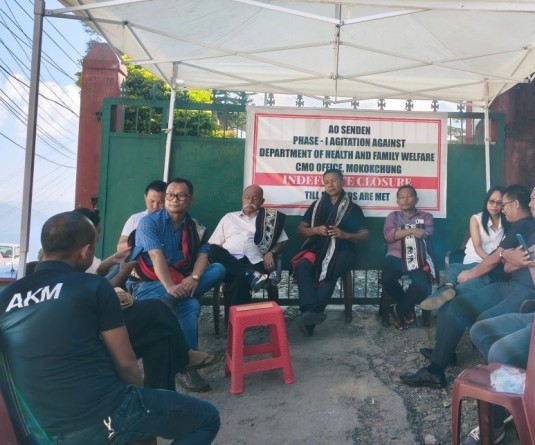
Neise Mich (extreme left), Director, Department Land Resource Development releasing the GSI maps. (inset) Director handing over the map to the Chairman, Watershed committee, Rüsoma village.
Dimapur, July 3 (MExN): The Department of Land Resources has released the GIS maps consisting of various micro watershed map layers, generated by the DoLR GIS cell for implementation of the IWMP in Kohima Project II. The first of its kind in the State, the maps were released by Neise Mich, Director, Department of Land Resource on July 1, 2011.
Altogether, 14 micro-watersheds were selected for the implementation of the project under Kohima project II. Seven different layers of GIS based maps viz. aspect map, contour map, drainage map, slope map, relief map, land use map and soil map have been generated for every single micro-watershed village under the project and in addition consisted of an action plan map as a target for the different activities to be taken up under the project area during the project duration.
The Director during the release of the maps to Rüsoma Village, which has a treatment area of 380 ha, termed the occasion as a landmark event in the history of the department as the maps are expected to help in implementation of the project with a pre-planned target and a focus, fully aimed at the development and upliftment of the rural people. The GIS based development project implementation helps to select the right crop for a particular area with the exact treatment required by that particular type of land and thus generating higher yield and also application of the proper soil management practices. The GIS based development system also helps in creating an environmental friendly system of development by integrating all the components of watershed in the development process.
Altogether, 14 micro-watersheds were selected for the implementation of the project under Kohima project II. Seven different layers of GIS based maps viz. aspect map, contour map, drainage map, slope map, relief map, land use map and soil map have been generated for every single micro-watershed village under the project and in addition consisted of an action plan map as a target for the different activities to be taken up under the project area during the project duration.
The Director during the release of the maps to Rüsoma Village, which has a treatment area of 380 ha, termed the occasion as a landmark event in the history of the department as the maps are expected to help in implementation of the project with a pre-planned target and a focus, fully aimed at the development and upliftment of the rural people. The GIS based development project implementation helps to select the right crop for a particular area with the exact treatment required by that particular type of land and thus generating higher yield and also application of the proper soil management practices. The GIS based development system also helps in creating an environmental friendly system of development by integrating all the components of watershed in the development process.