New Delhi: Vehicles ply on the waterlogged Bahadur Shah Zafar Marg after heavy rain at ITO in New Delhi, Wednesday, Sep. 1, 2021. (PTI Photo/Vijay Verma)
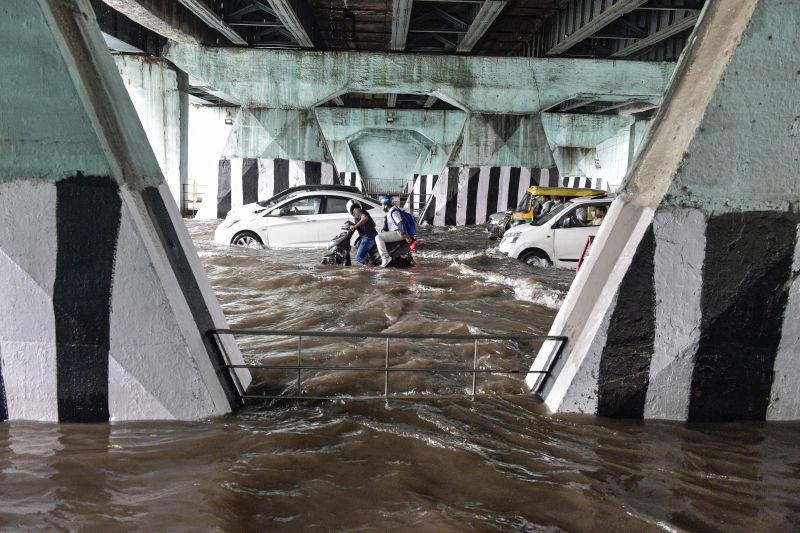
New Delhi, September 1 (PTI): Delhi recorded 112.1 mm rainfall in a span of 24 hours ending at 8:30 am Wednesday, the highest single-day precipitation in September in 19 years, that inundated several areas, including the Chanakyapuri diplomatic enclave, in knee-deep water and disrupted rain and road traffic.
The capital had recorded 126.8 mm rainfall on September 13, 2002. The all-time record is 172.6 mm on September 16, 1963.
Delhi has already recorded 188.6 mm rainfall since 8:30 am on Tuesday, surpassing the normal of 129.8 mm for September.
The incessant rainfall affected around 25 trains.
Trains to Punjab, Jammu and Kashmir and central and western parts of India were affected, the Railways said.
Municipal corporations in Delhi reported 21 incidents of uprooting of trees. The authorities said a part of a building collapsed in Raghuvir Nagar, and a wall collapsed in Munirka.
Asked if the India Meteorological Department (IMD) expected such heavy rainfall, an official said it is difficult to make "precise predictions" for a small area like Delhi two to three days in advance.
"The predictions are for larger areas, such as Haryana and Punjab. This applies across the world," he said.
IMD officials said the Safdarjung Observatory, considered the official marker for the city, gauged 112.1 mm rainfall in the 24 hours ending 8:30 am on Wednesday, the highest in a day in September in 19 years.
The weather stations at Lodhi Road, Ridge, Palam and Ayanagar recorded 120.2 mm, 81.6 mm, 71.1 mm and 68.2 mm rainfall, respectively, in the same period.
Since 8:30 am, Palam, Lodi Road, Ridge and Ayanagar have recorded 80.6 mm, 75.8 mm, 52 mm and 55.4 mm rainfall, respectively.
Rainfall recorded below 15 mm is considered light, between 15 and 64.5 mm is moderate, between 64.5 mm and 115.5 mm is heavy, between 115.6 and 204.4 is very heavy. Anything above 204.4 mm is considered extremely heavy rainfall.
On Tuesday, Delhi gauged 84 mm rainfall in just six hours -- between 8:30 am and 2:30 pm -- that flooded roads and led to massive traffic snarls on key stretches such as ITO, Ring Road near IP Estate flyover, Dhaula Kuan, and Rohtak road.
"The intensity is likely to reduce. Another spell of rain is likely from September 7," an IMD official said.
In its forecast for the month of September, the IMD said, "Normal to below-normal rainfall is most likely over many areas of northwest."
Mahesh Palawat, vice-president, Skymet Weather, a private forecasting agency, said the monsoon pattern is changing due to climate change.
"The number of rainy days has reduced over the last four to five years, and there has been an increase in extreme weather events," he said.
"We have been recording short and intense bouts of rain, sometimes around 100 mm rainfall in just 24 hours. In the past, this much precipitation would occur over a period of 10 to 15 days," he added.
Weather experts said such spells of rain do not help recharge groundwater and lead to flooding in low-lying areas.
The water percolates in the ground if it rains slowly over four to five days. In case of heavy falls, the rainwater runs off quickly, Palawat said.
"Rain washes away pollutants, but since the number of rainy days has reduced, the average annual air quality is also getting affected," he said.
Overall, Delhi has recorded 868.5mm rainfall since June 1, when the monsoon season starts, which is 64 per cent more than normal.
The city recorded just 10 rainy days in August, the lowest in seven years, and a cumulative rainfall of 214.5 mm, lower than the average of 247 mm.
In July, the national capital gauged 507.1 mm rainfall, which was nearly 141 per cent above the long-period average of 210.6 mm. It was also the maximum rainfall in the month since July 2003, and the second-highest ever.
Despite the monsoon embracing Delhi only on July 13, making it the most-delayed in 19 years, the capital had recorded 16 rainy days in the month, the maximum in the last four years.
It received 34.8 mm rainfall against the normal of 65.5 mm in June.