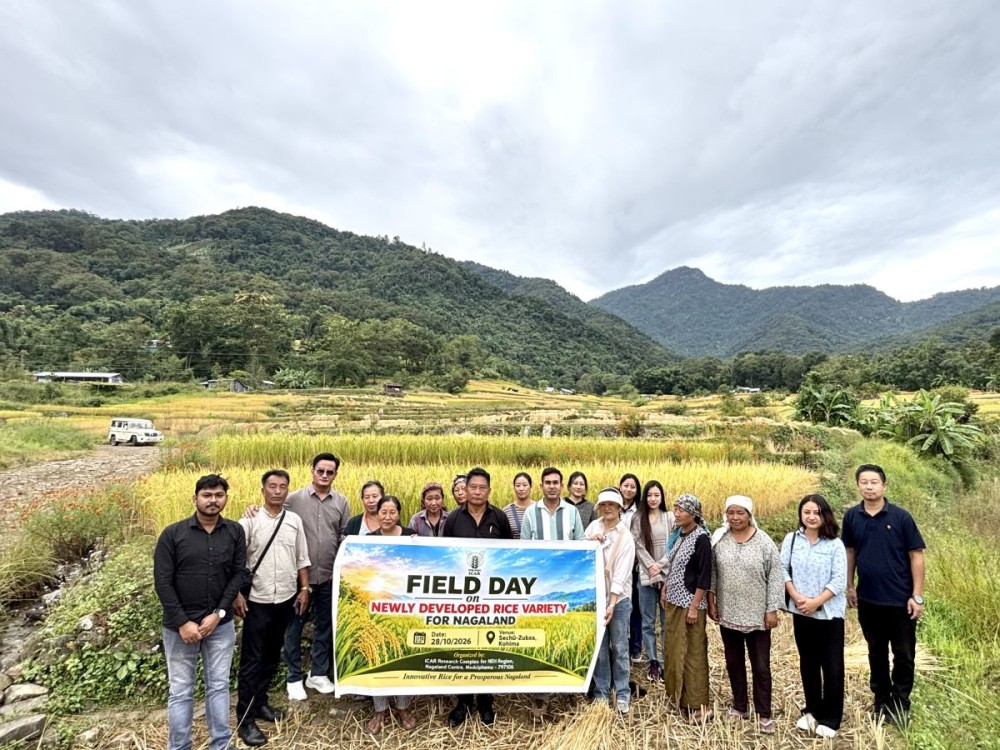
Officials from ICAR Nagaland Centre and the State Department of Agriculture during a field day showcasing four newly developed rice varieties at Sechü-Zubza, Kohima, on October 28. (Photo Courtesy: ICAR Nagaland Centre)
Kohima, October 28 (MExN): Four newly developed rice varieties have reportedly recorded an estimated 30–40% yield advantage over locally cultivated varieties and traditional landraces under farmers’ field conditions at Sechü-Zubza, Kohima.
The outcome highlights their potential to improve rice productivity and enable early harvesting in the State, noted a press release from the ICAR Nagaland Centre.
The performance of the four varieties: Sekrenyi-lha 138, Ahuna-khi 395, Patkai Pearl 131 and Aoleang Tahwan 295, was showcased during a field day organised by the ICAR Research Complex for NEH Region, Nagaland Centre, in collaboration with the State Department of Agriculture, Kohima, on October 28.
The varieties mature in approximately 115–120 days, offering farmers an opportunity to harvest rice earlier and establish subsequent rabi crops within the appropriate planting window, the release said.
Dr Harendra Verma, Scientist (Plant Breeding and Genetics), ICAR Nagaland Centre, said the varieties were developed to address challenges in rice cultivation, including prolonged crop duration, disease susceptibility and low productivity.
He highlighted their yield potential, early maturity and suitability for Nagaland’s diverse agro-climatic conditions.
He also stressed the importance of timely transplanting and appropriate crop management to realise their full potential, noting that early-maturing varieties could improve cropping intensity and land-use efficiency.
Kekhrieletuo Yhome, District Agriculture Officer (DAO), Kohima, encouraged farmers to adopt high-yielding, early-maturing and disease-tolerant varieties to improve agricultural productivity and farm returns. He also urged them to undertake community-level seed multiplication to facilitate wider access to quality seeds ahead of the next cropping season.
The press release stated that the varieties could allow farmers to cultivate subsequent rabi crops, including potato, onion, toria and field pea, thereby diversifying cropping systems and improving the utilisation of available farmland.
A total of 28 farmers attended the programme, along with the Sub-Divisional Agriculture Officer, Agriculture Officer, Agricultural Inspector and other personnel from the State Department of Agriculture, Kohima, as well as technical staff from ICAR Nagaland Centre.
The participating farmers expressed interest in adopting the improved varieties, it added.