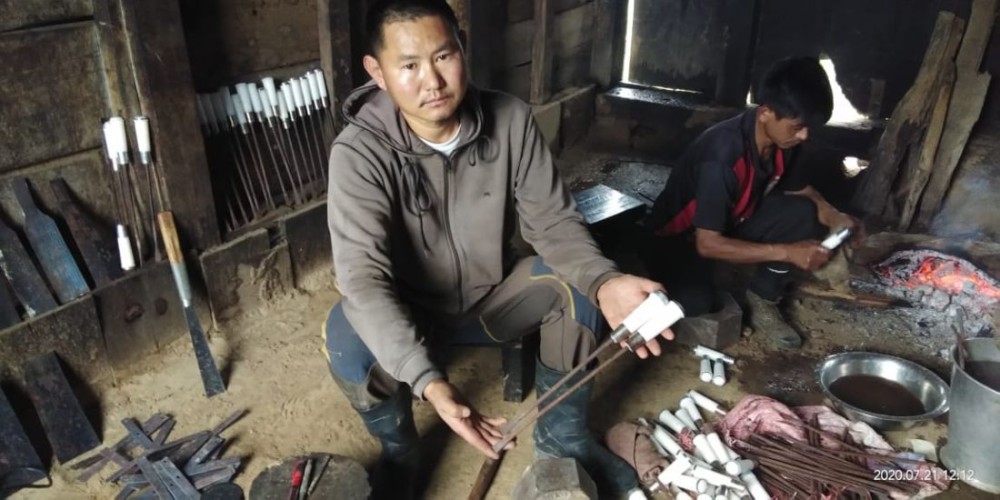
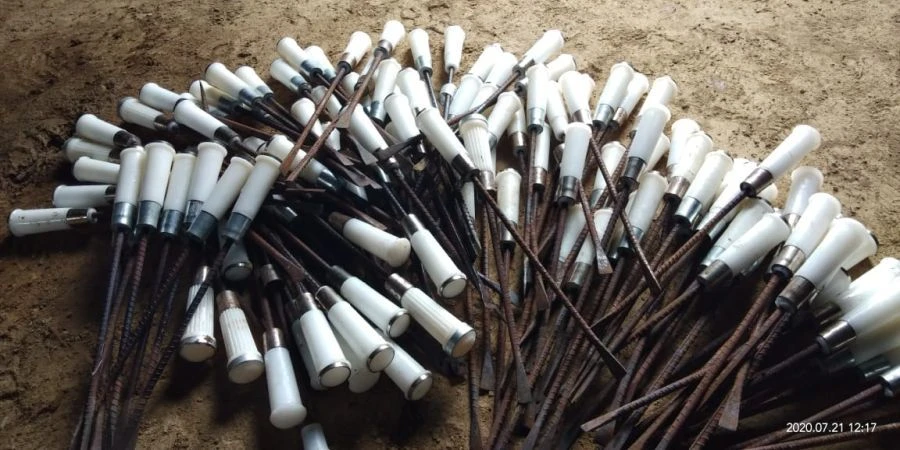
Ayemi displays his invention - ‘Spike Cutter or Cardamom Harvester.’
‘The greatest achievement is benefiting the farmer’ - L Holuto Ayemi
Tokavi K Zhimo
Zunheboto | September 13
A cardamom farmer in Nagaland has developed a harvesting tool using an 8 mm mild steel (MS) rod fabricated at his own home, offering a solution to a problem he encountered on his farm.
L Holuto Ayemi, an integrated farmer and educator from Tichipami-Suruhoto under Zunheboto district, watched fellow farmers rely on self-made tools to harvest cardamom spikes, a practice that could damage plants, particularly when cutting was done too close to the rhizome. Undeterred by the absence of a laboratory, sophisticated machinery or a commercial prototype, Ayemi fashioned the tool himself, working from a simple problem he had encountered on his farm.
There was also no dedicated cardamom-harvesting tool available to him in the market or online. Instead, farmers used random, self-made tools, and harvesting cardamom with these tools had been a major cause of damage, as the pseudostems and rhizomes were often injured. So he decided to make one himself.
Ayemi, now 49, cut an MS rod at home, heating and shaping the metal. He then sharpened the cutting edge and fitted a handle.
That simple implement became the foundation of what he calls the ‘Spike Cutter or Cardamom Harvester.’ Nearly a decade of testing, modification and field experience later, the innovation has moved beyond his farm. It has been demonstrated to farmers, documented by the Krishi Vigyan Kendra (KVK) Zunheboto.

The official certificate records him as the chief innovator supported by Dr Rakesh Kumar Chaurasia, Principal Scientist and Head, KVK, Nagaland University, Lumami Dr AK Mohanty, Dr AK Sinha and Dr PK Pathak. The accompanying representation sheets state that the novelty lies in the shape and configuration of the Spike Cutting Tool. For Ayemi, however, the registration is only one milestone.
“The greatest achievement is benefiting the farmer,” he says. That belief lies at the heart of the tool. Cardamom spikes are connected to the plant by stalks, and Ayemi’s method is to reach into the bush, locate the stalk and cut it without unnecessarily injuring the rhizome.
In a YouTube tutorial recorded in 2021, Ayemi demonstrated the tool and explained how it should be used. He described the Spike Cutter as a tool he had designed and conceptualised himself and showed farmers how to construct and handle it. The tool is approximately 15 inches long, according to Ayemi, allowing it to reach into dense cardamom bushes. Its construction is deliberately simple: an MS rod, a flattened and sharpened cutting end and a handle. Low cost, durability and ease of use are among the qualities Ayemi believes make it useful to farmers.
The journey did not begin with the registration certificate. Ayemi says he received a national award for best innovation from the ICAR - Indian Agricultural Research Institute (IARI), Pusa, New Delhi, in March 2020.The KVK’s intervention became another important turning point.
Ayemi says the KVK, Zunheboto, identified and documented his work after it was presented during an ATMA closed-door exhibition. He particularly credits Dr Rakesh, for helping enable the formal documentation and registration process. The registration documents list Ayemi alongside the four other applicants and contain multiple representations of the tool, including front, top, bottom and side views.
For Ayemi, innovation and teaching have always gone together. He runs a cardamom farm school at Tichipami village, initiated with the support of the Land Resources Department, where practical, field based training is conducted. Over the years, he has accumulated extensive practical knowledge of cardamom and kiwi cultivation. He has shared that knowledge with farmers and trainees in several villages of Zunheboto district.
In 2025, he provided training on kiwi cultivation at Nagaland University and has also worked with the Horticulture Department in Zunheboto. The ATMA Zunheboto has initiated a Farm School on Cardamon with the support of the land Resources Department Zunheboto at Tichipami Village where farmers involving Tuensang, Kiphire and Zunheboto Received hands on and on spot training from the school.
Ayemi says M. Sc students and scholars have approached him through departmental recommendations seeking for dissertation and research work, with field visits forming an important part of the learning process. For him, teaching others has also been a way of expanding his own knowledge.
One of the most revealing records of Ayemi’s journey is a YouTube tutorial he produced in 2021. At a time when the COVID-19 pandemic had disrupted normal life, Ayemi used a basic smartphone to record a practical demonstration of cardamom harvesting which captures Ayemi’s approach to farming: use the right tool, understand the crop and avoid damaging the plant while harvesting.
Ayemi’s story is rooted in a simple belief that farmers themselves can be innovators. His cardamom farm exposed him to a recurring problem. Years of experimentation produced a practical solution. The response from the farming community encouraged him to continue, while institutional recognition helped document and advance the innovation.
ATMA, he says, has procured the tools and distributed them to farmers, with users responding positively. “It is a simple tool,” he says, but one that he believes can reduce damage during harvesting, remain affordable to farmers and serve farmers over a long period.
Ayemi does not see the Spike Cutter as the end of his innovation journey. He wants to develop more agricultural tools for problems that farmers face but for which suitable equipment is not readily available. His approach remains the same: start with the field, identify the problem and build a practical solution.