District-level training programme for district and charge officers on Census 2027 commenced at the Wokha Deputy Commissioner's conference hall on April 20. (DIPR Photo)
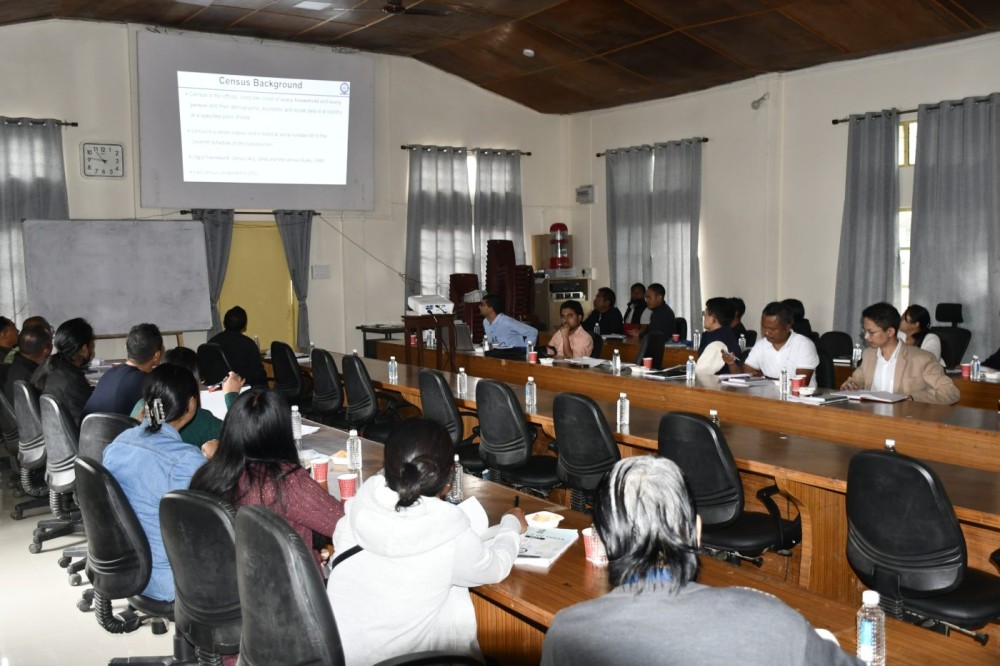
Wokha, April 20 (MExN): A two-day district-level training programme for district and charge officers on Census 2027 commenced at the Wokha Deputy Commissioner's conference hall on April 20, aimed at equipping officials with the knowledge and skills required for the upcoming census operations.
The programme was opened with a briefing and welcome address by Assistant Director, Census Operations Nagaland, Mhathung Rangthang, who also delivered the inaugural session on “Introduction to Census 2027,” covering the role of census functionaries, legal provisions, fund management, and publicity activities.
Statistical Investigator Vaibhav Sharma conducted the second session, introducing the Census Management and Monitoring System (CMMS), its modules, features, types of users and user registration process.
The third session was taken by Statistical Investigator Faujdar Singh Yadav, who provided a theoretical and demonstration-based overview of CMMS-HLO (House Listing and Housing Census Operation) management, House Listing Block Creator (HLBC), generation of appointment letters and identity cards, and layout map preparation.
The training will continue on April 21 with additional sessions, stated a DIPR report.
Census 2027 in Nagaland will be conducted in two phases. Phase 1, the House Listing and Housing Census (HLO), will commence with a self-enumeration period from June 16 to June 30, 2026, followed by house-to-house fieldwork from July 1 to July 30, 2026. This phase will capture data on housing conditions, amenities, and household assets, and will serve as the frame for Phase 2.
Phase 2, Population Enumeration, will be conducted in February 2027, with September 2026 earmarked for snow-bound areas. A five-day revisional round for self-enumeration will also be carried out.
This phase will generate data on demographic, socio-cultural, and economic parameters, including migration and fertility characteristics.
Officials underscored that the training is critical to ensuring accuracy, efficiency, and smooth execution of the census, described as one of the largest administrative exercises in the country.