CM Rio speaks during the General Conference of the APO at the Kohima Village Multipurpose Building on September 4. (DIPR Photo)
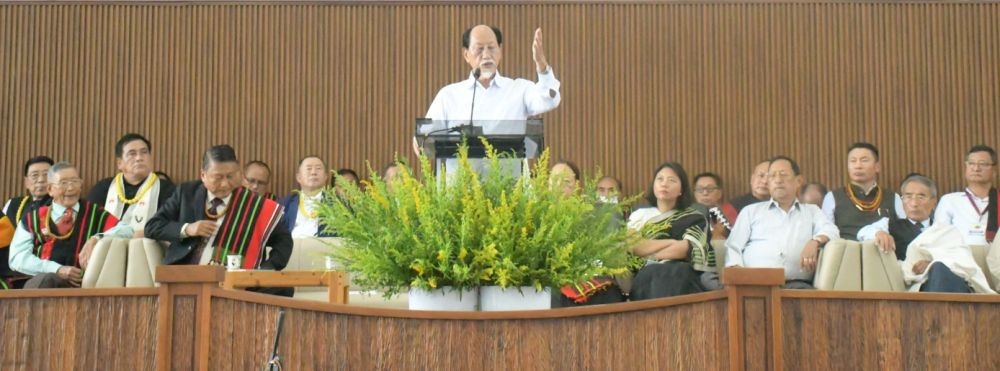
Kohima, September 4 (MExN): Nagaland Chief Minister Dr Neiphiu Rio on Friday urged all sections of Naga society, negotiating groups, and stakeholders to unite and discard internal factionalism to achieve permanent peace, cautioning that proliferation of groups creates confusion and mutual mistrust.
Addressing the General Conference (Mechü Kehou) organized by the Angami Public Organization (APO) at the newly constructed Kohima Village Multipurpose Building, Rio underscored that Christianity remains a minority faith in India, the world's largest democracy. He called on Nagas to stay unified so their minority identity is not undermined.
Highlighting emotional and socio-cultural bonds transcending administrative boundaries, Rio noted that Nagas residing across Manipur, Myanmar, Assam, and Arunachal Pradesh remain tied by shared roots. He said the state government’s official motto, "Unity," serves as a call for solidarity across all Naga communities, urging people to coexist harmoniously with neighbors without forsaking their distinct identity.
Reflecting on regional history, the Chief Minister said Naga distinctiveness was formally acknowledged under British colonial rule. Rather than disrupting local customary laws, village norms, and administration, colonial authorities enacted the Bengal Eastern Frontier Regulation of 1873. He noted that this framework established the "Inner Line" to regulate entry into tribal frontier tracts—a safeguard that continues today.
Rio also addressed the Inner Line Permit (ILP) system, the Register of Indigenous Inhabitants of Nagaland (RIIN), and the Frontier Nagaland Territorial Authority (FNTA) bill recently passed by the Nagaland Legislative Assembly.
Praising the host community, Rio said the state capital Kohima, situated within Angami jurisdiction, serves as an economic hub whose commercial advantages must be channeled to benefit future generations. Emphasizing visionary stewardship, he remarked that "it is easy to follow others, but hard to lead others with responsibilities."
Speaking as the chairperson, APO President Thejao Vihienuo voiced concern over the declining adherence among youth to Mechü die—resolutions formally adopted at community conferences that traditionally function as binding customary law.
Vihienuo cautioned that younger demographics—Generation Z, Generation Alpha, and future cohorts—rely increasingly on artificial intelligence and mobile devices for guidance rather than learning directly through oral histories, community gatherings, and tribal elders. Citing recent youth-led socio-political shifts in countries such as Nepal, Bangladesh, Madagascar, and Kenya, Vihienuo warned that unguided technological dependence poses cultural risks.
He called on current leaders and millennials to proactively shape, mentor, and pass down ancestral values, morals, and cultural traditions to the youth before younger cohorts assume public governance.
Reports on regional activities were presented by APO General Secretary Keneilesa Neikha, alongside representatives from the Angami Women Organization (AWO), Angami Youth Organization (AYO), Angami Students’ Union (ASU), Angami Sports Association (ASA), and Angami Gazetted Officers’ Krotho (AGOK).