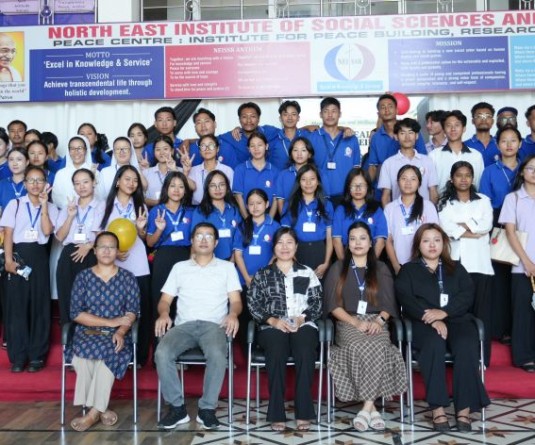
Resource person addresses the gathering during the STAR induction programme held at NEISSR, Chümoukedima on July 28.
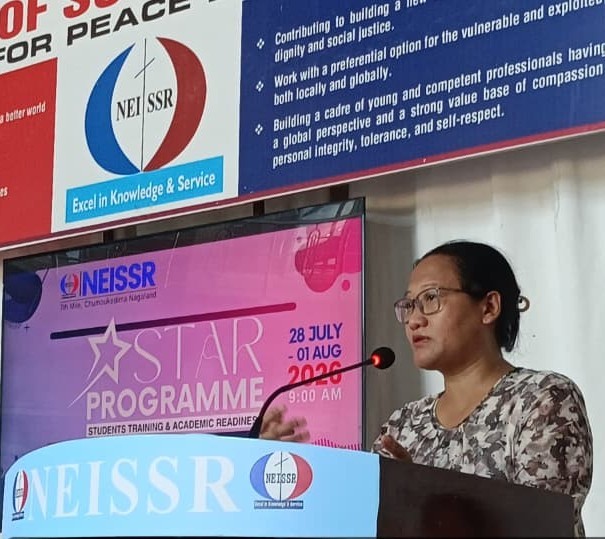
Chümoukedima, July 28 (MExN): The North East Institute of Social Sciences and Research (NEISSR) on Tuesday inaugurated a five-day induction programme for newly admitted Master of Social Work (MSW) students to facilitate their academic, professional and personal transition into postgraduate education.
The MSW STAR (Student Training and Academic Readiness) Induction Programme, which began at BAM Hall, will continue till August 1.
According to the institute, the programme is designed as a learner-centred platform integrating simulation-based learning, experiential activities, interactive sessions, reflective discussions, group exercises and skill development modules.
It aims to strengthen students' academic preparedness, professional competence, leadership, communication, teamwork, critical thinking and ethical values, while familiarising them with the institute's vision, mission and culture.
Welcoming the students, NEISSR Vice Principal Fr G.L. Khing encouraged them to embrace their academic journey with enthusiasm, confidence and optimism.
Describing learning as a lifelong process, he said there is no age limit to education and urged the students to build meaningful friendships, interact freely and seek guidance whenever required. He also encouraged them to make the most of opportunities for academic, personal and professional growth.
Delivering the keynote address, Head of the Department of Social Work Dr Toli H Kiba spoke on contemporary social challenges in India, including poverty, caste-based discrimination, religious divisions, economic inequality, climate change, youth mental health concerns, gender exclusion and the continued marginalisation of vulnerable communities.
She said genuine development must be rooted in justice, inclusion, equity and human dignity, which form the foundation of the social work profession. Although social work is recognised as a licensed profession in several countries, it is yet to receive comparable professional recognition in India despite being a scientific, value-based and ethically grounded discipline, she added.
Addressing the freshers, Dr Kiba urged them to combine compassion with professional competence, saying effective social workers require empathy, sound knowledge, practical skills and ethical commitment. She encouraged them to strive for academic excellence while remaining committed to promoting social justice and human well-being.
Highlighting the importance of leadership, she encouraged students to take up responsibilities as opportunities for growth and to develop the courage to speak for marginalised communities.
Quoting Nelson Mandela's words, "Education is the most powerful weapon which you can use to change the world," she urged the students to use education as a tool to promote justice, peace, inclusion and sustainable social transformation.
The inaugural session was chaired by Asela Sangtam, an MSW third-semester student, while Zipise Sangtam, a BSW third-semester student, presented a special song.
The institute said the induction programme reflects its commitment to nurturing competent, compassionate, ethically grounded and socially responsible professionals dedicated to the service of humanity and the promotion of social justice.