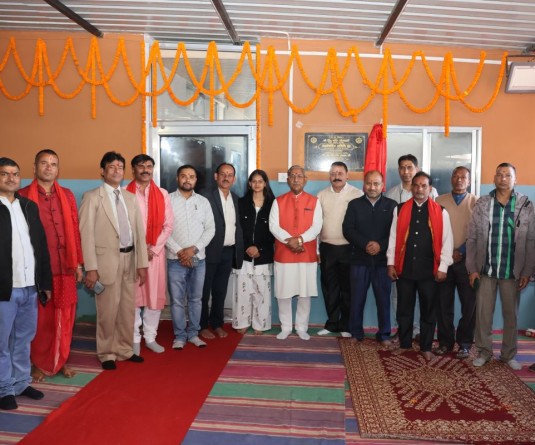
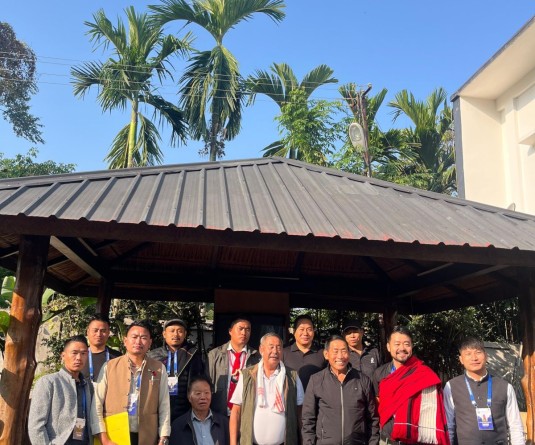
Resource persons along with the participants pose for a photo during the seminar on "Policy and Implementation of the NEP 2020 at PCC in Chümoukedima on November 13.
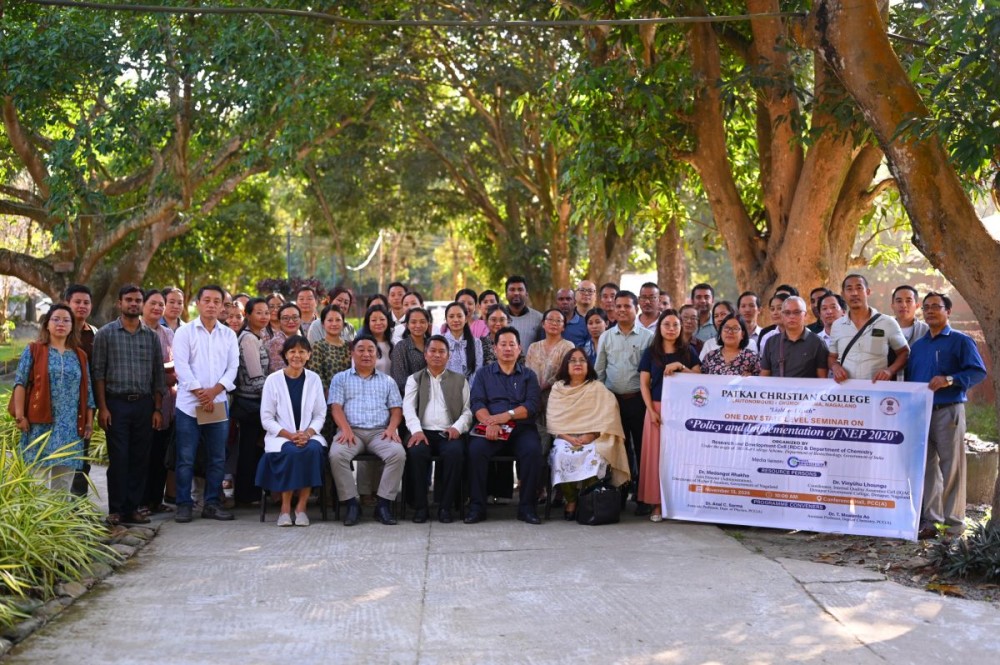
Chümoukedima, November 15 (MExN): Experts at a state-level seminar organised by Patkai Christian College (Autonomous) have highlighted challenges in implementing the National Education Policy (NEP) 2020 in Nagaland, stressing the need for stronger institutional support, industry-academia linkages and skill-based learning.
The one-day seminar on "Policy and Implementation of the National Education Policy (NEP) 2020" was organised on November 13 under the DBT-Star College Scheme, jointly coordinated by the college's Research and Development Cell (RDC) and Department of Chemistry.
Dr Medongoi Rhakho, Joint Director (Administration), Directorate of Higher Education, Government of Nagaland, delivered the first technical session on "Implementation of NEP 2020: Policy and Challenges in the Context of Nagaland".
In his presentation, Rhakho called for a shift from the traditional education system, which he described as a winner-loser model where students are often assessed primarily on their performance in competitive examinations.
He elaborated on key provisions of the policy, including the Academic Bank of Credits (ABC), Multiple Entry and Exit System, Choice-Based Credit System (CBCS), multidisciplinary education, Skill Enhancement Courses (SEC), Value-Added Courses (VAC) and employability-oriented learning.
Explaining the Multiple Entry and Exit System, he said students could obtain a certificate after one year, a diploma after two years and a degree after three years, with the option of pursuing a four-year degree with Honours or Honours with Research, subject to prescribed requirements.
Highlighting the importance of experiential and practical learning, Rhakho discussed the Recognition of Prior Learning (RPL) framework, which enables skills acquired through personal interests, hobbies and self-learning to be assessed and recognised through appropriate certification.
Identifying challenges in implementing NEP 2020 in Nagaland, he pointed to the limited availability of industries and organised sectors for internships, shortage of trained faculty, inadequate infrastructure and the need for stronger institutional support.
Rhakho also highlighted the proposed Apprenticeship Embedded Degree Programme (AEDP), which seeks to integrate workplace experience into academic programmes and provide students with practical exposure and a monthly stipend.
The second technical session was conducted by Dr Vinyühu Lhoungle, Coordinator, Internal Quality Assurance Cell (IQAC), Dimapur Government College, on "FYUG Degree (Honours with Research): Prospects and Challenges".
Drawing on his institutional experience, Lhoungle provided an overview of the Four-Year Undergraduate Programme (FYUG), its curriculum structure and credit framework under Nagaland University.
He explained the three-year and four-year undergraduate degree options available under the Multiple Entry and Exit System and highlighted the opportunities offered by the four-year programme for multidisciplinary learning, academic advancement and research.
He discussed the requirements for introducing four-year Honours and Honours with Research programmes, including adequate infrastructure, qualified faculty members, PhD-qualified teachers, information and communication technology (ICT) facilities and well-equipped libraries.
Identifying challenges faced by higher educational institutions, Lhoungle cited shortages of qualified teachers, financial constraints, administrative complexities and the need for continuous faculty development.