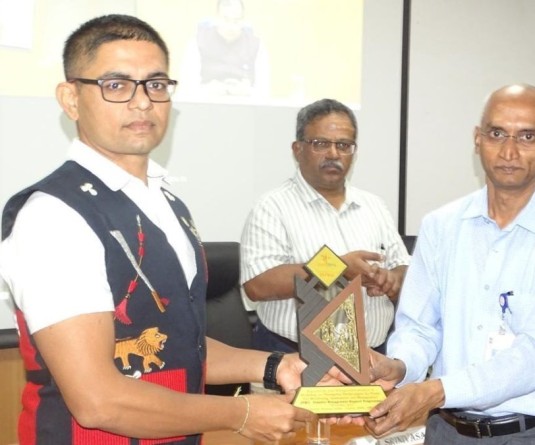
Phaisringdao Longmailai
State Organising Secretary ABVP Nagaland
The Prime Minister’s visit to Israel should not be seen as a major change in India’s West Asia policy. It reflects continuity — not a departure. India’s approach to the region has evolved over time, but its core principles have remained steady: balance, strategic autonomy, and engagement based on national interest.
India’s Ties with Israel Are Not New
India established full diplomatic relations with Israel in 1992. Since then, cooperation has steadily grown, especially in defense, agriculture, water management, and technology. Israel has been one of India’s key defense suppliers for years, and both countries share strong cooperation in counterterrorism.
What has changed in recent years is the visibility of the relationship, not its foundation. High-level visits and public acknowledgment of close ties may appear new, but the partnership itself has been developing for decades under different governments.
Engagement with Israel Does Not Mean Abandoning Palestine
Some critics argue that closer ties with Israel signal a move away from India’s traditional support for Palestine. That conclusion is not accurate.
India continues to support a two-state solution and maintains diplomatic relations with the Palestinian leadership. It has consistently backed Palestinian statehood in international forums. The current approach treats Israel and Palestine as separate relationships. Engaging one does not mean distancing from the other.
This balanced approach allows India to pursue strategic cooperation with Israel while maintaining its longstanding position on Palestinian rights.
Strategic and Practical Reasons
India’s engagement with Israel is driven by practical needs:
Defense cooperation has strengthened India’s security capabilities.
Technology partnerships help in areas such as agriculture, water conservation, and innovation.
Counterterrorism cooperation reflects shared security concerns.
These are decisions based on national interest, not ideology.
A Broader West Asia Strategy
India maintains strong ties across West Asia — with Israel, the Gulf countries, and Iran. It relies on the Gulf region for energy supplies and is home to a large Indian diaspora. At the same time, it works closely with Israel on security and technology.
This multi-directional engagement shows that India is not aligning exclusively with any one country. Instead, it is building relationships across the region to safeguard its interests.
Importantly, the regional environment has changed. Several Arab countries now openly engage with Israel. This has reduced the diplomatic sensitivities that existed in the past and made India’s balanced approach easier to sustain.
Continuity with Greater Confidence
The Prime Minister’s visit to Israel reflects confidence in a relationship that has matured over decades. It does not mark a sudden shift or a break from tradition. Rather, it shows that India is comfortable pursuing its interests openly while maintaining balance in a complex region.
In short, the visit represents policy continuity — a steady, pragmatic approach to West Asia that prioritizes national interest while preserving diplomatic balance.