Participants of the two day national seminar held at Tetso College on June 25 and 26.
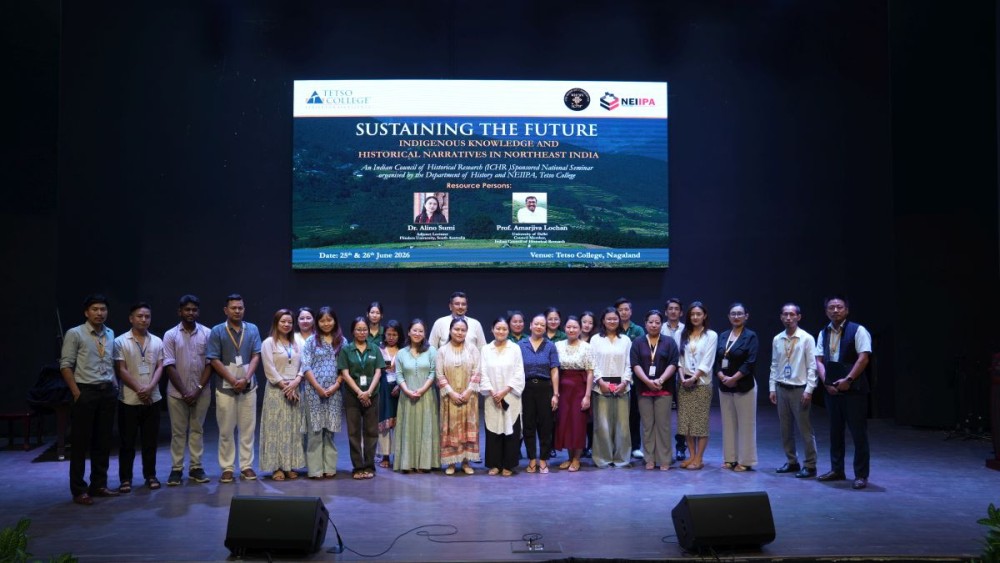
DIMAPUR, JUNE 26 (MExN): Indigenous knowledge systems are living traditions with continuing relevance to environmental, cultural and social challenges, speakers said at a two-day national seminar held on June 25 and 26 at Tetso College.
The Indian Council of Historical Research (ICHR)-sponsored seminar on “Sustaining the Future: Indigenous Knowledge and Historical Narratives in Northeast India” was organised by the Department of History, Tetso College, and the Northeast India Indigenous People’s Archive (NEIIPA).
Delivering the inaugural keynote address, Amarjiva Lochan of the University of Delhi and Council Member of the Indian Council of Historical Research (ICHR) said indigenous communities have long practised sustainable living before it became a global concern. Referring to the ceremonial watering of the Tree of Wisdom during the inaugural programme, he said such traditions reflect a worldview where people see themselves as caretakers and partners of nature rather than its owners.
Citing renewed interest in traditional medicine during the Covid-19 pandemic, he said, “indigenous healing practices continue to hold value,” and urged scholars to document oral histories, ecological knowledge, folklore and medicinal traditions before they disappear. He also called for greater recognition of oral narratives and folklore as historical sources. He further encouraged young researchers to reclaim ownership of their histories and cultures, saying modernity should not come at the cost of indigenous identities, languages and customary practices.
In the welcome address, Tetso College principal Hewasa L Khing said participants must reflect on the questions, “Who are we?” and “What makes us who we are?” She said indigenous knowledge is “a living resource” rather than a remnant of the past and called for reassessing historical narratives shaped through external perspectives. She also stressed the need to decolonise historical narratives and urged participants to become active storytellers of their own histories.
She highlighted the work of the Northeast India Indigenous People’s Archive (NEIIPA), describing it as a digital initiative documenting oral histories, folklore, traditional knowledge, recipes and community memories from across Northeast India, and encouraged contributions to preserve these cultural resources.
At the valedictory session, keynote speaker Alino Sumi, adjunct lecturer at Flinders University, Australia, said indigenous knowledge is a living system rooted in relationships between people, land, ancestors and community. She noted that scholarship on Northeast India has often prioritised external interpretations over indigenous voices, overlooking what she described as the “interiority” of communities.
She said researchers must create spaces where communities can narrate their own histories in their own languages and on their own terms, and questioned whether academic research adequately benefits the communities whose knowledge is being documented.
Sharing personal experiences of learning from her grandmother, she said indigenous knowledge is dynamic and community-centred, passed through everyday life rather than formal institutions. She added that preservation requires more than documentation and called for protecting the social and cultural conditions that sustain such knowledge. She also said indigenous knowledge should receive equal recognition alongside academic knowledge, with communities empowered to narrate their own histories.
Across four technical sessions, scholars, researchers and students presented papers on oral traditions, indigenous ecological knowledge, ethnoarchaeology, governance systems, architecture, food systems, religion, gender, identity, customary institutions and sustainability.
Presentations included topics such as Khiamniungan Naga folklore, Konyak women’s ecological knowledge, cultural memory in festivals, jhum cultivation ethnoarchaeology, traditional Naga architecture, headhunter narratives, legal pluralism in Nagaland, indigenous food systems, indigenous health knowledge, Chang oral traditions, indigenous governance systems, Vaiphei belief systems and Christianity, and traditional hornet rearing and rural livelihoods.
The seminar opened with an inaugural programme chaired by an assistant professor from the Department of History, with an invocation by Talinungsang Lemtur, College Anthem and the ceremonial watering of the Tree of Wisdom. A cultural segment featured a Folk Fusion performance, Tsüngremmong Tsüngsangtepro, by Imlibenla Imchen and Limeka Yepthomi.
The valedictory programme included a cultural dance by BA third and fifth semester students of the Department of History, followed by certificate distribution to paper presenters by vice principal Rosy Tep. The programme concluded with a vote of thanks by seminar coordinator and head of department, Department of History, Tatongkala, and a benediction by an assistant professor from the Department of Linguistics, Lothunglo P. Murry.
The seminar concluded with a call for collaborative research, ethical engagement with indigenous communities, and continued efforts to preserve and strengthen indigenous knowledge systems as living foundations for a more inclusive future.