Dimapur, January 30 (MExN): Chief Minister of Nagaland Neiphiu Rio has made a strong pitch that the focus of furthering Indo-Myanmar ties must be centered on developing the socio-economy of the border areas before their greater international relation are expected to grow. During the International Conference on Myanmar at Jamia Millia Islamia University, New Delhi today, January 30 Rio emphasized the importance of cross-border economic linkages as a ground to address greater political issues common to both Indian and Myanmar.
In his address, the chief minister opined – “…what should be done to bring about a socio-cultural renaissance in the region and how best can India and Myanmar uplift the quality of lives of people living on both sides of the border? The answer would surely lie in the cross-border development of our two peoples, cutting across international and historical divides. I am sure that all of you here would agree with me that peaceful and tranquil borders are best ensured through developmental efforts. Thus far, the border between the two countries is relatively safe and peaceful. There exists goodwill on both sides and more importantly, the people across the boundaries are ready to reach out to each other and co-exist. This is certainly plus point for all stake holders to exploit.”
The Nagaland chief minister said the India-Myanmar relations are multi-faceted and comprehensive. “They range from cooperation in the field of security to trade and commerce. There are a number of major Indian Projects in Myanmar, both in infrastructural and non-infrastructural areas,” he said, pointing to a number of “encouraging developments in the economic front.” These include an increase in bilateral trade from USD 12.4 million in 1980-81 to USD 1207.56 million in 2009-10; the Bilateral Investment Promotion Agreement and the Double Taxation Avoidance Agreement (DTAA) of 2008. “The need of the hour is to bring political stability into the region on both sides of the international boundary. This has to be backed up by economic progress based on infrastructure development, human resources development, and respect for peoples’ rights and dignity,” he said.
“These instruments will further strengthen our economic ties. Further, in today's unpredictable international markets, exemplified by the recent downturns in the EU and the US, it is perhaps time to strengthen inter-regional trade ties. As India and Myanmar are both signatory to the India-ASEAN Trade in Goods Agreement, which was signed in August 2009, I would call upon both sides to work out concrete steps to facilitate this positive development, including promotion of people-to-people contacts,” Rio said.
The chief minister noted that India and Myanmar shared age-old historical, cultural and “religious ties” and specially for people in North East India, common borders and cultural affinities “make Myanmar very close to our hearts.”
The Nagaland chief minister said there is further scope for cooperation in the fields of tourism, education, culture, transport and communication. “Energy cooperation, in particular, holds tremendous potential, and I urge Myanmar to consider use of the territory in the North East States for trans-shipment of oil, gas and transmission of power.” India and Myanmar have also signed an agreement for development of the Tamanthi and Shwezaye Hydro-Electric Power project in Chindwin River valley. However, he cautioned, even as we jointly develop our immense hydro electric power potential, we should bear in mind the environmental impact in the sensitive areas of the region. The CM was making reference to the proposed Indo-Myanmar dam which Naga villages in Burma have opposed, citing displacement and environmental repercussions.
Concerning border trade, Rio said India and Myanmar signed a border-trade agreement in 1994, and at present two border trade points are operational at Moreh-Tamu in Manipur and at Zokhawthar–Rhi in Mizoram on the Indo-Myanmar border. Recently an agreement was reached on setting up a third border trade point at Avangkhu- Pansat/Somra which falls in Nagaland, and is of special significance for the Nagas. The chief minister urged the Ministry of External Affairs and the Ministry of Commerce and Industry of both the countries “to work on operationalizing this third border trade point, which holds immense potential for inter-regional trade between ASEAN and India.”
On the political front, the CM said the Indo-Myanmar region on both sides of the border is a volatile area “infested” with insurgencies that have the potential to impact the rest of ASEAN. Therefore, he said, efforts must be made by both governments to collectively address the issues along with economic and infrastructure development initiatives.
“In this context, it is pertinent to point out that the governments of the concerned countries must take into confidence the local population. No policy can be of any success unless the sentiment of the concerned population is taken into account. It is imperative to bring about political stability into the region, if it is to be used as a corridor for international trade and cooperation. Political stability cannot be achieved if policies like the ‘look east policy’ simply fly over the region, or is a mere super highway that cuts through the region without any beneficial impacts on the local population.”
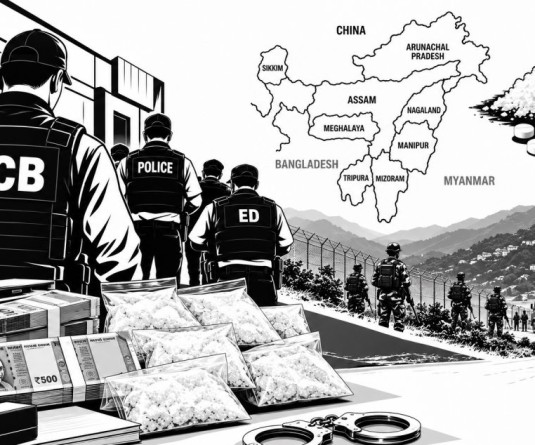
Another hindrance to devising solution to socio-economic issues Rio explained was that of the rampant poppy cultivation in the border. This directly contributes towards the global menace of drugs and narcotics, he said. “The Indo-Myanmar region is used as a gateway for the narcotics trade which has created serious social and security concerns on both sides of the international border. Myanmar is the world's second largest producer of illicit opium, after Afghanistan and has been a significant cog in the transnational drug trade since World War II,” he said.
As responsible members of the international community, the chief minister said, governments like India, Myanmar and other members of the ASEAN must rise to the occasion and take up serious measures to address the menace of drugs and narcotics.”