

Officials along with the participants during the Vermicomposting management session held at ICAR Research Complex for NEH Region, Nagaland Centre, Medziphema on March 20.
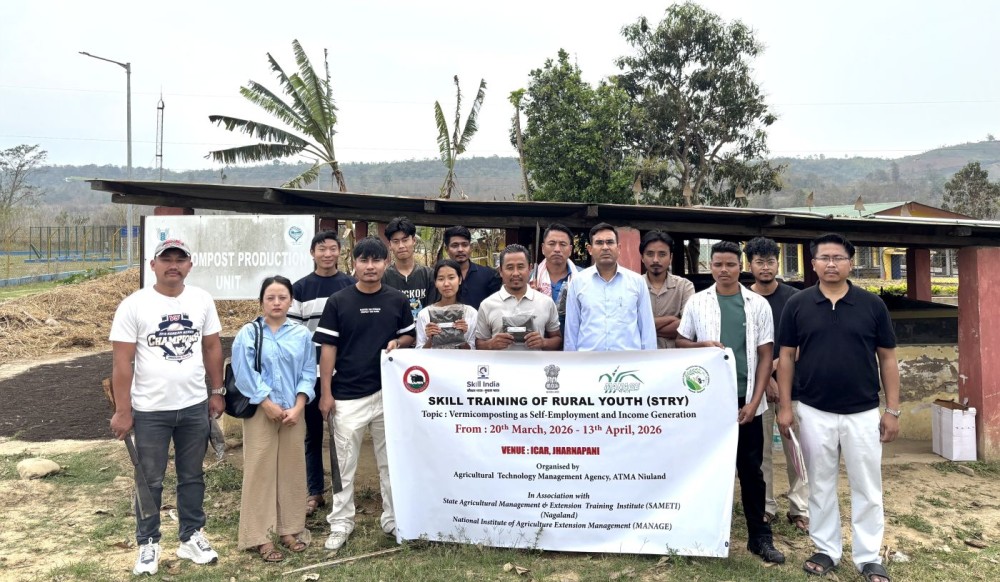
Medziphema, March 20 (MExN): A technical session and practical demonstration on “Scientific Method of Vermicomposting and its Management” was successfully conducted on March 20 at the ICAR Research Complex for NEH Region, Nagaland Centre, Medziphema.
The programme witnessed the participation of 10 trainees from Aghunaqa Block, who were accompanied by officials from ATMA. The initiative aimed to enhance farmers’ knowledge and skills on sustainable organic waste management practices through vermicomposting.
The session was led by resource persons, Dr Harendra Verma, Scientist, ICAR Nagaland Centre, and Dr Moatoshi Jamir, PGB Division. During the technical session, both experts elaborated on the scientific principles of vermicomposting, which included the selection of suitable earthworm species, preparation of vermicompost pits, maintenance of moisture and temperature, and proper management practices for efficient decomposition.
Dr Verma highlighted the importance of vermicomposting as an eco-friendly and cost-effective method for improving soil health and fertility, which contributes to sustainable agriculture. He emphasized its role in recycling organic waste into nutrient-rich manure.
Dr Jamir, in his address, focused on the practical aspects and field-level application of vermicomposting. He demonstrated the step-by-step procedure for setting up vermicompost units and guided the trainees on harvesting, storage, and utilization of vermicompost and vermiwash for crop production.
According to the update, the hands-on practical demonstration enabled participants to gain firsthand experience in preparing vermicompost and understanding its management under local conditions. The trainees actively interacted with the experts and clarified their queries regarding implementation at the farm level.
The programme concluded with feedback from the participants, who expressed their interest in adopting vermicomposting practices to enhance agricultural productivity and sustainability in their respective areas.

