Officials and participants during the district stakeholders' consultation workshop on Viksit Nagaland@2047 held at the DC's conference hall, Kohima on April 21. (DIPR Photo)
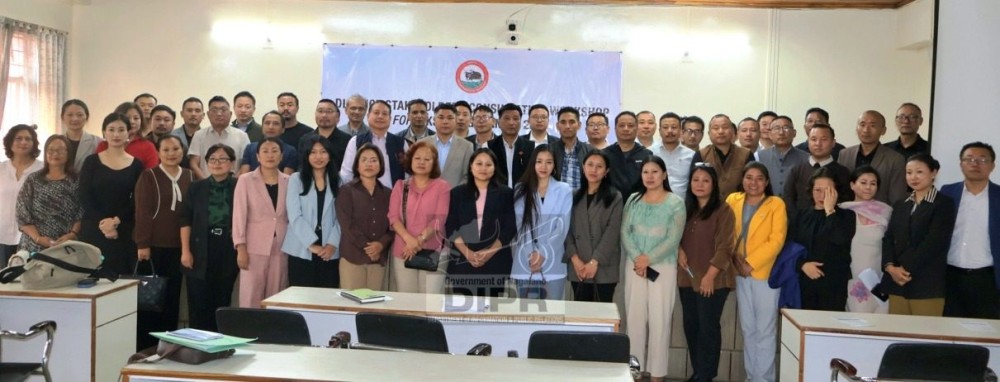
Kohima, April 21 (MExN): A district stakeholders' consultation workshop on Viksit Nagaland@2047 was held at the DC's conference hall, Kohima on April 21, bringing together government departments, civil society organisations and other stakeholders to deliberate on a vision for a developed Nagaland aligned with national goals.
The workshop aimed at capturing inclusive, multi-sectoral perspectives, identifying systemic gaps, and setting visionary targets for 2030, 2038 and 2047, a DIPR report said.
Delivering the welcome address, Deputy Commissioner Kohima B Henok Buchem (NCS) said the consultation process was a coordinated exercise aimed not only at data collection but at enabling structural and governance reforms.
“The outcome will contribute to the preparation of a comprehensive Vision Document aligning district and state aspirations with national priorities, including the Sustainable Development Goals,” Buchem said.
He said the planning framework had been structured into short, medium and long-term timelines to ensure systematic implementation and monitoring.
Deliberations were carried out through five thematic working groups covering economic development, social development, infrastructure, environmental sustainability, and governance and institutional strengthening.
The Department of Planning and Transformation, presenting an overview of sectoral assessments, said the Viksit Bharat initiative envisions India as a developed nation by 2047, and that states have been urged to formulate their respective vision documents through stakeholder consultations.
The department noted that Nagaland had earlier articulated its SDG Vision 2030, and the present exercise seeks to co-create Nagaland Vision 2047 by incorporating district-level aspirations.
Various departments presented key schemes, achievements and challenges during the session. The Chief Minister's Micro Finance Initiative highlighted improvements through digital onboarding, digital livestock insurance, vehicle subsidies and Swavalamban Kendras for applicant facilitation.
The District Urban Development Agency presented the PM Street Vendor's Atma Nirbhar Nidhi scheme, while the District Industries Centre outlined the PM Vishwakarma Scheme focusing on skill upgradation and market linkages for traditional artisans.
The Social Welfare Department presented implementation of Saksham Anganwadi and Poshan 2.0, and the Chief Medical Office highlighted progress under Ayushman Bharat PM-JAY and CMHIS, noting challenges in card issuance due to documentation gaps and connectivity issues.
The Power Department presented initiatives under the PM Surya Ghar: Muft Bijli Yojana and the Nagaland Solar Mission, aimed at promoting rooftop solar installations and advancing green energy adoption.
Participants were subsequently divided into five thematic groups for breakout discussions, followed by a plenary session where each group presented proposed interventions and policy recommendations. The programme concluded with a briefing on next steps for compilation of the district report based on outcomes of the consultation.