Imlisanen Jamir
Dimapur | June 8
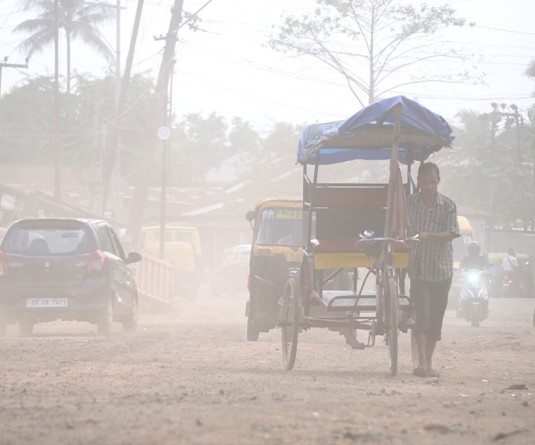
Every so often, a child is spotted carrying bricks at a construction site in Dimapur, washing dishes at a roadside stall, or tending to a household in a town far from their village. Passers-by may feel uneasy, but most do not know what the law actually says, or what they can do about it. This explainer is for them.
Before examining specific statutes, it is vital to recognise that the protection of children from exploitation is not merely a matter of statutory policy, it is an explicit fundamental right under the Constitution of India.
The legislative framework against child labour relies primarily on two constitutional pillars:
Article 24 (Prohibition of Employment of Children): The Constitution explicitly prohibits the employment of children below the age of fourteen years in any factory, mine, or any other hazardous employment.
Article 21A (Right to Education): This article guarantees free and compulsory education for all children between the ages of six and fourteen years as a fundamental right.
Together, these provisions establish that a child’s rightful place is in the classroom, not the workforce. The statutory laws enacted by Parliament are designed to give operational teeth to these constitutional guarantees.
The law in plain terms
India's central law governing child labour is the ‘Child and Adolescent Labour (Prohibition and Regulation) Act, 1986,’ significantly amended in 2016. The amended law does two things the original did not: it draws a clear line between children and adolescents, and it moves from regulation, which implied that some child labour was acceptable under controlled conditions, toward outright prohibition.
Readers often face confusion because different Indian laws define a "child" differently based on their specific legal mandates. For instance, the Juvenile Justice (Care and Protection of Children) Act, 2015, which focuses on comprehensive child welfare and protection, defines a child as any person who has not completed eighteen years of age.
In contrast, to regulate and prohibit employment effectively, the ‘Child and Adolescent Labour Act’ explicitly distinguishes between two categories of young persons under Section 2:
Section 2(ii): ‘Child means a person who has not completed his fourteenth year of age or such age as may be specified in the Right of Children to Free and Compulsory Education Act, 2009, whichever is more.’
Section 2(i): ‘Adolescent means a person who has completed his fourteenth year of age but has not completed his eighteenth year.’
For children under 14, the legislative stance leaves no room for creative interpretation.
Section 3(1): ‘No child shall be employed or permitted to work in any occupation or process.’
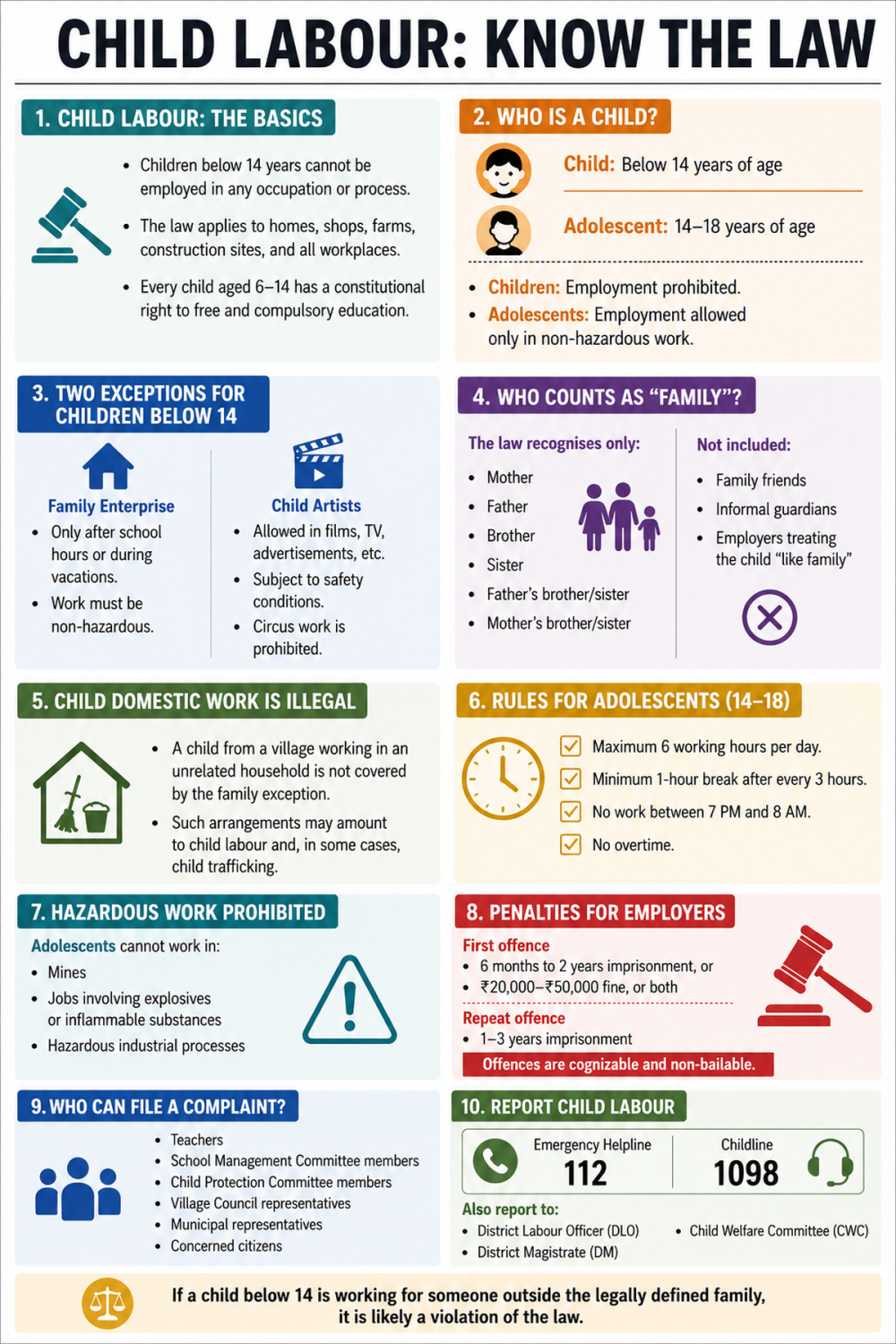
This is an absolute prohibition, and it applies across all sectors including domestic work, shops, construction, agriculture, and any other setting.
For adolescents between 14 and 18, work is regulated but strictly banned in specific sectors.
Section 3A: ‘No adolescent shall be employed or permitted to work in any of the hazardous occupations or processes set forth in the Schedule...’
The exceptions
The law makes two exceptions for children below 14, and both have been sources of confusion and, in some cases, misuse.
The first is the ‘family enterprise exception.’ A child may help their family or family enterprise provided the work is non-hazardous and occurs strictly within the parameters laid down by the statute:
Section 3(2)(a): ‘Nothing in sub-section (1) shall apply where the child,— helps his family or family enterprise, which is other than any hazardous occupations or processes set forth in the Schedule, after his school hours or during vacations…’
To prevent employers from claiming a broad, cultural definition of an extended family to bypass the law, the Act provides a strict, narrow biological checklist:
Section 3, Explanation (a): ‘Family in relation to a child, means his mother, father, brother, sister and father's sister and brother and mother's sister and brother’
Section 3, Explanation (b): ‘Family enterprise’ means any work, profession, manufacture or business which is performed by the members of the family with the engagement of other persons…’
No one outside this exact definition can claim the exception. An employer or household that is not family as defined above cannot invoke this clause, regardless of how close the relationship feels in practice, or what informal arrangements have been made.
The Ground Reality
This is the provision that most directly concerns child domestic labour in Nagaland. A child from a village working in the home of an unrelated family in Dimapur or Kohima falls entirely outside the family enterprise exception. The law does not recognise affective relationships, traditional arrangements, or informal guardianship as equivalent to family for this purpose.
Further, the issue of child labour in Nagaland and the wider Northeast cannot be separated from the broader crisis of ‘child trafficking.’ In many instances, vulnerable children are moved from underdeveloped rural areas to urban centres under false promises of education, proper care, or lucrative employment made to their guardians. Once separated from their support systems, these minors frequently end up trapped in exploitative domestic servitude or commercial labour. Under the law, such arrangements do not constitute benign community support; they represent a severe intersection of illegal child labour and human trafficking.
The second exception is for ‘child artists’ in the audio-visual entertainment industry, including films, television serials, and advertisements, subject to safety conditions prescribed by the government. The circus is explicitly excluded.
What employers must not do
For adolescents employed in permitted occupations, the law sets clear conditions. Work cannot exceed six hours a day. There must be a rest interval of at least one hour after every three hours of work. Adolescents cannot be made to work between 7 PM and 8 AM. Overtime is strictly prohibited.
None of these protections apply if the adolescent is in a hazardous occupation, because no adolescent should be in one to begin with.
It is also worth noting what the 2016 Amendment did to the list of hazardous occupations. The original 1986 Act listed 83 hazardous categories (comprising 18 occupations and 65 industrial processes). The amended Schedule reduced this to three broad categories: mines, inflammable substances or explosives, and hazardous processes as defined under the Factories Act, 1948. Critics have argued this narrowing leaves adolescents exposed in sectors, such as spinning mills, garment production, and carpet making, where dangerous conditions persist.
What the Penalties Are
The 2016 Amendment substantially increased the penalties for employers who violate the law.
For employing a child in any occupation, or an adolescent in a hazardous occupation, the penalties are strictly codified under Section 14(1):
Section 14(1): ‘...shall be punishable with imprisonment for a term which shall not be less than six months but which may extend to two years, or with fine which shall not be less than twenty thousand rupees but which may extend to fifty thousand rupees, or both.’
For those who continue to break the law after a first conviction, the mandatory penalties scale up quickly:
Section 14(2): ‘Whoever having been convicted of an offence under section 3 or section 3A commits a like offence afterwards, he shall be punishable with imprisonment for a term which shall not be less than one year but which may extend to three years.’
Offences under the Act are ‘cognizable and non-bailable,’ granting law enforcement immediate authority to step in without waiting for local warrants:
Section 14A: ‘Notwithstanding anything contained in the Code of Criminal Procedure, 1973, any offence committed by an employer and punishable under section 3 or section 3A shall be cognizable.’
Parents or guardians who permit a child to work in violation of the Act can also be penalised, but they are statutorily exempt from punishment for a first offence. For a repeat offence, they may be fined up to Rs 10,000.
The law also allows for ‘compounding of offences:’ a first-time accused may apply to the District Magistrate to settle the matter by paying a prescribed amount to the government, without the case going to trial. If the accused fails to pay, criminal proceedings continue under the Act.
Rehabilitation, not just punishment
One of the more significant additions in the 2016 Amendment is the ‘Child and Adolescent Labour Rehabilitation Fund,’ constituted at the district level to ensure immediate relief for rescued children.
Section 14B(1): ‘The appropriate Government shall constitute a Fund in every district or for two or more districts to be called the Child and Adolescent Labour Rehabilitation Fund to which the amount of fine realized from the employer of the child and adolescent... shall be credited.’
Crucially, the government cannot wait for an employer to clear their fines before funding rehabilitation. The state must step in independently:
Section 14B(2): ‘The appropriate Government shall credit an amount of fifteen thousand rupees to the Fund for each child or adolescent for whom the fine amount had been credited under sub-section (1).’
This dual funding model ensures that immediate rehabilitation funds are made available to the victim even if an employer delays or evades paying their share. Rescued children are further rehabilitated in accordance with the Juvenile Justice (Care and Protection of Children) Act and related central and state social welfare schemes.
The District Magistrate's role
The 2016 Amendment gives the District Magistrate significant authority. The state government confers powers and duties on the DM to ensure the Act is properly implemented. The DM may in turn delegate these powers to subordinate officers, specifying the local limits of their jurisdiction.
The Act also requires periodic, monitored inspections of places where child employment is prohibited and where hazardous processes are carried out.
The Child and Adolescent Labour Act is a central legislation and applies to Nagaland as it does to every other state. The Nagaland Department of Labour formally implements the law across all districts.
In terms of education-based rehabilitation, the older model of standalone National Child Labour Project (NCLP) schools has been systematically phased out and integrated into the central ‘Samagra Shiksha Abhiyan (SSA)’ framework. Instead of parallel special schools, rescued children are now placed into designated Special Training Centres (STCs) operated under the education department, designed to quickly bridge learning gaps and mainstream them directly into formal public schools.
As with any progressive legislation, the practical challenge in Nagaland remains enforcement. Labour inspectors are the primary enforcement mechanism, and their administrative reach, particularly into domestic households, local commercial hubs, and semi-urban border areas, dictates how effectively the Act protects vulnerable minors.
What you can do
The law empowers more citizens to act than most realise. School teachers, school management committee representatives, child protection committee members, and village panchayat, municipal, or village council representatives are all legally entitled to file complaints under the rules framed under this Act.
If you know of a child below 14 who is working, in a home, a shop, a construction site, or anywhere else, and the employer is not a strict family member operating within school-vacation guidelines, it is a legal violation.
Cases can be reported directly to the National Helpline (1098 / 112); Childline (1098) which operates in emergency integration with the Emergency Response Support System (ERSS) at 112; the District Labour Officer (DLO); the District Magistrate’s office; or the Child Welfare Committee (CWC), a statutory body constituted under the Juvenile Justice Act in every district, responsible for the immediate care, protection, and safe placement of rescued children.
Disclaimer: This report is part of the ‘Media Fellowship Initiative on Child Protection Awareness and Ethical Public Discourse’ series, supported by DKA Austria and implemented by Prodigals’ Home. The content is intended for public legal literacy and preventive awareness and does not constitute legal advice.