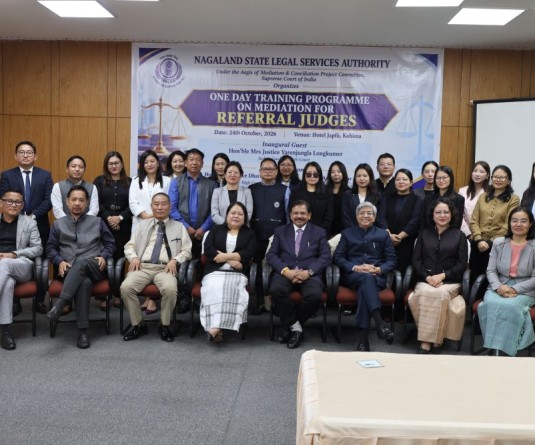
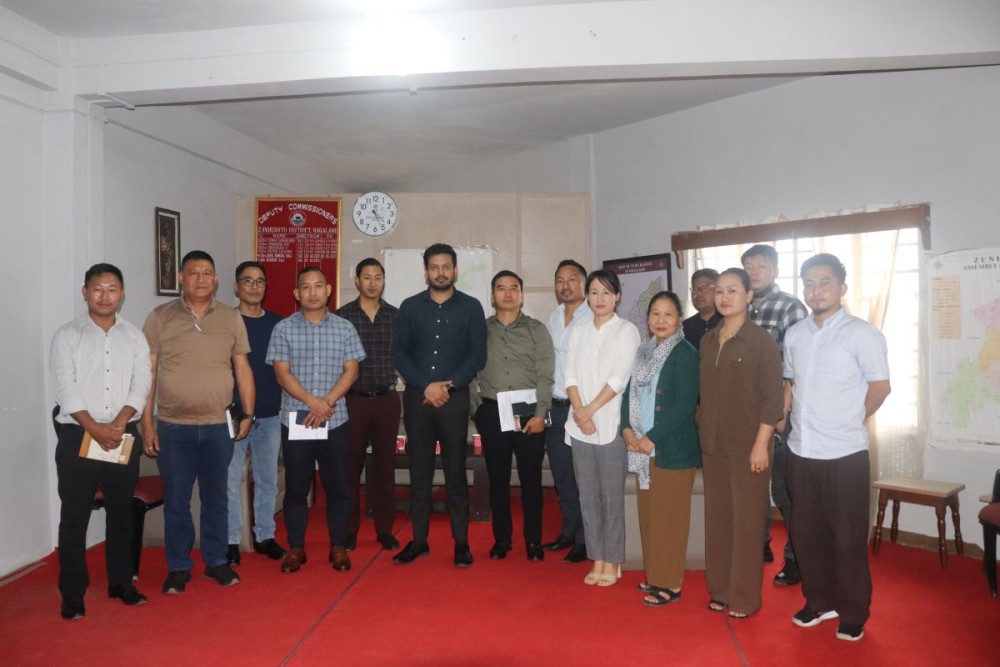
DWSM Chairman Dharam Raj, along with other officials during the review meeting held at the chamber of the Deputy Commissioner in Zunheboto on July 28. (Morung Photo)
Morung Express News
Zunheboto | July 28
The District Water and Sanitation Mission (DWSM) on Tuesday reviewed the progress of the Jal Jeevan Mission (JJM), rural sanitation, water supply infrastructure and revenue collection in Zunheboto district, with officials stating that over 95 per cent of rural households have been provided tap water connections.
The meeting, held in the chamber of the Deputy Commissioner, was chaired by Deputy Commissioner and DWSM Chairman Dharam Raj, while Sub-Divisional Officer (PHED) Beto T. Jimo presented the departmental report.
Addressing the meeting, Raj acknowledged the disruption caused by the recent landslide that damaged the district's main water supply pipeline and said the district administration and the Public Health Engineering Department (PHED) were working in close coordination to restore the supply at the earliest.
"We are aware of the water supply issues caused by the damaged pipeline. The district administration and the PHED department are working together in coordination to ensure that the restoration is completed as early as possible," he said.
According to officials, the district has 33,089 rural households, of which 31,588 households, or 95.46 per cent, have been provided Functional Household Tap Connections (FHTCs) under the Jal Jeevan Mission.
Before the launch of the mission in August 2019, only 2,713 households, or 8.13 per cent, had access to tap water. Officials said 1,501 households remain to be covered to achieve universal tap water connectivity.
The meeting also reviewed the Har Ghar Jal programme and noted that all 186 villages in the district have been covered under the scheme. Of these, 161 villages have been reported and 114 villages certified.
Officials said 162 villages have achieved 100 per cent household tap water coverage, while work is continuing under two Multi Village Schemes (MVS) and one Single Village Scheme (SVS). Village Water and Sanitation Committees have also been constituted in all villages to strengthen community participation.
The meeting highlighted the role of the District Technical Unit in providing technical support, water quality monitoring, operation and maintenance of rural water supply infrastructure, source sustainability planning, capacity building and convergence of government schemes.
Under the Swachh Bharat Mission (Gramin), the district has 162 ODF Plus villages, including 116 ODF Plus Model villages. Officials said the district aims to achieve 100 per cent ODF Plus status by October through improved solid and liquid waste management and enhanced community participation.
The meeting also discussed a roadmap that includes accelerating Jal Jeevan Mission implementation, undertaking spring rejuvenation and catchment protection works, integrating MGNREGS and Forest Department interventions for watershed management, empowering Village Water and Sanitation Committees for operation and maintenance of water supply systems, strengthening inter-departmental convergence and preparing a District Water Security and Resilience Plan for Zunheboto headquarters and surrounding villages.
Reviewing urban water consumers, officials said Zunheboto subdivision accounts for 1,407 of the district's 2,321 water consumers, followed by Satakha with 356, Aghunato with 298, Pughoboto with 150 and Atoizu with 110.
The PHED division also reported collecting Rs 25.42 lakh against an annual revenue target of Rs 30 lakh during 2025-26, achieving 84.7 per cent of the target.