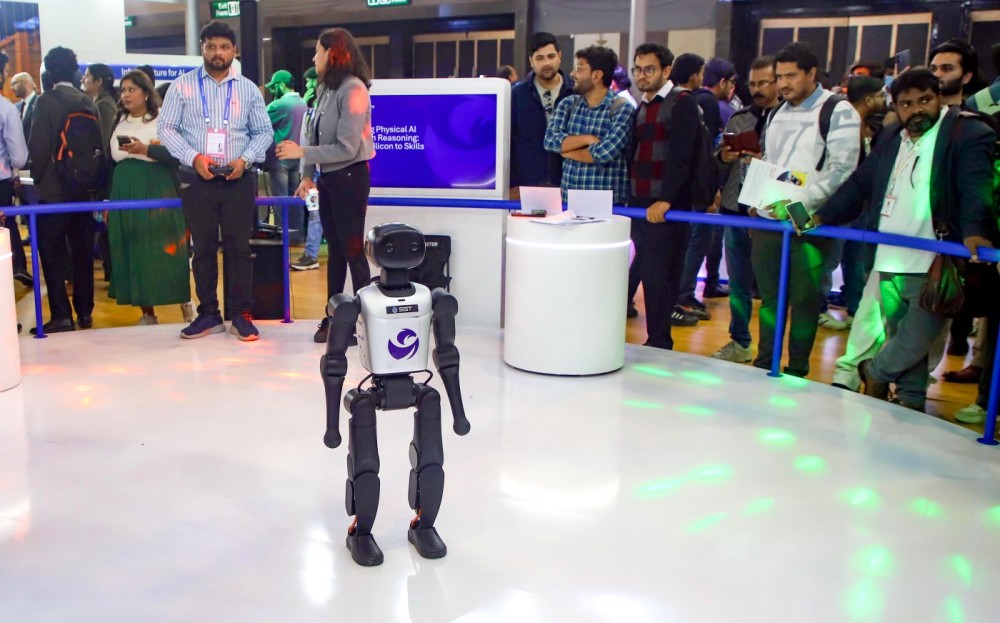
New Delhi: Visitors take a look at a robot at a stall during the AI Impact Summit 2026 at Bharat Mandapam, in New Delhi, on Tuesday, February 17, 2026. (Photo: IANS/Qamar Sibtain)
New Delhi, February 25 (IANS) If the India AI Impact Summit 2026 has taught us anything, it is that artificial intelligence is no longer just a catchphrase used by business leaders and techies. It is increasingly being presented as a tool for development, which must address real-world issues rather than being used for theoretical and technological goals.
When Prime Minister Narendra Modi articulated the summit’s guiding motto, “Sarvajan Hitay, Sarvajan Sukhaye” (welfare and happiness for all), he was signalling a deeper imperative: that India must anchor its AI ambition not in Silicon Valley benchmarks but in the lived realities of its 700,000 villages and nearly half a billion rural citizens.
This February, amidst an unprecedented chorus on inclusion, world leaders, business executives, and technologists gathered in Delhi. Their presence demonstrated the importance of establishing technology as a public good as well as India's growing influence in determining the global AI agenda. It was no coincidence that the summit, which was held for the first time in the Global South, put People, Planet, and Progress at the centre of its framework.
This marked a shift away from limited commercial narratives and towards an impact-oriented strategy.
However, ambitious plans are only useful if they help heal the deep-rooted divisions that splinter Indian society. The most notable of them is the contrast between the rural hinterlands marked by patchy connectivity, low levels of digital literacy, and restricted economic prospects and the urban centres brimming with digital infrastructure. Too frequently, India's technology policy is drafted from the perspective of metropolises, but the true test of its efficacy is found in the villages where the benefits of digital transformation have not yet materialised.
This divide's lines are not only arbitrary. An ecosystem of data-driven services in healthcare, education, and business already helps urban India. In contrast, rural India struggles with inconsistent broadband, a workforce that is both precariously employed and underqualified for modern jobs, and low institutional capacity. This is about turning technology potential into real gains in livelihoods, resilience, and citizenship, not just about having access to gadgets.
The key question that thus emerges is whether AI can be used to democratise opportunities instead of sustaining inequality. This goal is indicated by the India AI Impact Summit's emphasis on "All-Inclusive Intelligence", a term that Union ministers have used frequently. AI must be evaluated based on how much it improves lives and lessens disparities in care delivery, not how complex its algorithms are, as India's Minister of State for Health rightly pointed out.
This is a systemic and structural difficulty. Urban areas gain from network effects, economies of scale, and human capital concentrations that increase the value of AI. On the other hand, rural areas require sturdy, reasonably priced, and culturally appropriate technology that is sensitive to context. A variety of languages, educational levels, and economic settings must be accommodated by AI interventions.
Think about how AI might be used in agriculture, which still employs almost half of India's workers. If AI-powered market recommendations, soil health prediction models, and precision agricultural technologies are available in local languages and distributed through reliable middlemen like panchayats or cooperative organisations, they can increase output and incomes. Compared to large expenditures in cloud infrastructure, a pilot project in personalised, AI-based agricultural extension services may appear insignificant, but its multiplier effect on rural incomes could be significantly larger.
Another area where AI's inclusion has the potential to revolutionise is education. Personalised learning systems, adaptive tutoring in vernacular languages, and mentorship networks mediated through AI could mitigate the disadvantages faced by schoolchildren in remote districts. However, these tools run the risk of being aspirational rather than practical if there isn't concurrent investment in local data infrastructure, dependable electricity, and teacher training.
According to studies, AI should be viewed as an addition to human labour rather than a replacement, particularly in environments with limited resources.
The meeting focused on how AI might help scale public health surveillance and diagnosis. This makes sense: AI can be a force multiplier for screening, early detection, and resource allocation in states with low doctor-to-patient ratios. Once more, though, the true difficulty is in incorporating these technologies into the public health system where they are most required, which is in community outreach initiatives and rural primary health centres.
These reflections give rise to two interrelated topics. AI integration must, first and foremost, be deliberate rather than accidental. Market forces alone will concentrate the benefits of AI in urban clusters where revenues are higher and infrastructure is richer, absent tailored policy design and fiscal incentives. This would widen the gap rather than close it. Second, inclusive AI must represent India's story, influenced by its linguistic diversity, democratic values, and development goals. It cannot be an imported screenplay.
This calls for a mental change. Policymakers and practitioners need to focus on equity issues, such as who gains, who loses, and how the marginalised might exercise agency in an AI-mediated future, rather than seeing AI as either disruptive or stable. Local languages, interoperability with rural service delivery, and grassroots capacity building must be given top priority in India's AI governance frameworks. This is indicated by the Summit's characterisation of AI for "social empowerment" and "democratising resources," but the true test will be its application.
Addressing the skills frontier is also critically important. India's demographic dividend has the potential to either promote prosperity or increase inequality. Attendees were warned by Chief Economic Advisor V. Anantha Nageswaran that India runs the risk of underutilising the potential of its youthful labour in the AI era if it does not implement strong upskilling. The gap between urban and rural areas will deepen if AI develops more quickly than human capital, making young people in rural areas more susceptible to marginalisation and displacement.
In the end, an ecological strategy that integrates technology, institutions, and human agency is what holds the potential of inclusive AI in India. Making decisions that enable every child in a village school, every farmer in a rain-shadowed area, and every small business owner to take part in and profit from the intelligence revolution is more important than simply providing algorithms.
Although the India AI Impact Summit was a positive step, summits are just the beginning, not the end. Whether India's AI trajectory fills in the gaps that have long limited its promise will be the true test. AI will have failed not only in rural India but also in its own purpose if it only serves to perpetuate already-existing disparities. The improvement of life will be used to gauge AI's value more so than model output.