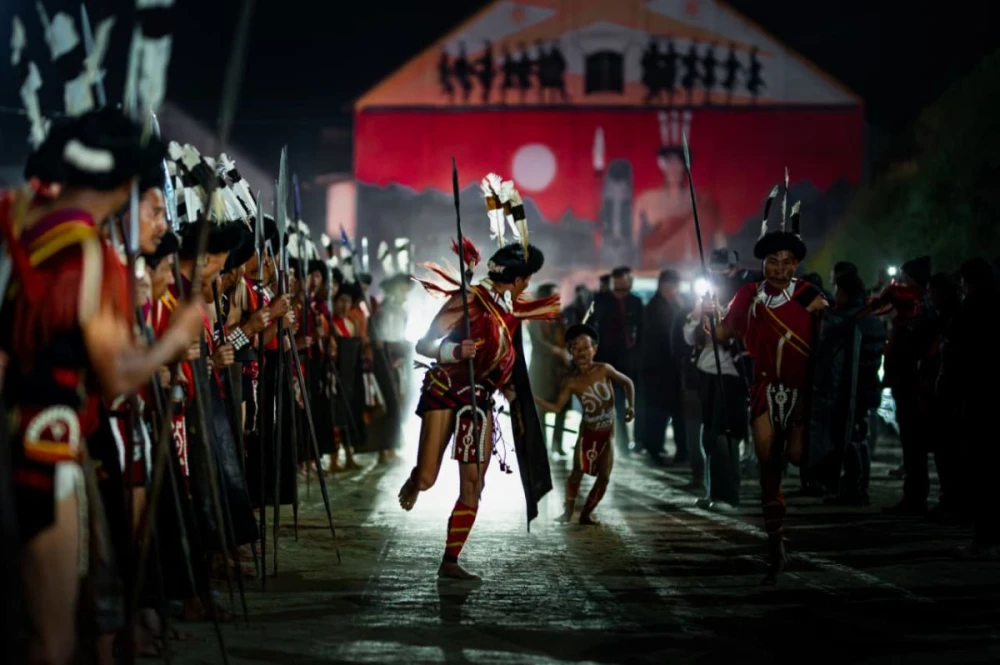
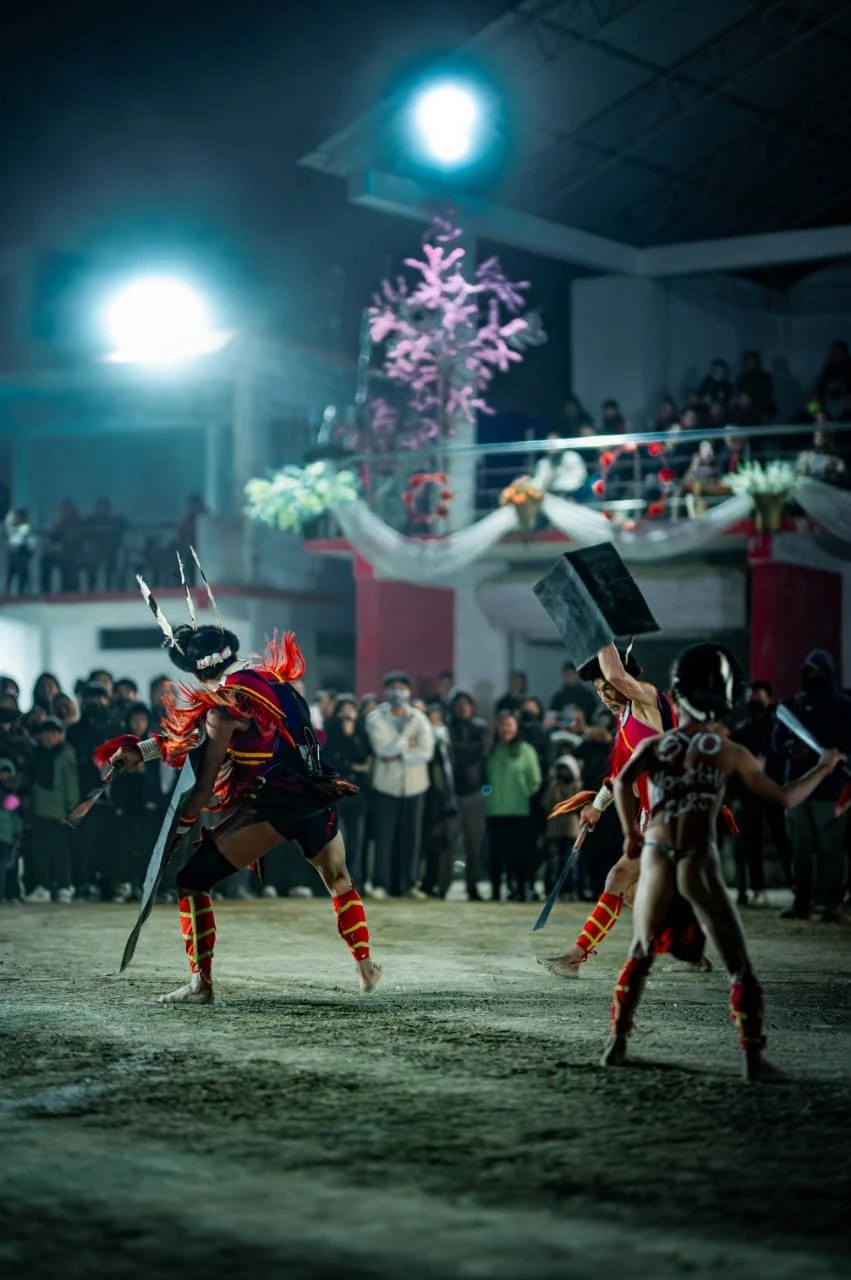
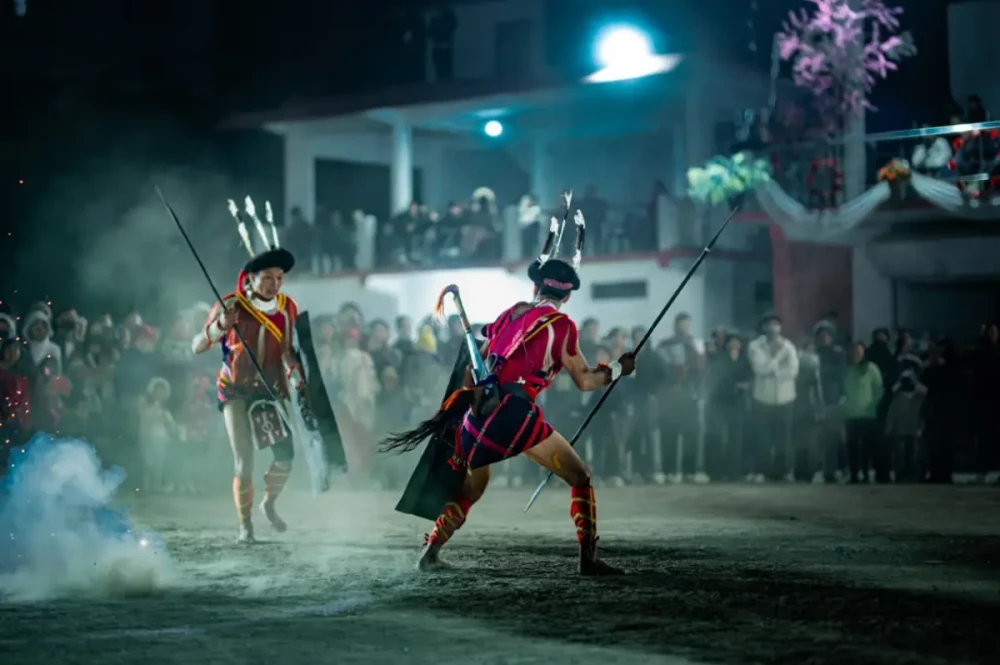
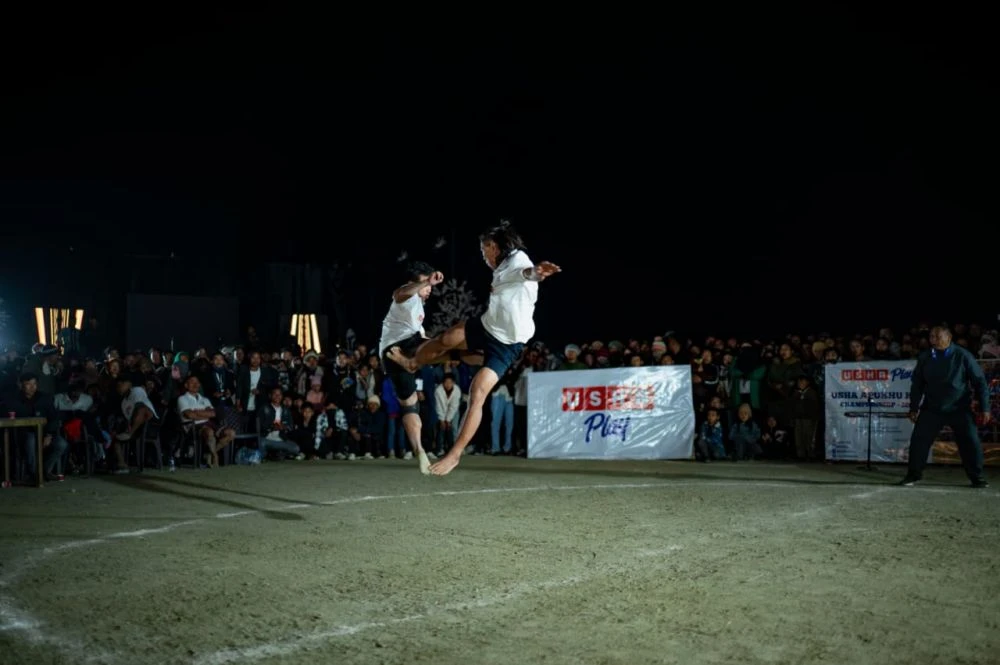
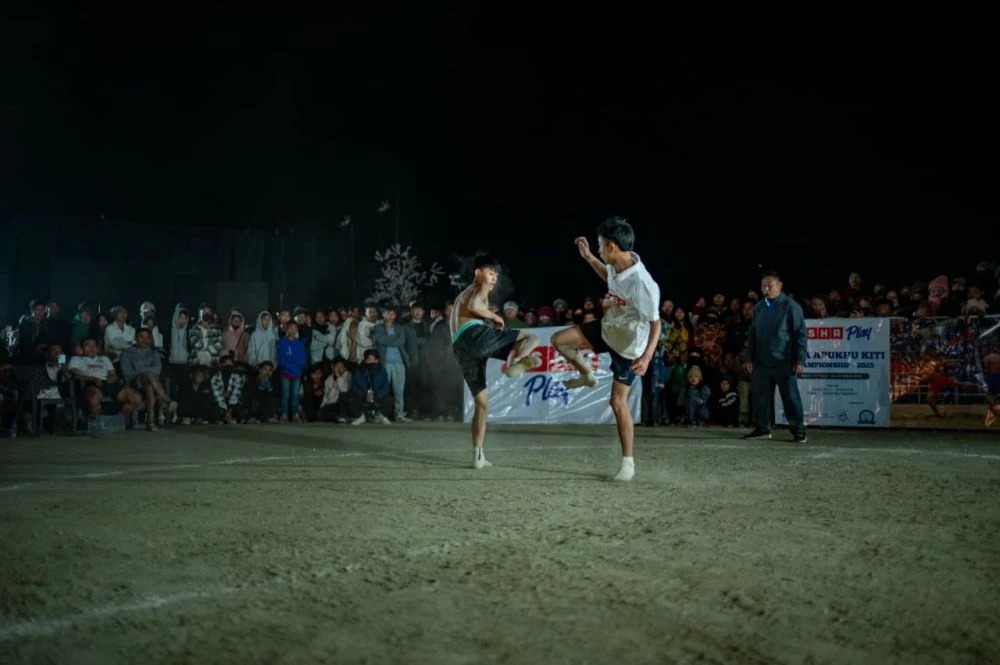
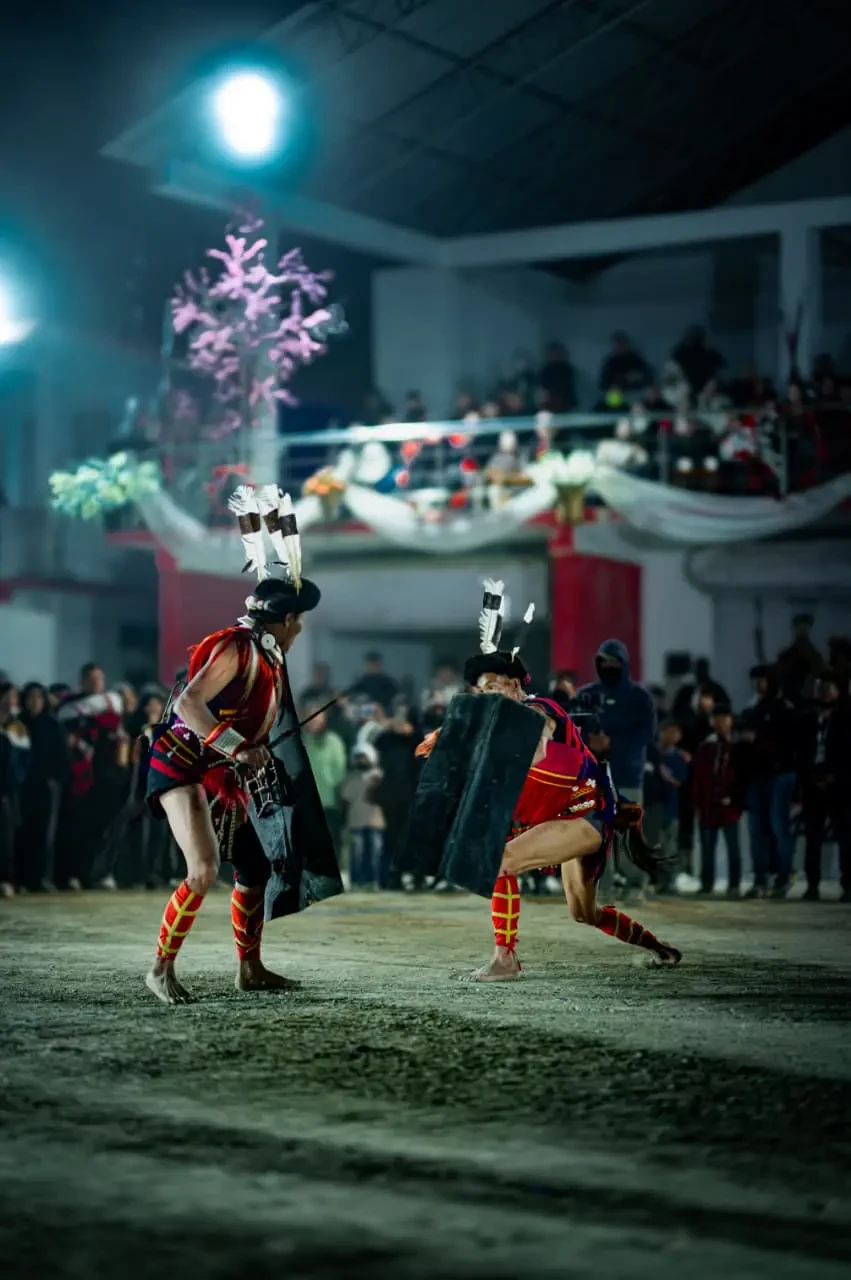
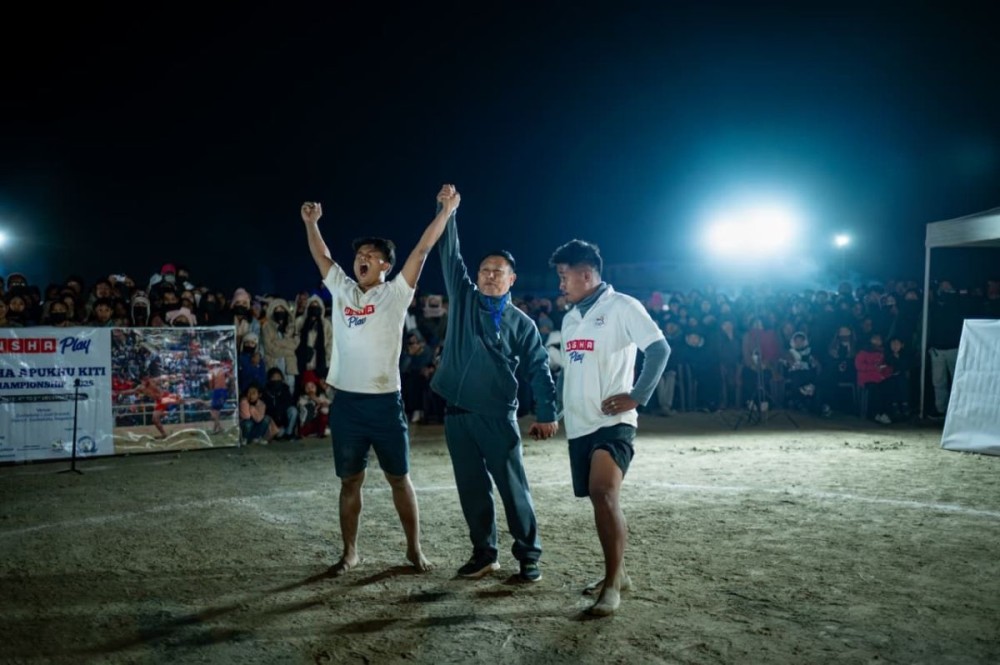
A winner is announced after an Aki Kiti match, an indigenous martial sport of the Sumi Naga community, during the second edition of the Hornbill Extension organised by the Sumi Youth Organisation on December 4–5, 2025, at the District Sports Complex, Zunheboto. (Photo courtesy: SYO)
Tokavi K Zhimo
Zunheboto | January 25
India’s cultural diversity is deeply rooted in its villages, where indigenous sports endure as living traditions. More than physical contests, they preserve history, values, discipline and collective memory across generations.
Nagaland is home to 16 major tribes, each with a distinct cultural identity, and in the Sumi heartland, one such tradition, Aki Kiti, an indigenous martial arts tradition, continues to survive despite the pressures of modern life.
Historically known for its warrior ethos, the Sumi tribe has preserved Aki Kiti, literally meaning kick fighting and also known as Apukukiti or Pukukiti, as a disciplined form of conflict resolution rather than conquest.
A tradition rooted in justice
Aki Kiti predates modern justice systems. Traditionally, it was used to settle disputes within villages with dignity and minimal bloodshed.
Contested strictly within a ring, the sport permits only the use of the feet, with hands, grappling, punching and boxing techniques prohibited. Balance, agility, control and precision define the contest.
Having practised and remained involved in Apukukiti since the age of five or six, Hoshepu Swu, now an Aki Kiti referee, explained that the sport is contested in three rounds of three minutes each.
“Only the sole of the foot is permitted. Side kicks and straight kicks are not allowed. Fouls include blocking with hands, grappling, punching or boxing,” he added.
Any violation of rules leads to immediate disqualification. Staying within the ring is as important as striking legally.
Though physically intense in appearance, Aki Kiti is governed by strict discipline and deeply rooted values, emphasising technique and control over aggression or dominance.
Training begins at a young age and demands rigorous physical and mental discipline.
More than a sport, an identity marker
Zunheboto town remains the epicentre of Aki Kiti. Matches held during special extensions of the Hornbill Festival transform the town into a living arena of heritage, where culture survives best in its place of origin.
Kiyexu Chishi, Aki Kiti coach and chairman of the GB Association, Zunheboto Town, said the sport was traditionally organised in villages during Sumi festivals such as Tuluni and Ahuna.
“Aki Kiti was a test of strength, skill and character. In some cases, it even determined marriage alliances, where suitors competed and the victor earned the right to marry,” he said, adding that every Sumi village has practised the sport since time immemorial.
Tracing the practice back to his forefathers, Aki Kiti player Itobo Zhimo said he has been practising Apukukiti since 2018 and explained that it was traditionally used to resolve village disputes, with elders organising matches and the winner being accepted as right.
“Even today, I practise for months before the season, morning and evening,” he said, adding that despite playing football and volleyball, he would never leave Aki Kiti as it remains central to Sumi tradition.
Describing it as physically demanding, Zhimo said the sport builds strength and courage, and that injuries had not deterred him from continuing.
Apukukiti as a symbol of Sumi identity, another player, Aqhevi Shohe, said the tradition, handed down by elders, was sustained through rigorous training and strict rules.
“Sometimes I win, sometimes I lose, but the spirit remains the same,” he said, adding that training includes early morning jogging and kicking sandbags.
In addition to Swu, he explained, strikes must be delivered with the sole of the foot.
Preservation and promotion efforts
Meanwhile, state leaders and cultural advocates have also recognised the significance of the sport. CL John, Nagaland’s Minister for Forests, Environment and Climate Change, said Aki Kiti has potential for wider recognition and that the government would discuss taking it to the state level, noting that the physically demanding sport would require proper regulation.
Bokato Zhimo, an Aki Kiti coach, said efforts are underway to preserve the tradition and seek national recognition, adding that the sport has the potential to grow with institutional support.
Aki Kiti is a unique and promising sport, and preserving it is essential to safeguarding the cultural identity, averred Miss Nagaland 2022 and social media influencer Hikali Achumi.
Dharam Raj, Commissioner of Zunheboto, said the Sumi community has a strong warrior tradition and that indigenous sports such as Aki Kiti should be promoted, adding that with proper development they could gain wider recognition.
For Temjen Imna Along, Minister of Higher Education and Tourism, its preservation is important not just as a sport, but for the transformation it brings in lifestyle, discipline and values.
Likewise, Lewrence Guria, coordinator of the ANIMA Integrated Development Association (AIDA), said the ancient sport was on the verge of decline and that efforts are underway to revive and promote it. “Awards recognise individual excellence, but the real victory lies in preserving cultural identity,” he added.
Advisor to the Chief Minister of Nagaland, Abu Metha, alluded to preservation efforts through the Hornbill Festival policy, with district level celebrations enabling tribes to showcase and sustain cultural heritage across the state.
Tradition meets modern training
In Dimapur, tradition is intersecting with modern training methods. Deep Kumar, a nationally recognised coach of Pencak Silat and Taekwondo at Faith in Action Academy, is integrating indigenous martial arts with international formats, with the academy producing medalists at Asian and global competitions.
“Children today are absorbed in mobile screens,” Kumar said. “Martial arts keep them active, focused and disciplined. Aki Kiti proves that Nagas possess a natural aptitude for combat sports.”
In 2008, Aki Kiti gained international exposure when it was featured in the fourth episode of Series 1 of Last Man Standing. Titled Sumi Kick Fighting, the episode saw six athletes from the United Kingdom and the United States compete against tribal champions in a bid to become the last man standing.
Rooted in balance rather than conquest, Aki Kiti continues as a disciplined Sumi martial tradition, sustained through community practice and evolving forms of recognition, linking the past with the present.