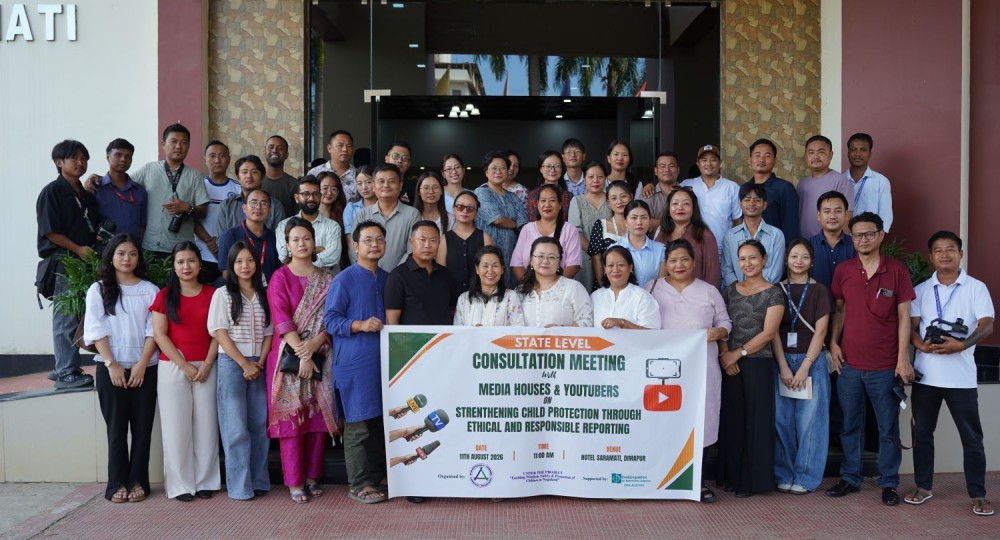
Participants during the State Level Consultation Meeting with Media Houses & YouTubers, organised by Prodigals’ Home at Hotel Saramati, Dimapur on August 11. (Morung Photo)
State level consultation calls for newsroom safeguards, stronger coordination and greater attention to realities on the ground
Morung Express News
Dimapur | August 11
When a child-related case enters the news cycle, the question for journalists is often framed around one immediate concern: whether the child’s name has been published.
But a state-level consultation on child protection and media reporting in Dimapur on Tuesday suggested that the question needs to go much further. It needs to go to the school, locality, family, social-media post, community statement, photograph and even the relationships surrounding a case.
The discussion at the State Level Consultation Meeting with Media Houses & YouTubers, organised by Prodigals’ Home at Hotel Saramati, repeatedly returned to the particular difficulty of reporting in Nagaland, where a close-knit society can make anonymity far more difficult than simply removing a name from a report.
The consultation, themed ‘Strengthening Child Protection through Ethical and Responsible Reporting,’ brought together journalists and media practitioners to examine the gap between child-protection principles and what happens when a case actually reaches a newsroom. The event was held with support from the DKA Austria.
The programme was chaired by Lozua Kape, Programme Manager, Prodigals’ Home. It opened with a prayer by A Rove Mao, Youth Director, MBCD, Kuda Village, followed by the welcome and introduction. The session on field experience, challenges and looking ahead featured Prasanjit Dutta, Sub-Editor, Eastern Mirror, and Musaraf Ali, Senior Reporter, Nagaland TV. Dr Moalemba Jamir, Associate Editor, The Morung Express, delivered the presentation on “Protecting Child Rights & Identity: From Law to Newsroom Practice,” followed by an open-house discussion.
A name is not the only identifier
Dr Moalemba Jamir said protecting a child’s identity goes beyond withholding the name. “We live in a very tight ecosystem. Stories travel instantly from one source to another,” he said, noting that details such as a school, locality, family relationship, age and other seemingly incidental information can allow children to be identified in close-knit communities.
“We say, ‘we are not using the name.’ But I think that is not enough,” he said.
His presentation drew on examples from recent Nagaland reporting where combinations of details could narrow down the identity of children, including school and class, locality, family relationships and distinctive circumstances surrounding a case. The presentation described the problem as an “indirect identity trap,” where the omission of a name does not necessarily prevent identification.
Dr Jamir also pointed to the circulation of information outside the newsroom. A report may be prepared after details have already travelled through social media, community networks and other channels. “Before our news, or before our content is published, it has already been shared on social media,” he said.
Once information enters the digital space, it can persist indefinitely through screenshots and re-sharing, even if the original report is later corrected or removed. Digital content, once published, leaves a permanent footprint, he noted.
He also addressed the role of community organisations that issue statements following incidents involving children. Such statements may be issued in good faith to condemn an incident, express solidarity and demand justice, but can contain identifying information.
Dr Jamir said media practitioners sometimes “go with the flow” without fully considering the consequences of publishing details that may already be circulating elsewhere. The presentation urged newsrooms to filter community statements rather than reproduce them verbatim when they contain names, village details, schools, relationships or other information that could identify a child.
Information Chain
The discussion session highlighted that the flow of information does not begin or end with the newsroom. Police, civil society organisations, tribal and student bodies, churches, families and social-media users can all become part of the information chain.
Musaraf Ali, Senior Reporter, Nagaland TV, observed that information identifying a child can sometimes come from people close to the child themselves. “A lot of information on the child’s identity is also leaked by close family or known people on social media,” he said, while also acknowledging that “there are lapses for civil society as well.”
He said the close-knit nature of Nagaland’s society also plays a role in making such reporting difficult. Sharing stories about abuse remains important to ensure that victims receive justice, he said, but it has to be done “with responsibility and patience.”
Ali pointed to the growing role of YouTubers and social-media actors in bringing sensitive cases to public attention. While their intentions may be good, he said they also need to act responsibly and work under guidelines that protect “not just the identity of the child but also their future and everything around it.”
For Prasanjit Dutta, Sub-Editor, Eastern Mirror, the realities of reporting become particularly difficult outside Dimapur and Kohima. He said gathering information on cases involving children in conflict with law or underage victims “become increasingly difficult outside urban spaces like Dimapur and Kohima”, with fear and stigma playing a major role in preventing such cases from coming to light.
Dutta pointed to uneven access to Child Protection Officers across districts and the difficulties reporters can face in obtaining information. Legal awareness within newsrooms was another concern. While journalists who have spent years covering cases involving children may become familiar with the relevant laws, Dutta said the same cannot necessarily be expected from someone new to the profession.
“Journalists who have spent years reporting and have dealt with reports concerning children in conflict with the law or victims who are underage can do a better job because they eventually become somewhat legally informed,” he said. “But such cannot be expected from someone who just joined the profession.”
That, he suggested, makes the role of the desk particularly important, especially when a reporter is working on a sensitive case under time pressure.
The close-knit society problem
The discussion highlighted a tension particular to reporting in Nagaland, the same close-knit social structure that allows information to move quickly can make confidentiality extremely difficult.
The problem is compounded by condemnation statements following incidents. Dutta said that even if a newsroom removes identifying details from such statements during editing, the original material may already have reached the public. “Condemnation notes are not shared only with the media but find their way to everyone’s phones,” he said.
The consultation called for better coordination between child-protection authorities and media organisations, particularly in districts where journalists face difficulties obtaining accurate information. Participants also discussed the possibility of media organisations developing their own internal child-protection guidelines so that reporters, editors, photographers and digital teams have a common framework for handling sensitive cases.
At the same time, participants noted that greater access to information cannot mean unrestricted access to identifying details. The challenge is to make reliable information available to journalists while protecting the child’s privacy and dignity.
From theory to reality
Another concern raised during the discussion was whether the media sometimes focuses too heavily on theory and legal principles while losing sight of the realities surrounding child-related cases.
The discussion shifted from post-incident response to pre-emptive action, specifically, how media can drive preventive change through sustained reporting on child protection, institutional gaps, awareness, and accountability.
The consultation also called for a framework to guide non-traditional media, YouTubers, independent creators, and social-media pages, ensuring sensitive child-related issues are handled with professional responsibility across all platforms.
Dutta said there have been instances where newsrooms published details that could reveal the identities of children, sometimes because the age of the person involved had not been specified or because the information came from an organisation considered to have legal authority.
“Our lack of awareness or information at the very moment when we are filing or editing the report can also lead to results that we do not want,” he said. “And this should make us more cautious.”
For Dr Jamir, caution does not mean abandoning the public interest. He stressed the need to find ways of reporting that allow the public to understand what happened, demand accountability and follow the justice process without exposing a child to further harm.
One of the practical tests proposed was whether three different readers could identify the child from a report: someone from the family or immediate circle, a local resident who knows the community, or an online searcher who can combine information from different reports and social-media posts.
The consultation called for a broader approach to child-sensitive reporting, with participants stressing that anonymity cannot be ensured merely by withholding a name. They called for newsrooms to assess the cumulative effect of details published, strengthen internal child-protection guidelines and improve coordination with child-protection authorities and digital media practitioners.
The programme concluded with closing remarks and a vote of thanks by K Ela, Director, Prodigals’ Home, and a closing prayer by Thujolu Demo, General Secretary, BYFD.