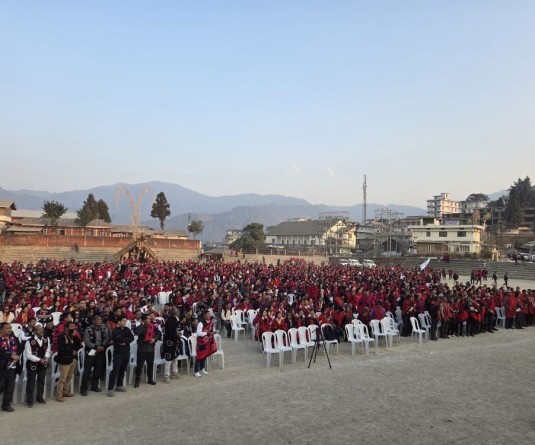
Models display products and representations of a unique intermingle of designs and prints during the launch of ‘Leejen – Colors of Nagaland’ in Dimapur, January 5. (Caisii Mao Photo)

Morung Express News
Dimapur | January 5
Blending different cultures and creating a new one is an established application today – from food to music. Tushisenla Ao, a homemaker who got influenced by the ‘Ajrakh’ block printing style wanted to apply the same using Naga tribal motifs. Her first encounter with the printing style was during her husband Wapang Jamir’s, an IPS officer, posting in Kutch district of Gujarat.
“The inspiration for ‘Leejen’ came from a chance encounter with one of the finest practitioner of this art Sufiyan Ismail Khatri hailing from the village of Ajrakhpur, Kutch,” the brochure of Leejen states.
In a joint venture with another entrepreneur Toshi Jamir, Tushisenla launched “Leejen Colors of Nagaland” in a hope to add a boost to the fashion industry in Nagaland, create employment opportunities as well as revive Naga traditional dyeing art. On January 5, the founder and secretary of Nagaland Gandhi Ashram, Natwar Thakar inaugurated a “Leejen - Colors of Nagaland” exhibition at Imliyanger Memorial Centre in Dimapur. The exhibition is scheduled till January 7, 10:00 am to 7:00 pm.
The Combination of East and West India
While addressing the gathering, Natwar Thakar said Tushisenla’s creativity has brought two cultures together through block printing. “Two ends of India meeting in Dimapur. I’m sure this small thing though it may look insignificant now, is a major historical landmark for Nagaland and west of the country.” He also encouraged the proprietors of Leejen to focus more on reviving the Nagas’ traditional dyeing art. “…make this as an aspect besides the commercial aspect.” Also, he said, natural dyes have greater appeal as they are environmental-friendly.
Promotion
Tushisenla said she wants to promote the use of natural dye in Nagaland by using available raw materials. At present, she said, raw materials for natural dye used in Kutch are madder root, indigo, alizarin, turmeric (haldi), iron scraps and tamarind seed powder. She said block printing are done on cotton, wool, suede, canvas, decors etc.
Marketing and opportunities
Jamir revealed that Leejen has tied up with a London-based designer as block printing is very popular in European countries. Also, recently the Nagaland Handloom agency had approached them and enquired on bulk purchase of products.
Concerning employment opportunities, the duo said to be planning to employ Naga workers for which they would send them out for training. The price range for the products starts from Rs 1000 to Rs 3000. The products include ladies’ dress materials, traditional dresses, shawls, bed sheets, pillow covers, curtains, decorative wall hangings and table top covers.
Elaborating the style of screen and block printing, the duo said screen printing uses chemical dyes and is cheaper in price while block printing uses natural dyes and is costlier as it cannot be produced in bulk.
To satisfy Naga costumers with a wider range of choice, they have replicated Naga shawls and ‘meghalas’ (wraparounds) on various textures of cloths using screen printing. The duo also revealed that in future they will market men’s attires. Leejen will soon launch its first store in Vikeye Centre in Dimapur.