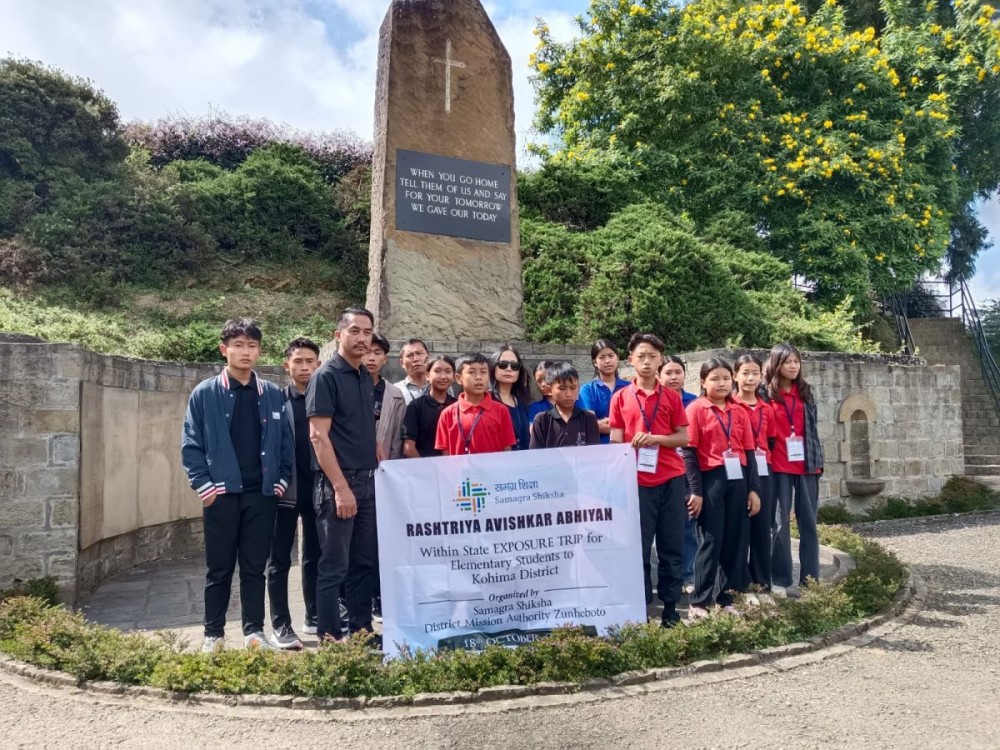
Students of GHSS Pughoboto exposure trip to Kohima War Cemetery. (Photo Courtesy: DEO Zunheboto)
• District has 218 government schools against 52 private institutions
• Education department reports 17,854 students across the district
Tokavi K Zhimo
Zunheboto | November 12
Government schools in Zunheboto district account for more than four times the number of private schools, yet private institutions enroll more than twice as many students, according to figures presented by the District Education Department, Zunheboto during the District Development Coordination and Monitoring Committee (DISHA) meeting held here on November 10 at the Deputy Commissioner conference hall, Zunheboto.
The figures, presented by Uketo Yeptho, Assistant District Coordinator, DMA, during a presentation on the activities, functioning and overall status of schools across the district from April 2025 to March 2026, highlighted a significant disparity in student enrolment between government and private educational institutions.
According to the presentation, government schools have an enrolment of 5,544 students, while private schools account for 12,310 students, taking the district's total enrolment to 17,854 as per the Unified District Information System for Education Plus (UDISE+) 2025-26.
The presentation listed 218 government schools and 52 private schools across the district, taking the total number of institutions to 270. Government schools comprise 104 primary schools, 77 middle schools, 21 high schools and five higher secondary schools, while the private sector has eight primary schools, 13 middle schools, 24 high schools and seven higher secondary schools. Yeptho clarified that 10 GPS and one GMS had been closed down this year alone.
Despite the numerical dominance of government institutions, the enrolment figures indicate that private schools account for approximately 69% of the district’s total student population, compared to around 31% in government schools.
The department's figures also showed that government schools have 1,646 teachers, against 775 teachers in private schools, indicating a considerable difference in the distribution of teaching personnel in relation to student enrolment.
Zunheboto block recorded the highest combined enrolment, with 9,821 students across 76 schools, comprising 2,061 students in government schools and 7,760 in private institutions. The block has 51 government schools and 25 private schools, with combined teacher strength of 953.
Akuluto block recorded 2,600 students across 50 schools, including 1,184 in government schools and 1,416 in private institutions. It has 42 government schools and eight private schools, with 438 teachers.
Aghunato block recorded 2,082 students across 59 schools, with 802 in government institutions and 1,280 in private schools. The block has 53 government schools and six private schools, with 346 teachers.
Satakha recorded 1,706 students across 48 schools, including 743 in government schools and 963 in private institutions. It has 41 government schools and seven private schools, with 359 teachers.
Pughoboto block recorded 1,645 students across 37 schools, with 754 in government schools and 891 in private institutions. The block has 31 government schools and six private schools, with 325 teachers.
The presentation also detailed the implementation of various activities under Samagra Shiksha for the financial year 2025-26.
Under the Composite School Grant, 156 government schools received Rs 10,000 each, 56 schools received Rs 25,000 each, five schools received Rs 50,000 each and one school received Rs 75,000. The department reported that a total of Rs 32.85 lakh was received by 218 government schools.
Under the Youth and Eco-Club initiative, 114 government primary schools received Rs 2,500 each, 78 government middle schools received Rs 7,500 each, and 26 government high and higher secondary schools received Rs 12,500 each. The total amount released under the initiative was Rs 11.95 lakh.
For sports and physical education, 77 government middle schools received Rs. 5,000 each, while 114 government primary schools received Rs 2,500 each, amounting to Rs 6.70 lakh for 191 elementary government schools.
The presentation also highlighted self-defence training for girls, with seven government middle schools receiving Rs 3,500 each for conducting the programme.
Under the residential education component, the NSCBV Residential Hostel in Zunheboto with an intake capacity of 50 students’ is currently accommodating 48 Urban Deprived Children (UDC). The hostel provides residential accommodation, nutritious meals and academic support, alongside regular monitoring of students' health, hygiene, attendance and overall well-being.
The department also highlighted on practical and vocational learning opportunities in schools. At the elementary level, pre-vocational activities include soap and dishwash making, traditional grain grinding and winnowing, bamboo basket making etc.
At the secondary level, vocational education is being implemented in 10 government schools through different trades including Government Higher Secondary School (GHSS) Aghunato offers automative and electronics courses, while GHSS Zunheboto provides information technology, healthcare and multiskilling. Government High School (GHS) Shovishe offers automative and retail, while GHS Atoizu and GHS VK offer automative courses.
GHS Ghathashi provides plumbing, GHS Ighanumi offers beauty and wellness, GHSS Akuluto provides plumbing and bookkeeping, GHS Suruhuto offers electronics, and GHSS Satakha provides plumbing and bookkeeping.
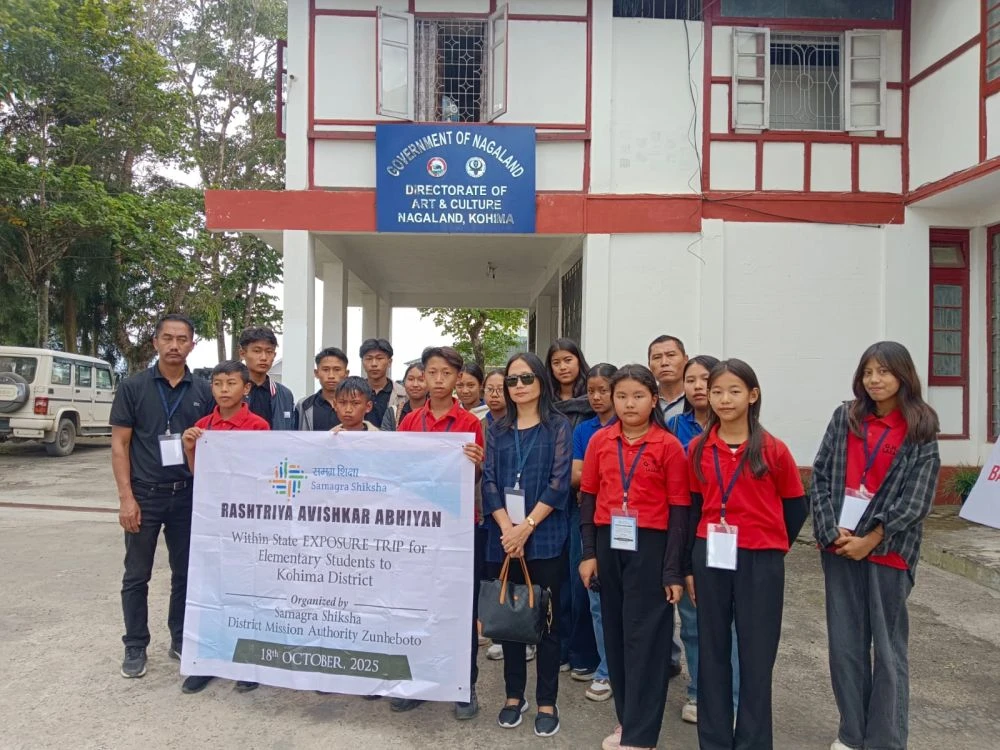
The district also recorded an achievement in Kala Utsav, with Zunheboto winning the state-level Visual Arts 3D category and participating at the national-level event held in Pune in December 2025. Students of GHSS Pughoboto also undertook an exposure trip to the Kohima War Cemetery and State Museum in Kohima.
This is the first report in a series on the activities, functioning, and overall status of the District Education Office, Zunheboto. Subsequent reports will cover other key findings, challenges, and developments within the department.