Dr N Janbemo Humtsoe
Climate Reality Leader, Wokha
“Etsutchukha” is a familiar and widely recognized name among the citizens of Wokha. Even those who may never have seen the lake in person have certainly heard of it. The pond is believed to have been dug by the early British administrators who established Wokha as headquarters of the Naga Hills in 1876. The name itself reflects history. “Etsu” referring to the British and “tchukha” meaning pond, thus literally signifying a pond created by the British.
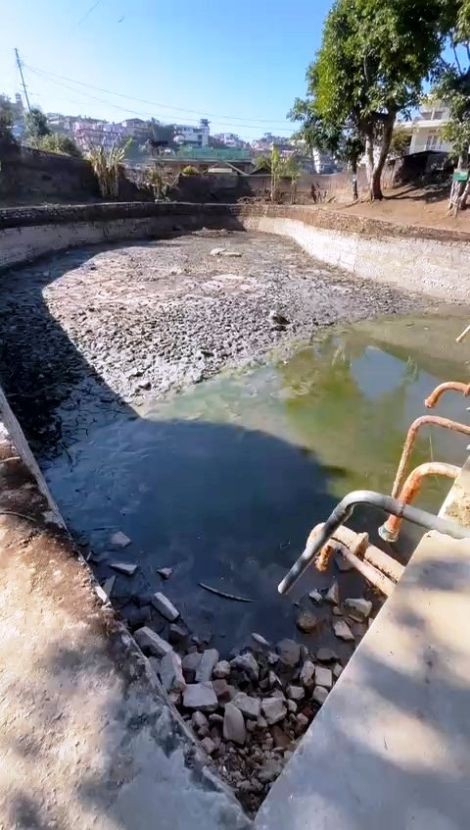
For decades, Etsutchukha Lake has quietly sustained Wokha Town. Through changing seasons and growing populations, it remained a dependable, perennial source of water, especially during the lean months. However, that quiet assurance has now been shattered in 2026, as the lake has almost completely dried up. What was once unthinkable has become a stark reality, and it should deeply concern every resident, administrators and policymaker in the state.
In recent years, the water level of Etsutchukha Lake has been steadily declining, with the most visible stress appearing during the dry season. This year’s near-total drying is not a sudden natural disaster; it is the cumulative result of sustained pressure on a fragile hydrological system. Many locals point to the proliferation of private bore wells in the vicinity of the lake as a major cause. Their concern is not without scientific basis.
Perennial lakes in hill towns like Wokha are rarely fed by surface water alone. They depend heavily on underground aquifers. In simple terms, underground aquifers are like natural water storage tanks beneath the ground. Rainwater slowly seeps through the soil and rocks and gets stored there over time. This stored water does not stay still; it moves very slowly and feeds springs, ponds, and lakes throughout the year, even when there is no rain. Because this recharge happens gradually, aquifers take a long time to refill. When too much water is pumped out quickly, say, through bore wells, the underground storage drops, and the springs and lakes that depend on it begin to dry up.
It is important to note that groundwater is not infinite. Aquifers are renewable only if recharge is allowed to keep pace with withdrawal. In hard rock and hill terrains like Nagaland, recharge is slow and storage is limited as steep slopes promote high surface runoff. Therefore, once the aquifers are depleted, recovery can take years or even decades. With the growing population on the one hand and the absence of adequate public water supply facilities on the other, dependence on groundwater has increased significantly. This rising pressure on underground water resources has led to excessive extraction, resulting in a steady decline in water levels.
The drying up of Etsutchukha Lake is therefore not merely a local dispute or a seasonal inconvenience; it is a clear warning signal. If a lake that sustained Wokha for decades can disappear all of a sudden, then no spring, stream, or water source can be considered safe. Etsutchukha is only the tip of the iceberg. Unless underground water extraction is brought under proper regulation, or unless an alternative source of drinking water is explored, many more ponds, springs, and traditional water sources will inevitably follow the same path toward depletion.
In Nagaland, Article 371A of the Indian Constitution vests ownership of land and its resources with the people. Over time, this constitutional safeguard has often been interpreted to mean that individuals may exercise unrestricted control over resources found within their private property. Bore well extraction also falls into this grey area. Many private landowners believe that drawing water from beneath their land is entirely their right. While this view may hold legal weight in terms of land ownership, water itself is a common good. Therefore, when private extraction affects public access to water due to drying up of lakes, springs, and community sources, it ceases to be a purely private matter. Individual rights over land must therefore be balanced with collective responsibility, especially when the survival of shared water resources is at stake.
In traditional Naga practice, water, whether in ponds, streams, or springs, has always belonged to the community. The idea of privatizing water resources was virtually unheard of, as access to water was governed by shared use and collective responsibility. To this day, the numerous village ponds do not belong to the individual land owner but are considered a public property. Any member of the village is permitted to fetch water from any of the village ponds. In this context, the commercialization or private control of community ponds and streams runs contrary to Naga customary practices and values, which emphasise stewardship, equity, and the common good over individual profit.
Towards this end, Etsutchukha can be recognized as a common heritage and common responsibility. A local water management committee involving district administration, technical experts and community leaders can help monitor extraction, spread awareness, and ensure compliance rooted in shared values and sustainability. Without regulation, the current practice effectively transfers a shared public resource into private profit, while the cost of scarcity is borne by all. Hence, not only in the Etsutchukha area, but across the entire town, bore-well owners must be restricted to using groundwater strictly for personal and household consumption, and not for commercial sale or profiteering.
Conservation ultimately depends on our attitude. Water drawn for private comfort at the cost of public survival is not progress; it is shortsightedness. Responsible use, guided by ethics and intergenerational concern, must become part of public discourse. The story of Etsutchukha is not just about water, it is about how we relate to nature, to one another, and to the future. A perennial source has fallen silent. Whether it remains a symbol of neglect or becomes an emblem of collective responsibility now depends on the choices we make, urgently, wisely, and together.