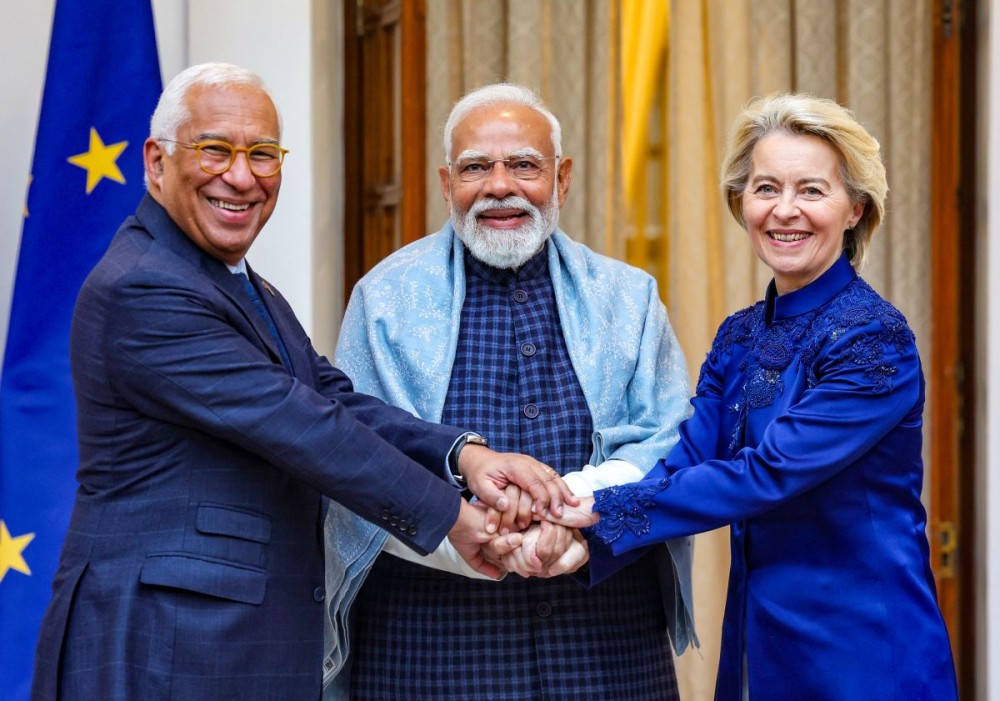
New Delhi: Prime Minister Narendra Modi joins hands with President of the European Council António LuÃs Santos da Costa and President of the European Commission Ursula von der Leyen during a meeting at Hyderabad House, in New Delhi on Tuesday, January 27, 2026. (Photo: IANS/PMO)
New Delhi, January 27 (IANS) European Commission President Ursula von der Leyen announced on Tuesday the successful conclusion of the India-EU free trade agreement, referring to the pact “as the mother of all deals”.
“Europe and India are making history today. We have concluded the mother of all deals. We have created a free trade zone of two billion people, with both sides set to benefit,” the EC President wrote on X.
“This is only the beginning. We will grow our strategic relationship to be even stronger,” she remarked.
By removing tariffs on 97 per cent of India’s exports, the deal will provide a huge boost to Indian manufacturing -- especially in textiles, gems, and leather -- while opening India’s market to European cars and machinery.
European Council President Antonio Costa also stated that he was looking forward to “a stronger partnership between the European Union and India, based on shared values and heightened ambition”.
“Today is about delivering tangible benefits for our citizens. Working together towards our shared prosperity and security and showing leadership on global issues to shape a resilient multipolar global order,” he added.
The summit at Hyderabad House marks the end of an 18-year journey, as India and the European Union officially finalised their Free Trade Agreement. Prime Minister Narendra Modi hosted European Commission President Ursula von der Leyen and Council President Antonio Costa, and hailed the pact as a "perfect example of partnership" between two global giants.
PM Modi hosted the 16th European Union-India Summit in New Delhi with President of the European Commission Ursula von der Leyen and visiting President of the European Council, Antonio Costa, to announce the 'mother of all trade deals'.
The deal is expected to come into effect sometime next year. The FTA is expected to bring a qualitative change in deepening the overall bilateral ties in a range of sectors.
The broad focus of the Tuesday meeting was on trade, defence and security, climate change, critical technologies and strengthening the rules-based global order. The two sides are also set to unveil a defence framework pact and a strategic agenda. The new partnership comes at a time when Europe is seeking to reduce its dependence on the US and China and deepen its diplomatic and economic ties to other regions.