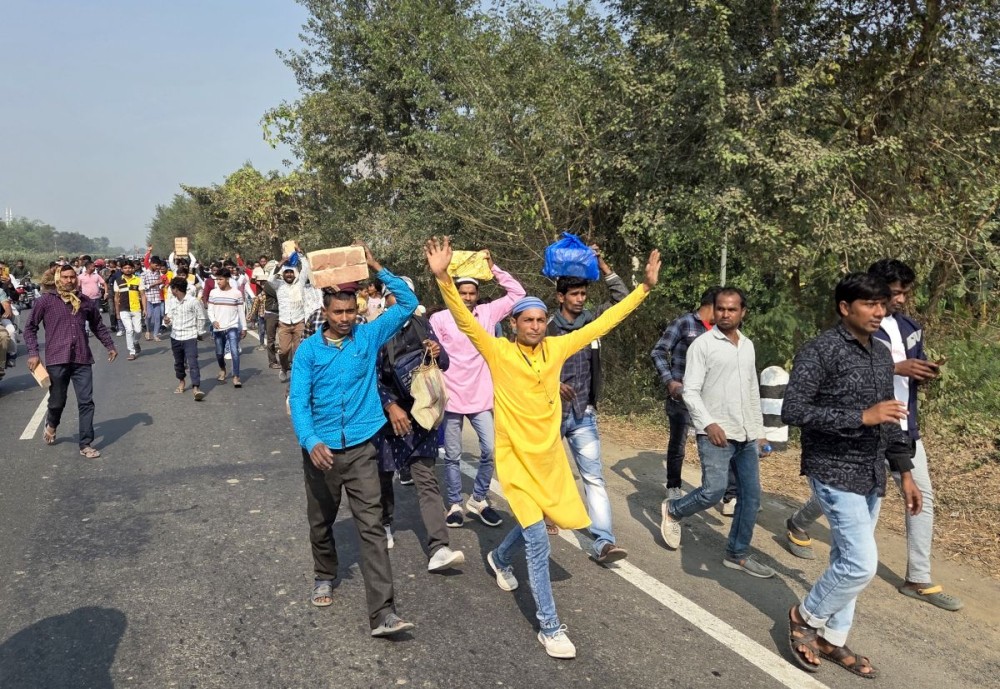
Murshidabad: People carry construction materials to the site of the foundation-laying ceremony of the Babri Masjid in Beldanga, Murshidabad, on Saturday, December 06, 2025. (Photo: IANS)
New Delhi, December 7 (IANS) On Mahaparinirvan Diwas -- when the nation pauses to honour Bharat Ratna Babasaheb Dr B.R. Ambedkar, the principal architect of India's Constitution -- a different spectacle unfolded in Murshidabad, West Bengal. Suspended Trinamool Congress legislator Humayun Kabir chose this solemn day of December 6 to lay the foundation stone for the 'Babri Mosque'.
Kabir declared that he was exercising his "constitutional right" and that nothing about the event violated the law. He even suggested that the state government supported him.
He said anyone can build a temple, church or mosque anywhere in the country. He has the right to do so, but intention matters, context matters, and timing matters even more.
Kabir invoked the Supreme Court's 2019 Ayodhya verdict, claiming it "acknowledged the demolition of the Babri Masjid" and did not bar the construction of a mosque elsewhere. But this was not an act of spiritual reconstruction. It was a political provocation crafted with precision.
The 2019 Supreme Court judgment -- which resolved the long-disputed 2.77-acre Ayodhya site -- was accepted across the spectrum because it came after exhaustive judicial scrutiny.
The Court recognised that a historic wrong had occurred, and it provided a pathway for closure. The Ram Temple has since been built.
The matter, for most Indians, had moved from agitation to acceptance. For six years, despite political attempts from various quarters, December 6 had begun losing its sting. The date no longer dominated headlines.
The country had, in its own way, allowed a difficult memory to fade into history. Until now. With Assembly elections approaching in West Bengal, Kabir has suddenly rediscovered Babri.
Backed subtly by his party and the state machinery, he mobilised crowds and triggered a deliberate political spectacle. His foundation-laying ceremony attracted thousands of Muslims carrying red bricks on their heads as if participating in a choreographed show of defiance, thereby putting December 6 back into the vortex of polarisation.
Every year, December 6 forces India to confront two contrasting histories. One marks the demolition of the Babri Masjid in 1992. The other marks the passing of Ambedkar in 1956 -- the man who built the intellectual and moral scaffolding of modern India. Ambedkar belongs to every Indian.
Babri, on the other hand, represents one of India's most divisive moments. When a political actor chooses Babri over Ambedkar on this day, the message is loud: division matters more than unity; provocation matters more than constitutional morality. Is it politics in the garb of religious assertion? Kabir's intention is no mystery.
Religion remains the most reliable tool to whip up emotions and herd voters toward political agendas. West Bengal’s upcoming Assembly elections are crucial for Mamata Banerjee's Trinamool Congress and are equally strategic for the BJP -- which seeks to expand its footprint in the state.
The unfortunate part is not merely that Kabir invoked Babri. It is that he chose December 6, a day that should remind India of Ambedkar’s vision -- of justice, equality, liberty and fraternity.
Instead, he reignited a symbol of communal division. The equation today appears to be like Ambedkar vs Babri, and the question is what must India choose? The Babri dispute -- its aftershocks were absorbed through commissions, courtrooms and, finally, closure. Ambedkar's ideas did not inflame passions, and he warned repeatedly against majoritarianism, communalism and the misuse of identity politics. And this is exactly what Humayun Kabir's actions imply.
Kabir's political theatrics pull India toward its worst impulses, not its best. They revive a symbol of division at the cost of a statesman who fought tirelessly to unite the fractured soul of the nation.
India is a young nation, but an ancient civilisation. Its challenge is to choose stability over sentiment, foresight over frenzy. If December 6 becomes merely a day of communal recall, India loses an opportunity for introspection. But if it becomes a day to revisit Ambedkar’s vision, India gains direction -- and dignity. Which is why Humayun Kabir's stunt deserves to be called out for what it is: a deliberate attempt to drag the state back into a manufactured conflict. Who benefits from stoking an old wound just before elections? The Trinamool Congress cannot wash its hands of this either.
Kabir may be suspended on paper, but the mobilisation, the machinery and the atmosphere surrounding the event tell another story. If the party truly disapproved, how was such a massive gathering allowed to take shape? Why was a day dedicated to Ambedkar permitted to be hijacked for a polarising spectacle? These are questions not just for Kabir, but for Mamata Banerjee and her government. If they claim to stand for constitutional values, then why endorse an act that undermines the very ideals Ambedkar lived and died for?