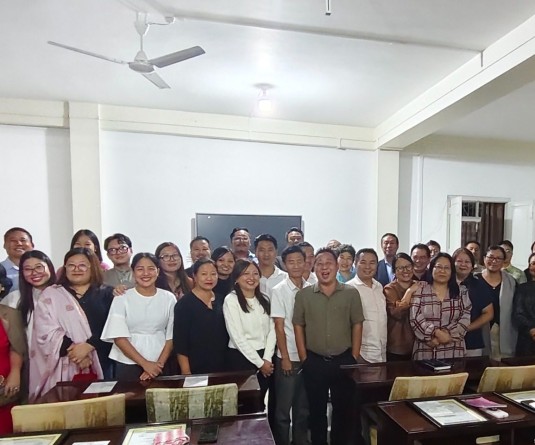
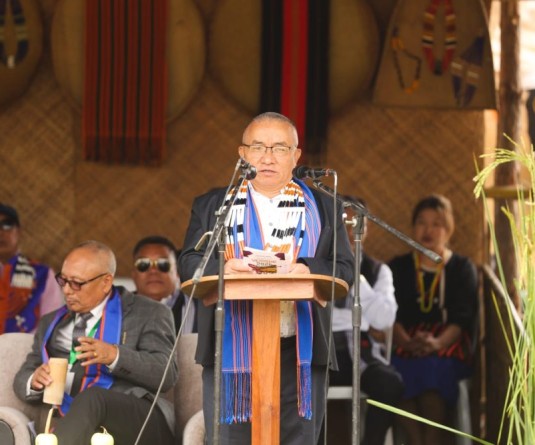
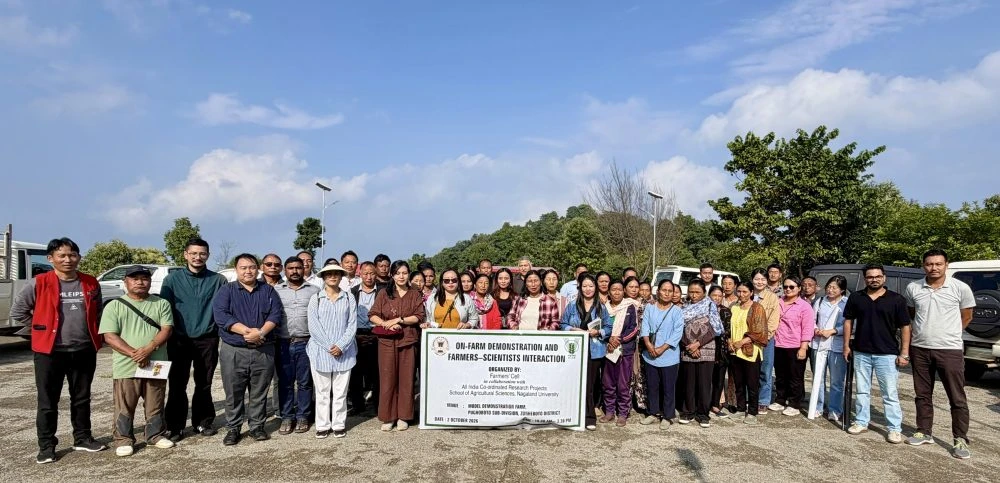
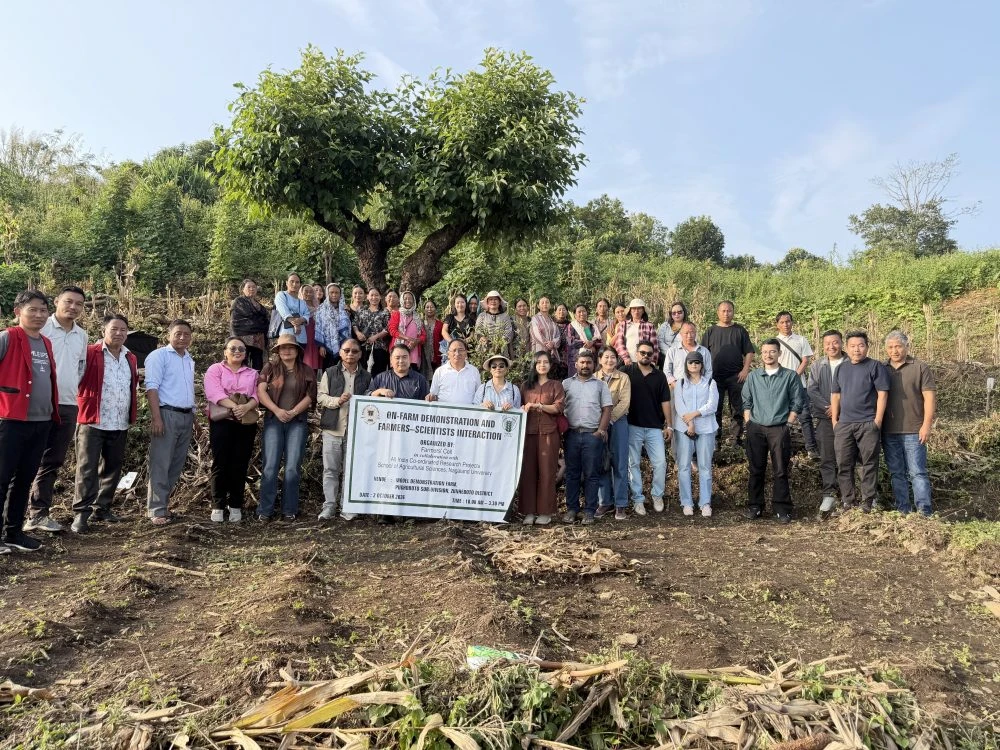
Officials along with the participants during a farmers-scientist interaction programme held at the Model Demonstration Farm, Pughoboto Sub-Division, on October 2.
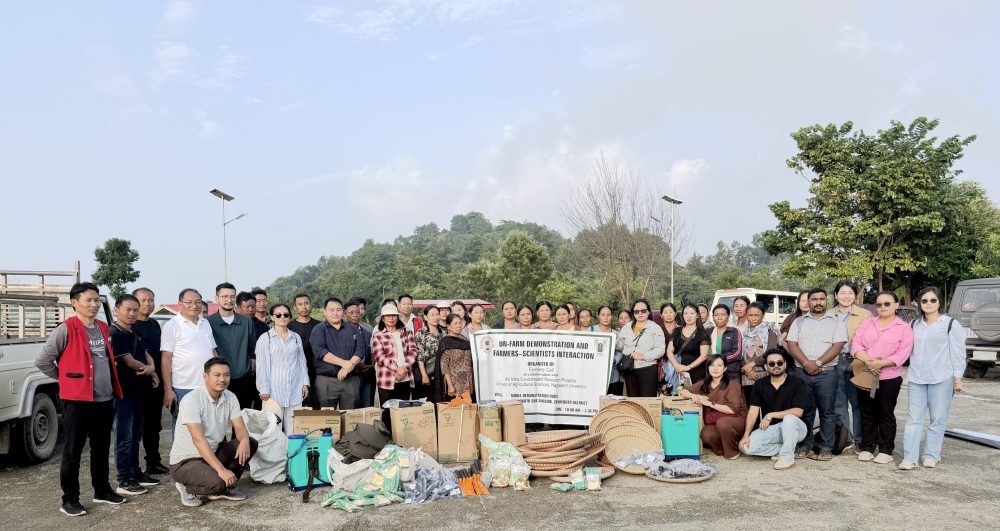
Pughoboto, October 4 (MExN): The Farmers' Cell, in collaboration with the All India Coordinated Research Projects (AICRPs), School of Agricultural Sciences (SAS), Nagaland University, Medziphema Campus, conducted an on-farm demonstration and farmers-scientist interaction programme at the Model Demonstration Farm, Pughoboto Sub-Division, on October 2.
Around 40 farmers from Pughoboto and Mishilimi, along with village leaders from Mishilimi, Lazami, Natsumi and Pughoboto, participated in the programme, which provided an opportunity for field-based learning and interaction with agricultural experts.
The programme was organised as part of a collaborative initiative between the Sub-Divisional Planning and Development Board (SDPDB), Pughoboto, and the School of Agricultural Sciences, Nagaland University. The collaboration was initiated following an interaction between the SDPDB and SAS in March 2026, with the Model Demonstration Farm identified as an important area of joint activity.
Addressing the gathering, Yithachu Thur, SDO (Civil), Pughoboto, encouraged farmers to make use of the technical knowledge and practical experience shared by the experts. He also highlighted the development of the Model Demonstration Farm through the initiative of SDPDB, Pughoboto, in collaboration with SAS.
Dr Mary N Odyuo, Associate Professor and Farmers' Cell In-Charge, introduced the team of experts and briefed the farmers on the day's activities. She encouraged farmers to view agriculture as a field combining science, art and business, and emphasised the importance of continuously updating their knowledge and adopting scientific practices suited to local farming conditions.
Dr Virosanuo Solo, Scientist, AICRP Linseed, introduced linseed cultivation and shared results of successful Front Line Demonstrations conducted in Niuland and Longleng districts and at the SAS farm.
As linseed is a newly introduced crop in the area, the session generated interest among farmers, who expressed willingness to take up its cultivation. She also highlighted its potential use for decorative purposes in the floriculture sector.
Dr Pezangulie Chakruno, Scientist, AICRP Soybean, discussed soybean production and crop management practices. She shared information on improved soybean varieties and ongoing research involving the evaluation of more than 400 soybean germplasm lines at the SAS, Medziphema Campus, as well as technology transfer to farmers in different districts of Nagaland.
Dr Rokozeno, Scientist, AICRP Kharif Pulses, presented research results from trials conducted in Zunheboto, Niuland and other locations in Nagaland. He explained the importance of pulses in improving soil fertility and their nutritional value as a source of protein.
Pigeon pea or arhar was also introduced as a potential crop for the area. As farmers had not previously cultivated it on a significant scale, the discussion generated interest in exploring the crop.
Dr Debika Nongmaithem, Assistant Professor, Department of Agronomy, discussed the importance of sesame and conducted a practical demonstration of seed treatment using biofertiliser. She demonstrated the process of mixing biofertiliser with seed and explained the use of jaggery solution in seed treatment. Farmers actively participated in the demonstration and expressed interest in trying sesame cultivation.
Dr Ashwini Ananda, Scientist, AICRP Vegetable Science, highlighted the importance of vegetables in the human diet and their potential to improve household livelihoods. A practical demonstration on nursery bed preparation, including appropriate spacing and other recommended practices, was also conducted at the Model Demonstration Farm.
Dr Sabbithi Pavan, Assistant Professor, Department of Entomology, spoke on Integrated Pest Management (IPM), timely identification of beneficial and harmful insects and the importance of using suitable, disease-resistant and location-specific seed varieties for healthy crop growth and better yields.
Dr Lizabeni Kithan, Guest Faculty, Department of Agronomy, also participated in the farmer-scientist interaction.