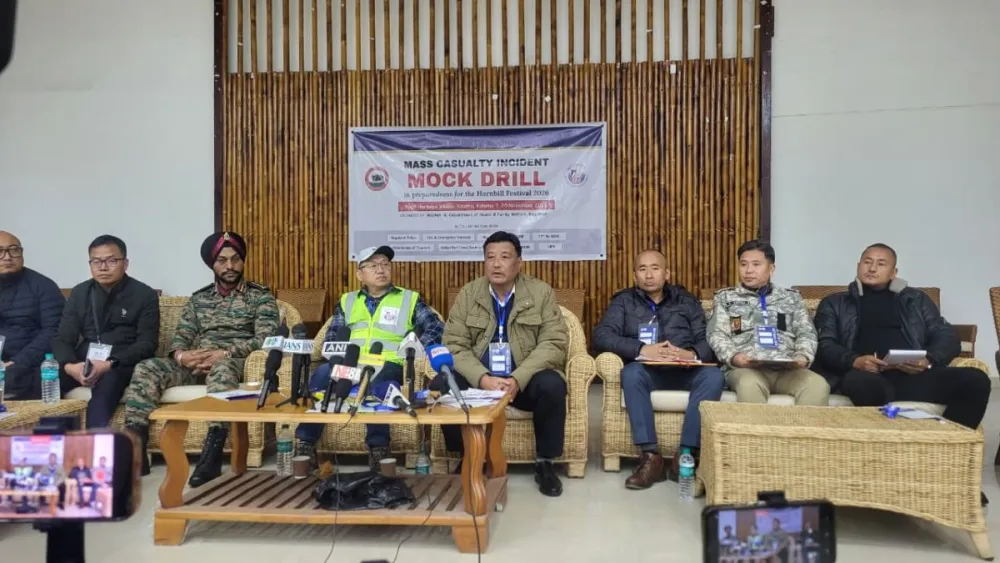
CMO Kohima Dr Leamnyei Konyak and others during the press conference on November 20. (Morung Photo)
Morung Express news
Kohima | November 20
Government agencies today emphasised the need for a coordinated approach among all stakeholders towards responding to disaster-related casualties to ensure timely action and reduce the burden on individual responders.
The emphasis came during a live Mass Casualty Incident (MCI) Mock Drill conducted at Naga Heritage Village, Kisama, as part of preparedness measures ahead of the Hornbill Festival 2026. The exercise was initiated by the Department of Health and Family Welfare, Government of Nagaland, with support from the Nagaland State Disaster Management Authority (NSDMA).
The mock drill simulated a bomb hoax and subsequent stampede during an inaugural ceremony at the Heritage Village, resulting in 30 simulated casualties. The exercise tested the response capabilities of participating departments and agencies in handling a mass casualty situation, including emergency response, rescue operations, medical assistance, casualty evacuation, triage and inter-agency coordination.
Agencies from the civilian, military and paramilitary sectors also participated in the exercise to establish a common platform for coordinated response and management.
During the exercise, NSDMA, District Disaster Management Authority (DDMA), Deputy Commissioner, Police, Traffic Police, 154 General Hospital, Zakhama, SDRF, Fire and Emergency Services, Red Cross and volunteers from Kigwema and Phesama were present.
Addressing media after the exercise, Chief Medical Officer (CMO), Kohima, Dr Leamnyei Konyak, said the involvement of multiple agencies was particularly significant as the Health Department had traditionally shouldered much of the responsibility during mass casualty incidents, including earthquakes and landslides.
He said the participation of various departments and organisations has helped ease the burden of each responders.
Explaining the rationale behind the exercise, State Nodal Officer, Department of Health & Family Welfare noted the forthcoming Hornbill Festival brings large gatherings of people, making it necessary for agencies to be prepared for possible emergencies such as stampedes, fire incidents and other unforeseen disasters.
The simulated casualties were categorised under the standard triage system of red, yellow, green and black, based on the severity of injuries and medical requirements. The exercise also incorporated procedures for the safe evacuation of VVIPs in the event of an emergency.
While describing the exercise as a successful and valuable learning experience, Kikon acknowledged that certain areas required further refinement. He also informed that observers were deployed at various locations, including the staging area, Naga Hospital Authority, Kohima, 154 General Hospital, PHC at Jakhama, Kimifuphe and other private hospitals, to assess different aspects of the response.
“The observations and findings will be consolidated to identify gaps, strengths and areas requiring improvement, Kikon said adding that the exercise was not intended to demonstrate a perfect response but to help agencies assess their preparedness and improve existing standard operating procedures.
The nodal officer meanwhile stressed that although the mock drill was based on a pre-planned scenario, an actual disaster could occur without warning.
“In such circumstances, an effective command and control structure, seamless communication and clearly defined responsibilities at all levels would be crucial in ensuring a timely and coordinated response,” he further added.