Hasina's return bid, Ganges treaty deadline pose twin challenges for Dhaka and New Delhi (File photo)
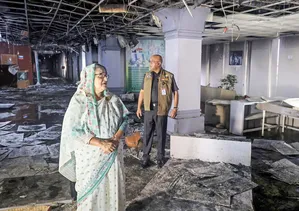
New Delhi, November 18 (IANS): Bangladesh is experiencing a wave of political turbulence marked by street violence, arson, and clashes with the police, say reports from Dhaka.
On the one hand, ready-made garment (RMG) workers are demanding a wage hike in a nationwide stir. On the other hand, Awami League supporters are said to be mobilising a groundswell in anticipation of their leader and former Prime Minister Sheikh Hasina’s anticipated return from exile sometime next month.
The 79-year-old deposed Premier was sentenced to death in absentia by Bangladesh's International Crimes Tribunal a year ago for alleged crimes against humanity.
The charges are related to the crackdown on protesters undertaken by her regime in July-August 2024, which Hasina has rejected.
She has since repeatedly announced her intention to return to Bangladesh and face legal proceedings, despite the death sentence.
While Hasina has offered to return, she and other Awami League leaders are prepared to surrender before the courts; Dhaka has demanded extradition only, with government voices implying carrying out the death sentence.
Now, renewed demonstrations mark rising political tensions as the Bangladesh Nationalist Party (BNP) government of Prime Minister Tarique Rahman tries to grapple with the situation.
Meanwhile, with less than a month before the Ganges Water Sharing Treaty expires, uncertainty hangs over the future of India-Bangladesh talks.
An article in Bangladesh’s ‘The Daily Star’ on Wednesday noted that India’s High Commissioner to Bangladesh, Dinesh Trivedi, had said on August 9 that a meeting between the respective Prime Ministers could help resolve bilateral differences.
“I think if the two leaders meet, a lot of problems can be solved,” he was quoted as having told reporters.
It also cited Humayun Kabir, former Bangladesh ambassador to the United States, who echoed a similar opinion while talking to the newspaper.
“If the two Prime Ministers meet, they can agree in principle to either extend it (Ganges Water Treaty) for another term, or extend it for a short-term pending a new agreement, or even think of extending it for a year or two to review the same,” he had said.
In August, a BBC report observed, “India is keen to host the leader of its eastern neighbour for talks – and the timing matters,” adding, “This would be Rahman's first visit since taking office after his Bangladesh Nationalist Party (BNP) won a landslide victory in parliamentary elections in February.”
As of the time of writing, Dhaka is yet to respond to New Delhi’s multiple calls of invitation.
On Dhaka’s principal demand, as the National University of Singapore’s Institute of South Asian Studies summarised this August, “Bangladesh has long sought India’s extradition of Sheikh Hasina. Her announcement that she plans to return to Bangladesh could further unsettle the country’s politics and strain India-Bangladesh relations”, implying the inherent dilemma.
While the country has remained politically polarised since Hasina’s ouster in August 2024, recent unrest has intensified as her declared plan to return from exile sometime in December has moved from speculation to a realistic political scenario.
As one Awami League leader stated, their future depends on the return of their leader to Bangladesh and the course it then follows.
Meanwhile, BNP leaders have alleged the hand of the Awami League in trying to destabilise the country ahead of Hasina’s return.
While authorities claim her return bid as a destabilising effort by a banned political force, Awami League supporters portray the former Prime Minister as seeking a legal and political comeback, rejecting allegations that she is orchestrating violence from exile.
Analysts say Bangladesh’s current situation has arisen from multiple causes, where labour unrest, economic pressures, unresolved grievances from the 2024 uprising, and the exclusion of the Awami League from formal politics have all apparently contributed to a volatile environment.
For Dhaka, RMG workers’ protests also need urgent attention as the sector accounts for more than four-fifths of Bangladesh’s export earnings, making any disruption a matter of national economic concern, point out reports.