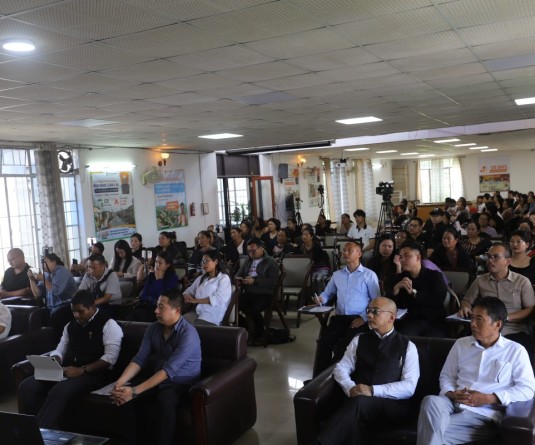
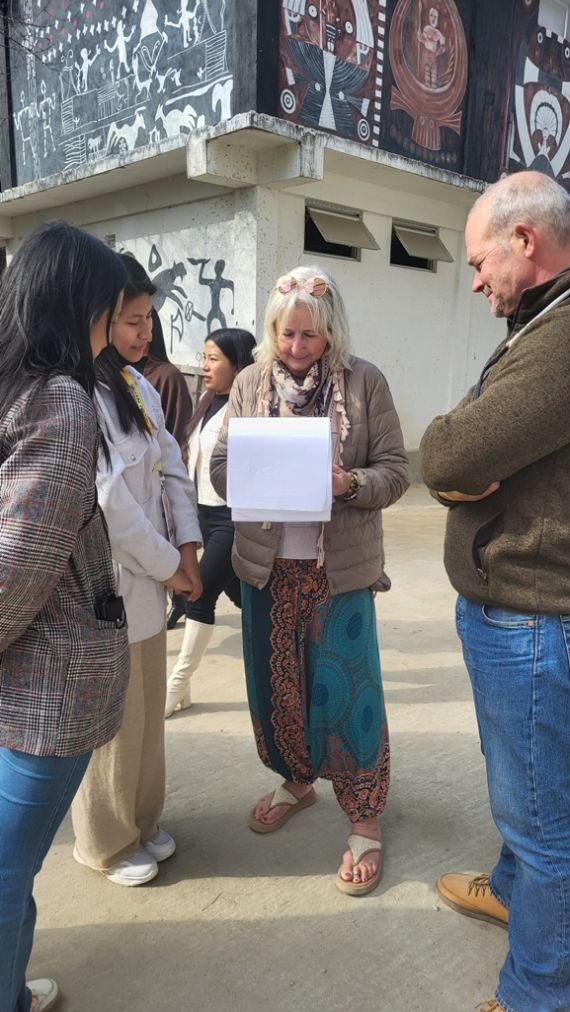
Researchers from Kohima Science College (Autonomous) interact with foreign tourists during an impact assessment survey of the Hornbill Festival at Naga Heritage Village, Kisama. (Morung Photo)
Morung Express News
Kohima | December 3
Beyond the numbers, the Hornbill Festival 2024 received accolades from tourists, yet an impact assessment also highlighted persistent on-site issues.
The Impact Assessment of the Hornbill Festival 2024, conducted by a team of researchers from Kohima Science College (Autonomous), Jotsoma, recorded total revenue of Rs 189.71 crore and a 33% increase in tourist footfall, with visitors from 38 countries and 31 Indian states.
The study, sanctioned by the Government of Nagaland’s Tourism Department, also estimated that the festival generated employment for over 1,400 people and captured both positive and negative feedback from foreign and domestic tourists.
The research team is also conducting a similar assessment for the 26th Hornbill Festival to gauge its economic impact and visitor perception.
Principal Investigator Dr Wenyitso Kapfo, Associate Professor in the Botany Department at KSC, informed that field assistants, primarily postgraduate students, are collecting data throughout the 10-day festival at the venue and surrounding areas.
In 2024, 183 foreign tourists and 1,094 domestic tourists participated in the survey. Case studies focused on the Bamboo Pavilion, tribal Morungs, and accommodation facilities around Kisama.
Dr Kapfo explained that this year’s study will follow last year’s baseline, with some additional parameters and indicators.
Springfest Model and new indices for 2025
A new addition, the Associate Professor shared, is the assessment of non-monetary impacts.
The study will assess the festival’s economic impact and tourist perceptions, using ten parameters including festival quality, hygiene, toilet facilities, local transportation, cultural experience, landscape, and food, he added.
Both foreign and domestic tourists are being interviewed for the report, he said, noting that 2025 marks the fourth formal Impact Assessment.
Dr Kapfo further informed that the study employs the “Springfest Model,” a standard method developed in Oregon, USA, to measure the economic impact of cultural events. The model is considered suitable for assessing the economic and cultural impact of the Hornbill Festival.
Tourist spending is being collected through questionnaires covering accommodation, food, beverages, shopping, souvenirs, and local transportation.
Bouquets and Brickbats
According to last year’s study, most tourists spent between Rs 5,000 and Rs 20,000. The 20th edition in 2024 drew 2,500 foreign and 56,217 domestic tourists.
Visitor satisfaction is measured on a perception scale ranging from 1 (very poor) to 7 (fantastic). The research team aims to collect data from 1,500 participants, using statistical methods to calculate averages, standard deviations, and expenditure categories ranging from Rs 5,000 to Rs 1 lakh.
The study also relied on Tourism Department data regarding the total number of visitors, which helps estimate overall economic revenue by multiplying average spending per tourist by total attendance.
In addition to economic analysis, case studies examined specific aspects such as homestays, vendors at the Kisama venue, parking facilities, and vehicle movement.
These are compared with previous assessments to track improvements or persistent challenges, including high local transportation costs, traffic congestion, and festival expenses.
Beyond the economic impact, the study revealed both positive feedback and areas needing attention.
While 90% of tourists rated the festival as “fantastic,” major areas of concern included inadequate information and signage, insufficient hygienic washrooms, limited vegetarian food options, better taxi services, and over-commercialization.
Other suggestions included providing Wi-Fi services, more polite entry staff, greater use of modern technology, and reducing excessive VVIP treatment.