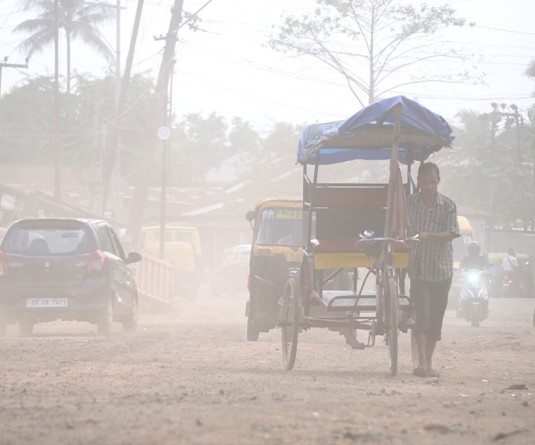
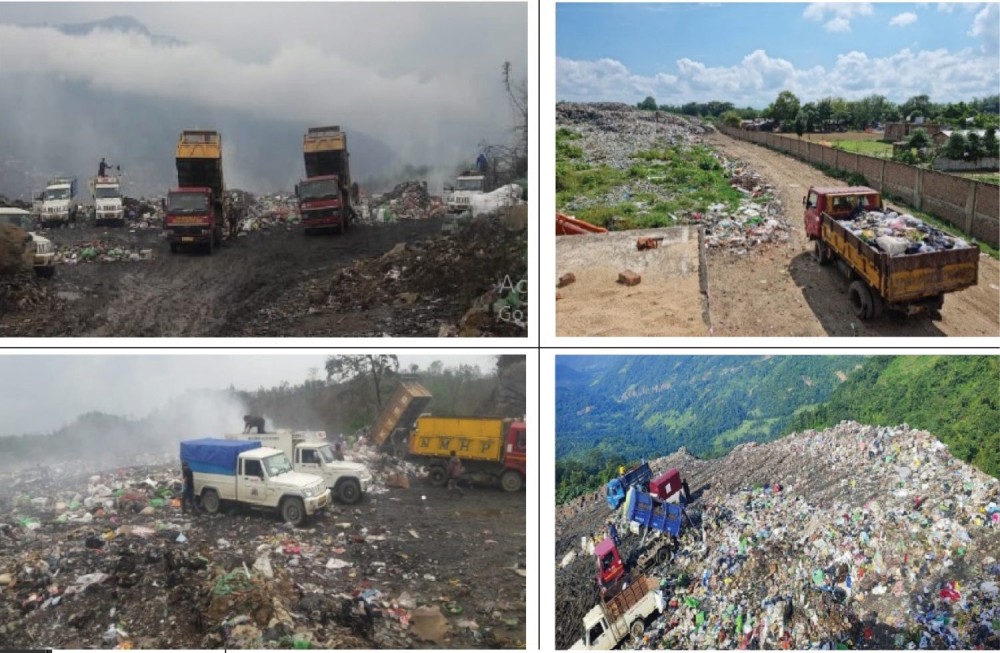
Waste collected by ULBs being dumped in “unsanitary landfill/dumpsite,” as it appears in the CAG report for the year ending March 31, 2023. (Source: CAG)
Morung Express News
Dimapur | March 30
The Comptroller and Auditor General’s ( CAG) performance audit covering six Urban Local Bodies in Nagaland from April 2017 to March 2023 found a waste management system that fails at many stages.
The state spent Rs 33.58 crore on solid waste management across six ULBs over 6 years. However, the CAG found that 43% of waste vehicles operate without registration, a Rs 48.63 crore processing plant in Kohima sits non-functional, biomedical waste from hospitals is turning up in open dumpsites, and nearly half the capacity building funds sanctioned under Swachh Bharat Mission were diverted to pay data entry honorarium.
The report indicates that Nagaland does not know how much waste its towns generate. Not a single ULB has a weighbridge at its dumping site. All figures submitted by ULBs and the Nagaland Pollution Control Board are per capita estimates, a method the government's own Service Level Benchmark handbook rates as having low reliability. The CAG found the figures submitted by ULBs and NPCB "were at variance with the audit estimation" and "not realistic."
The data conflict between the two state bodies is stark. For 2020-21, the six sampled ULBs generated 213.96 tonnes per day. NPCB reported 286.60 tonnes per day for the same area. This is a difference of 72.64 tonnes. When the CAG asked for an explanation, it emerged that the NPCB does not independently measure waste.
The CAG said that the government accepted the finding and assured instructions would be issued to ULBs for "realistic quantification."
Figures on special waste (biomedical, e-waste, construction and demolition) were not available with either the ULBs or NPCB at all.
Plans? What Plans?
During the entire audit period from 2017-18 to 2022-23, no ULB in Nagaland prepared a short-term waste management plan. None prepared a long-term plan. The MSWM Manual requires short-term plans covering two to five years and long-term plans covering 20 to 25 years.
The CAG said that infrastructure decisions were "driven by perceived availability of funds rather than a need-based analysis."
The Government of Nagaland notified the Nagaland Integrated Waste Management Policy in 2019. The policy itself stated that a long-term strategy and action plan would be developed. When the government replied to the CAG in August 2023, it stated a short-term plan had been approved in June 2023, after the audit had already begun.
Contingency plans, required under the 2016 MSWM Manual for situations where disposal facilities stop functioning, were prepared by none of the sampled ULBs. When DMC sanitary workers protested non-payment of salaries in September-October 2022 and waste collection stopped, there was no protocol for temporary storage, the CAG said.
Detailed Project Reports for waste management were not prepared by any ULB during this period, except by Dimapur and Mokokchung Municipal Councils in 2018-19. The government reply that DPRs would be prepared when projects were sanctioned by the Ministry of Housing and Urban Affairs was rejected by the CAG as validating the fact that ULBs cannot act without central grants.
The CAG also noted that draft bye-laws prepared by ULBs, cleared by the Law and Justice Department, remain unnotified by the State Government as of October 2023. Without notified bye-laws, ULBs have no legal authority to impose penalties for non-segregation or non-payment of user charges.
Questions on Revenue
The CAG also noted that only one of the six sampled ULBs (Mokokchung Municipal Council) collected enough in user charges to cover its own revenue expenditure on solid waste management. Kohima Municipal Council collected Rs 4 lakh in user charges in 2022-23 against expenditure of Rs 69.52 lakh. Pfutsero Town Council collected zero in user charges for three consecutive years. The government attributed low collections to citizen reluctance. The CAG pointed out that without notified bye-laws, which the government had not issued, ULBs had no legal basis to compel payment or impose penalties.
Under SBM-U 2.0, Rs 78 lakh was sanctioned for capacity building across all ULBs. Of that, Rs 36.48 lakh (47%) was diverted to pay honorarium to employees for uploading data to the MIS system. The government cited Covid-era disruptions to training, but the CAG rejected this, stating that the SBM-U 2.0 funds were released after the pandemic. On the diversion itself, the government gave no reply.
Under SBM-U 1.0, Rs 95.71 lakh sanctioned for IEC activities was used instead to procure 11 waste management vehicles. The government described vehicle procurement as part of an awareness campaign. The CAG found this “unacceptable”. A further Rs 2 lakh released to DMC for a plastic-free IEC campaign in schools and religious places remained unspent as of March 2023, over three years after release.
Waste bins and sanitation vehicles worth Rs 4.75 crore were procured across six ULBs without open tender, without e-procurement, and without the Government e-Market portal, the AG found.
Procurement was restricted to limited quotations among a narrow group of firms, it added. The CAG found this "resulted in lack of competition and transparency in selection of the suppliers and prevented better price discovery." The government said it would adopt transparency in future.
Under SBM-U 2.0, Rs 156 lakh in scheme funds for SWM and water management projects remained unreleased to ULBs more than 12 months past the mandated release deadline.
43% of Waste Vehicles Unregistered
Of the 135 waste management vehicles operating across the six sampled ULBs as of March 2023, 58 to 43 per cent had no registration certificate, in direct violation of the Motor Vehicles Act 1988, the CAG found. It further noted that logbooks for these vehicles were not maintained. The government said registration is "in process."
Until 2019-20, 20 of Nagaland's 39 ULBs had no waste transportation vehicle at all. The shortfall was partially addressed using XIV Finance Commission grants, but as of March 2023, the existing fleet in sampled ULBs still fell short of assessed requirements by 39 per cent.
None of the 135 vehicles have GPS tracking devices. No ULB has CCTV cameras or weighbridges at disposal sites. There is no mechanism to track vehicle movement, confirm collection routes, or measure waste loads, the CAG reported.
Two road sweeping machines were purchased, one by DMC at Rs 66.64 lakh and one by KMC at Rs 170 lakh under the Smart City Mission. Physical verification found both machines are only occasionally used. The CAG noted they can only collect dry micro-particles on even surfaces and are "unsuitable for narrow, uneven and pot-holed roads." No government reply was given.
Effectively 0 Waste Processing
Across the six sampled ULBs, the share of collected waste that was processed between 2017-18 and 2021-22 was statistically zero, below 0.1 per cent in each of those five years. In 2022-23, it reached 6.5 per cent.
The CAG said that Kohima Municipal Council is the only sampled ULB with a proper processing facility: a 50 TPD compost plant and sanitary landfill built under an Asian Development Bank project, commissioned in February 2016 at a cost of Rs 48.63 crore. The plant was non-functional at the time of the audit. When the government cited inadequate facilities as the reason for low processing rates, the CAG's response was direct: "The reply is not tenable as the existing SWM plant in Kohima remains non-functional."
Outside Kohima, all landfill and dumping sites in the state were termed unsanitary by the CAG. Four of the six sampled ULBs generate more than five metric tonnes per day. Of those four, only KMC had obtained authorisation. The NPCB could not assess pollution levels at other sites because haphazard dumping made environmental testing impractical.
Biomedical Waste in Open Dumps, Slaughterhouses Unused
As per the audit, Nagaland has 646 functioning health care establishments. There is no Common Bio-Medical Waste Treatment Facility anywhere in the state. In its absence, biomedical waste from these facilities is disposed through deep burial and incineration at the establishments themselves. These methods are permitted under the Bio-medical Waste Management Rules only for remote areas without CBMWTF access.
No data on biomedical waste generation or disposal exists with either the ULBs or NPCB, the CAG stated. During physical verification at the KMC dumping site, the CAG found biomedical waste mixed with regular solid waste.
No ULB maintains records of e-waste generated, collected or sent to recyclers, as required under the E-Waste Management Rules 2016, the CAG further found. No Extended Producer Responsibility system has been established. On construction and demolition waste, no ULB has identified a disposal site or maintained generation data. The CAG observed C&D waste dumped along roadsides and in low-lying areas in Kohima during physical verification.
Nagaland's ban on single-use plastic, notified in June 2019, was also found to be ineffective. Banned plastic was collected at source from households and found in dumpsites. The government's response cited the need for public cooperation.
Segregation Only on Paper
Coloured waste bins (blue for dry waste, green for wet) worth Rs 150.24 lakh were procured from Finance Commission and SBM-U funds and distributed to 36 to 94 per cent of households across four ULBs. Physical verification found segregation had not been adopted despite both the bin distribution and awareness campaigns.
KMC had 29 vehicles fitted with partitions to collect wet and dry waste separately. During field visits, waste collectors were found depositing both types of waste into both sections.
The 18,000 waste bins procured for Mokokchung Municipal Council at Rs 46.39 lakh were red and blue. The prescribed colours under both the NIWM Policy 2019 and MSWM Manual 2016 are green and blue. Red has no prescribed meaning in the waste management system. The government gave no reply on this.
No incentive or penalty mechanism for segregation was operational in any sampled ULB. The NIWM Policy 2019 provides for both. None of the sampled ULBs communicated penalty provisions to residents. No ULB's awareness campaigns addressed the prohibition on burning or burying waste. The CAG found no government reply was offered on deficiencies in IEC activities.
On an average, 23 per cent of waste generated across the state and 13 per cent in the sampled ULBs was not collected at all during the audit period.
The CAG asked the State Government to "notify bye-laws of ULBs expeditiously to operationalise the Nagaland Integrated Waste Management Policy, 2019," to "rationally assess manpower requirement and take steps to fill the requirement in a non-arbitrary manner," to "ensure transparency in procurement process for competitive price discovery," to "take necessary steps to make SWM facility in Kohima functional," and to "enforce strict adherence to Plastic Waste Management Rules, Bio-medical Waste Management Rules, E-Waste Management Rules and Construction and Demolition Waste Rules."