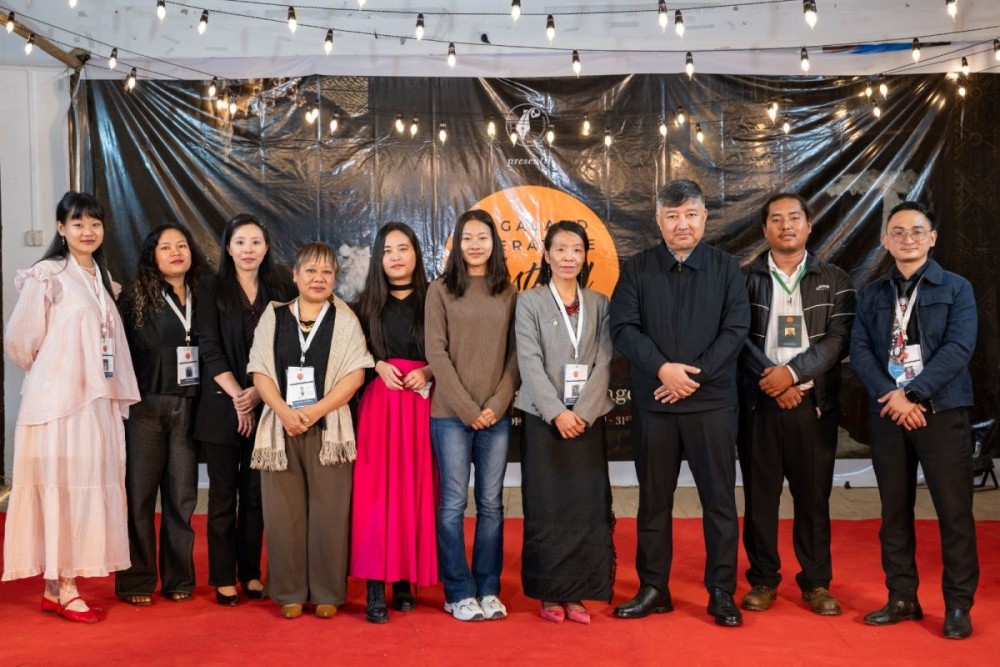
Advisor to Chief Minister & Chairman, IDAN, Abu Metha, with members of Writers Collective and winners of NLF Prizes 2026 during the closing ceremony of the two-day Nagaland Literature Festival at Don Bosco Higher Secondary School, Kohima on October 31.
Two-Day 6th Edition of Nagaland Literature Festival Concludes
Morung Express News
Kohima | October 31
Stating that in the creative industry comprising writers, musicians, people who innovate, who create, who paint, etc., are all challenged by artificial intelligence, Advisor to Chief Minister & Chairman, Investment & Development Authority of Nagaland (IDAN), Abu Metha on Saturday, stated that in the context of writing and literature, “we should use artificial intelligence to research, to study, to know, use a form of technology to empower ourselves with knowledge, and information.”
But while modern technology allows us to research, to know, to find out, to ask questions, and helps us to spend less energy, less time researching, he underscored that, “we must always ensure that we continue to let the inner voice speak, and let the flowering of the human spirit continue to blossom and flower.”
Addressing the two-day 6th edition of Nagaland Literature Festival closing ceremony at Don Bosco Higher Secondary School, Kohima on October 31, he underlined, “we must use artificial intelligence to research, but we must not surrender our humanity. We must not surrender our human voice.”
In this connection, he urged that as people who promote innovation, creativity, and literature, schools, colleges, institutions, clubs, organizations like Writers Collective must understand the challenges that we face today, and then come up with strategies and game plans and innovative approaches to strengthen reading, and writing, to make it exciting and appealing.
Stating that no matter how much we say that reading and writing is good, he underscored that, “unless we are innovative, and we have strategies to appeal to young minds, we will not succeed.” Here is where, he said, leaders of institutions, especially schools, colleges, communities, clubs, must understand these realities and formulate plans to bring young minds to read and write more while emphasising that it is in these writings that our stories, history, and legacy will be preserved for future generations.
He also dwelt on the importance of language while asserting that, “when we lose a language, we lose an entire history, tradition, and legacy.” Towards this end, he underscored that “Literature and language must go hand in hand to protect, preserve, and empower each other.”
For too long, he also remarked that, “others have represented or misrepresented us. For too long, we’ve been judged by others. The journey that we’ve undertaken, the colonial era that we underwent, and even the past decades of strife, struggle, tears and sweat, others have always told our stories.”
Today, he strongly advocated that, “we must tell our own stories.” “From the Naga context, from the Naga perspective, from the Naga language, we must tell our own stories to the world”, he articulated.
He further remarked that, “storytelling is so important” and thanked the writers and authors for telling our stories. “Maybe we face so many challenges. Maybe there are so many difficulties. Maybe there’s not enough appreciation, not enough money to make, because at the end of the day, there’s nothing you can do. But I want to say thank you to you for continuing to tell your stories”, he expressed.
He further congratulated Team Writers Collective on another successful edition and exuded hope that Nagaland Literature Festival continues to grow. “It should be an intellectual property of the Naga people that becomes international”, he said while assuring the support of the government of Nagaland in that collective aspiration.
NLF prizes for short story, poetry & essay
Writers Collective also introduced the inaugural round of NLF Prizes in 3 different categories namely Short Story, Poetry and Essay, conceptualised to recognise, appreciate and encourage Naga writings. Out of the 83 entries for the NLF Prizes including 19 short stories, 48 poems and 15 essays, three top entries were shortlisted in each category and were screened by a 7-member jury.
During the closing ceremony, Amenla I Chang was declared winner of the NLF Short Story Prize for her story titled, “Apang” while Temjenwapang won the NLF Poetry Prize for his poem, ‘I taste my ashes’ and Atino Yeptho was declared winner of the NLF Essay Prize for her essay titled, “Hearth to Page’.
They were presented with the awards by the Advisor to Chief Minister, Abu Metha. The winners received a cash prize of Rs 10,000 each along with certificates of award and citations.