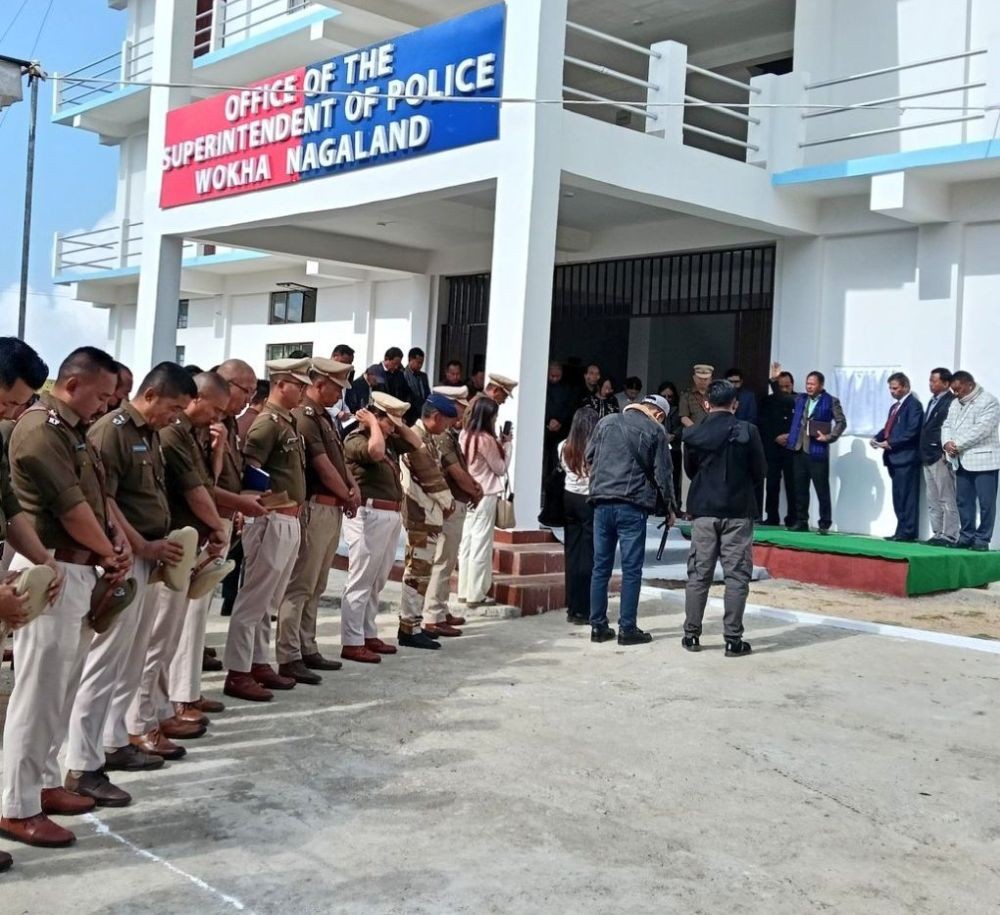
Officials and others during the inauguration of Wokha Superintendent of Police’s office building and barrack on January 5.
10 to 12 stations see less than two FIRs a year; Nearly 300 police personnel ‘underutilised’ in low-FIR stations
Morung Express News
Wokha | January 5
The newly constructed Superintendent of Police (SP) Office building and Barrack at Wokha were inaugurated by the Deputy Chief Minister, in-charge of Home & Border Affairs, Y Patton on January 5. The inauguration programme was held in the presence of Advisor, Fisheries & Aquatic Resources, A Pangjung Jamir, MLA Y Mhonbemo Humtsoe, Director General of Police, Nagaland, Rupin Sharma, IPS and other senior officials.
Addressing the occasion, Nagaland DGP Rupin Sharma, expressed confidence in the Wokha police and said he was sure that the newly inaugurated SP Office and Barrack would be utilised to the maximum by SP Wokha and the district police. However, he used the occasion to reflect on broader policing issues in Nagaland.
He observed that traditionally, the Nagaland Police has been structured around the pillar of Armed Police Battalions, whereas in most parts of the country, armed police play a secondary role to the District Executive Force (DEF).
Across India, he said, the district police act as the first responders to emergencies and crimes, with armed police stepping in later. Even in Nagaland, he noted, the first responder is inevitably the district police whether it is personnel from police stations, SDPO offices or the SP office.
Sharma pointed out that historically, DEF units in Nagaland have remained relatively weak in terms of manpower, infrastructure and facilities. He explained that most Government of India policies, including police modernisation schemes under the Ministry of Home Affairs (MHA), focus primarily on strengthening DEF police stations and SDPO offices. Funding parameters, he said, are based on population, the number of police stations and the volume of crimes reported to district police stations.
However, he expressed concern that crime reporting across Nagaland remains very low. While acknowledging the presence of informal customary laws and village or tribal-level dispute resolution mechanisms, he said that excessive reliance on these systems has resulted in people not approaching the police. This, in turn, keeps official crime figures artificially low.
He stressed that government funding for infrastructure development including buildings, vehicles, computers, software and evidence-recording systems largely depends on the number of cases registered. “If crimes are not reported, our policing infrastructure will also not grow,” he said, emphasising that modernisation is directly linked to strengthening the DEF ecosystem.
Clarifying that his remarks were not a criticism of the government, Sharma highlighted that while the state has established around 15 to 20 new police stations over the past 15 years, there are at least 10 to 12 police stations where fewer than two FIRs are registered annually.
“If there are 15 such police stations with about 20 personnel each, nearly 300 personnel are being underutilised. Salaries are paid for work, and policing is technical and legal work not merely wearing a uniform and patrolling,” he remarked.
He urged both the public and police personnel to work together to improve district-level policing. Increased public trust in the police, he said, would strengthen policing outcomes, while greater police engagement would also enhance trust in the community.
Commending SP Wokha T Relo Aye, NPS, and his team for their work, the DGP reiterated his confidence in the Wokha Police and the Nagaland Police as a whole. He expressed hope that the newly inaugurated infrastructure would not become a wasted effort and that both the public and police personnel would make the best possible use of the facilities created.
New infrastructure to boost police morale, efficiency: Dy CM Patton
The special guest, Dy CM Y Patton, in his address described the occasion as a “red-letter day” for the people of Wokha, particularly for the District Executive Force (DEF). He recalled that the SP Office, which was upgraded from an SDPO post created in 1973, had been functioning without a proper building, operating from makeshift arrangements since 1981.
Expressing optimism, Patton said the new infrastructure would boost morale and efficiency among police personnel and strengthen their commitment to public service. He urged the staff of SP Office Wokha to make optimum use of the new facilities with enhanced dedication and professionalism.
Patton informed that the SP Office was constructed with funds sanctioned under the State Plan in 2021, while the Barrack was funded under SASCI. He further noted that similar infrastructure development initiatives have been extended to newly created districts including Niuland, Tseminyu, Noklak and Chümoukedima.
Delivering the welcome address, Superintendent of Police, Wokha, T Relo Aye, NPS, highlighted the long-standing need for proper office infrastructure in the district and expressed gratitude to all agencies involved in completing the project.
The technical report was presented by Er Jenithung Kikon, Executive Engineer (PEP), Kohima Division, who briefed the gathering on the construction aspects of both the SP Office building and the Barrack.
The programme began with dedicatory prayers. The Barrack was dedicated by Myingthungo Ezung, Assistant Pastor, Police Baptist Church, Wokha, followed by the dedication of the SP Office building by Zuben Ngullie, Pastor, Police Baptist Church, Wokha. It concluded with a vote of thanks proposed by Additional Superintendent of Police, Wokha, Biren Lotha, NPS.