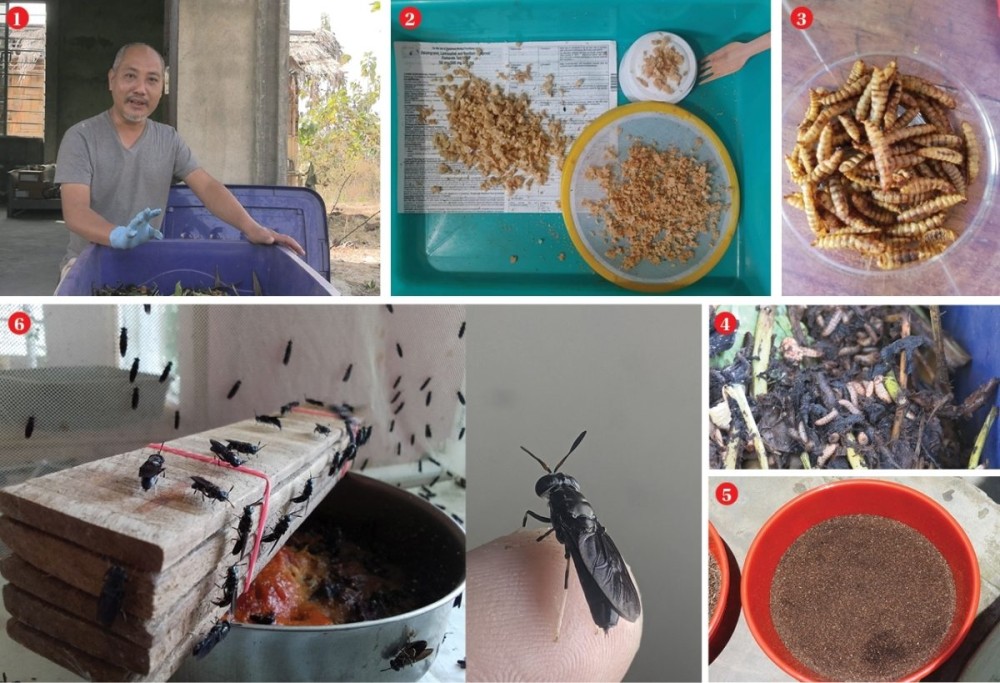
Clockwise from top left: 1. Sutsung Enterprise co-founder Jongpong Chiten, 2. Black soldier fly (BSF) eggs, 3. Dried BSF larvae, 4. BSF larvae in a breeding bin, 5. BSF frass/compost, 6. Adult BSF.
Giving new meaning to sustainable waste management
Imkong Walling
Dimapur | March 29
Flies and maggots, a combination that screams filth, stench and disease; revulsion is what it provokes. But there is one fly that is everything the housefly is not. Clean and efficient, it is quietly redefining humanity’s approach to waste, with potential to render landfills obsolete.
Known as the black soldier fly (BSF), it is a natural bioengineer that recycles waste like a machine. It is making waves across the world, including in India, giving new meaning to environment-friendly, sustainable waste management. Unlike the pesky housefly, the larvae of the unassuming BSF have the ability to transform food and agricultural waste into animal feed and frass (organic fertiliser).
In Nagaland, a startup is on a mission to replicate this phenomenon locally. “Countries like China, the Philippines, Indonesia, and Vietnam are doing this on a large scale. In cities like Bangalore, Pune, and Kolkata, startups are already processing tons of waste daily,” Jongpong Chiten, co-founder of Nagaland-based startup, Sutsung Enterprise, told The Morung Express. He co-founded the startup with Dr Akumtoshi Longkumer, an EarthON Changemaker and a Faith for Our Planet Fellow.
Shared dream
Their paths crossed in 2020. According to Chiten, Sutsung Enterprise was born out of a shared dream in 2023. The enterprise focuses on agri-tech and sustainable manufacturing, and “building scalable circular economy solutions.”
With a PhD in Botany (Riparian Ecology), Dr Longkumer is a sustainability specialist, with expertise in ecology, environmental systems, and nature-based solutions.
Chiten is a sustainability strategist and enterprise builder with experience in the development sector. Holding degrees in Philosophy and Education, he had a considerable stint with the UN working on public health and grassroots programmes as a state project officer attached to Nagaland State AIDS Control Society .
Their introduction to the black soldier fly was rather fleeting. During an edible insects’ workshop on sustainable livelihood, at the Kohima Science College in 2021, where Dr Longkumer and he participated as a team, the insect was mentioned in passing. “The Black Soldier Fly was only briefly mentioned that day, but that lone mention stuck like a rivet,” Chiten recalled.
It was their Eureka moment. In his words, “In that moment, we saw not just an insect, but a possibility to turn waste into wealth, scarcity into abundance, and a waste management system into one that could be circular and regenerative.”
According to him, this little-known insect can sustainably monetise waste without straining the environment, while reducing the carbon footprint.
Theory to practice
Following that brief introduction at the 2021 workshop, he recalled catching his first BSF from a jackfruit brought home by his wife.
In the years since, Sutsung has garnered not only curiosity but actual investment, translating that “Eureka” moment into real-world application. Chiten is currently in the process of building a breeding facility in Seithekema, Chümoukedima. It will be a demonstration facility built around the concept of a self-sustaining ecosystem.
According to Chiten, the objective is “a closed-loop, self-sustaining facility equipped with solar energy, soak pits, and filtration systems for rainwater harvesting,” ensuring even water used for compost is recycled.
With support from Foreign Direct Investment and awards from the Ministry of Science & Technology, the demonstration farm is gradually taking shape. “Work has started on the larvae breeding enclosure,” he said, pointing to a structure with thin metal walls, transparent roofing, and fishnets at the site in Seithekema. The enclosure will evolve into an automated BSF ecosystem.
Recycling machine
While the farm gradually takes shape, Chiten has successfully demonstrated the functionality of the science. BSF larvae thrive in environments with temperatures ranging from 27-30° C. Given the ideal environment, all the insect need is organic kitchen waste— fruit peels or vegetable scraps.
According to him, it is a simple process viable even for individual households. At his flat in Dimapur, he maintains a mini-breeding facility requiring only containers, minimal lighting, and nets. There is neither stench nor the buzzing drone of flies; and importantly, no complaints from neighbours.
“It looks like a litter bin, but there is no garbage here. You won't smell anything. It is safe,” he said, sifting through dry organic matter that resembled finely ground tea leaves on a crate. This residue was the leftover of kitchen waste processed by the larvae, nutrient-rich compost ready for the garden or any farm land.
The conventional composting takes months. In comparison, composting by the BSF takes just 10-12 days. He calls them “Nature’s recycling machine.”
While the compost enriches the soil, the larvae become high-protein feed for livestock and fish, reducing feed costs by 30 to 40 percent. For angling enthusiasts, the larvae also work great as fish-bait.
Solving waste crisis
The BSF larvae could also be the answer to a mounting urban waste crisis. According to Chiten, municipal bodies adopting the BSF larvae can alleviate waste disposal to a great extent. This, however, would first require institutionalising waste segregation at source, or at the individual level.
He has already taken baby steps in that direction. “I am currently working with apartments and farmers,” he said, and aiming to involve Urban Local Bodies (ULBs), and villages.
He added, “We feed food waste to pigs or chickens. We often feed animals leafy vegetables without knowing the nutritional value. BSF provides a protein replacement. We can create raw materials for our own farms, reducing expensive inputs,” he added.
The prospect does not stop there. BSF larvae extract has proven scientific use in the cosmetics industry, and research is on in the pharmaceutical sector for its potential medicinal properties.
Decentralising sanitation
Perhaps the most sustainable aspect of Chiten’s vision is his refusal to privatise or monopolise the process. He argued that thes centralised waste management model is inefficient.
He envisions a localised model where neighborhoods — clusters of 10 to 20 families in urban or rural settings — jointly managing their own waste. “If every household processes just 20 to 30 kg of organic waste a month, imagine the burden lifted from the municipal council,” he said.
He added that by treating waste at the source, rural communities can produce their own fertiliser and animal feed, creating a "circular economy" within the village.
“Food comes from the soil; waste goes back to the soil. This is one way to care for the earth,” a process, he said, captures the essence of a circular, closed-loop, self-sustaining ecosytem.
A work in progress, but to Chiten, the vision is clear, and its potential massive in a world struggling to manage the waste it generates.