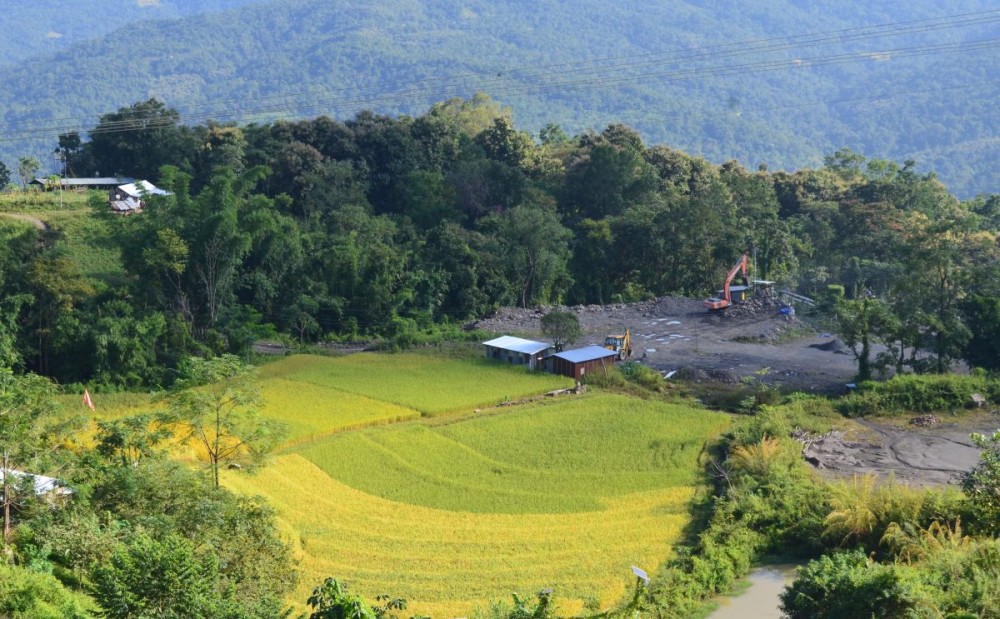
A paddy field surrounded by mountains along the highway between Dimapur and Kohima. (Morung Photo)
Amba Jamir
Policy Analyst and Development Strategist
A “One Value Chain, Many Crops” approach aligns better with Nagaland’s land, culture, and ecological strengths than top-down single-crop schemes.
Across the world, agriculture is undergoing rapid transformation. Climate instability, collapsing commodity prices, and ecological degradation are forcing countries to rethink not just what they grow, but how they grow. Into this shifting landscape, Nagaland is latching on to the One Crop One Village (OCOV). It echoes the earlier One District One Product (ODOP) model and is presented as a pathway toward increased incomes and “business-oriented farming.”
Recently, Chief Minister Neiphiu Rio reiterated the importance of OCOV. The Agriculture and Horticulture Departments presented crop suitability maps, highlighted promising commodities like avocado and persimmon, and noted the distribution of twelve thousand avocado saplings. They pointed to the Khonoma kiwi pilot, which has shown encouraging results in controlled conditions. These are sincere efforts. Officers have travelled, surveyed, mapped, discussed, planned. They deserve recognition.
But sincerity is not the same as suitability. And while OCOV may appear forward-looking, we must ask whether it truly fits Nagaland’s land systems, agricultural ecologies, and cultural traditions. To answer this, let us begin with a deeper understanding of what agriculture in Nagaland already is.
The intelligence embedded in jhum
Jhum is perhaps the most misunderstood practice in the Northeast. Outsiders, including our own policy makers, have long referred to it as destructive “slash-and-burn” agriculture. Yet modern research, and global indigenous movements, are now validating what Naga farmers always knew: jhum is a sophisticated, regenerative, and ecologically intelligent system.
A single jhum field often contains fifteen to forty crop species - rice, millets, pulses, sesame, taro, yam, gourds, beans, greens, oilseeds, medicinal herbs, and wild edibles. This diversity is not accidental; it is a carefully curated strategy for climate resilience, soil regeneration, balanced nutrition, pest suppression, forest-food integration, and long-term sustainability.
Jhum is both an ecological system and a cultural system, a living syllabus of knowledge handed down through generations. It is also an economic strategy. By cultivating a wide range of crops simultaneously, jhum households distribute risk. If a rice variety fails, millet compensates. If a pest attacks one crop, five others remain unaffected. Jhum is essentially a risk portfolio hedge perfected over centuries.
Against this backdrop, OCOV, requiring an entire village to specialise in a single crop, represents an inversion of everything that has kept Naga agriculture resilient.
The fragility of monoculture
Monocropping, even when profitable for a few years, inevitably exposes farmers to volatility. Global and regional examples illustrate this vividly. Kerala’s pepper economy collapsed when Vietnam entered the market. Mizoram’s broomstick-based livelihoods crumbled as demand declined. Bhutan’s passion fruit boom or Sikkim’s cardamom successes ended abruptly due to disease and price saturation. Don’t forget Nagaland’s very own ginger crop experience.
A village that dedicates itself to one crop becomes vulnerable to exactly these shocks: a fungal disease in kiwi, a pest infestation in ginger, a sudden market crash in pineapple, transport disruptions, storage failures, or a shift in consumer preference. The beauty of Naga agriculture has always been in its ability to withstand uncertainty. My argument is that OCOV will weaken this protective logic and replace it with fragility, amongst others.
Land cannot be standardised
Even if monocropping promised economic gains, there remains a deeper structural obstacle: Nagaland’s landholding patterns themselves. Contrary to most of India, land here is managed and governed by communities. Article 371A protects the customary ownership and management of land and its resources, ensuring they remain with the people rather than the state.
This means land, including agricultural land or forests, are held by clans, families, kinship groups and communities. For example, agricultural lands in a community could be fragmented across landscapes and these are accessed through customary negotiation and protocols. In the case of jhum, while the land may be owned by community groups, the selection of sites, setting of fire or other major activities are managed by village authorities and customary institutions.
Given such an architecture, a uniform cropping directive, “this village must grow one crop”, has no legal or customary foundation. The diversity of rights, holders, and land-use practices makes such a model impracticable and socially discordant. OCOV assumes consolidated, contiguous land under state control. Nagaland has neither and planners must not be presumptive.
The slow erosion of traditional land-use: a warning sign
Nagaland is witnessing an accelerating shift away from traditional land-use patterns, not because jhum or mixed farming have lost their ecological or economic value, but because schemes with attached funds and expanding market forces are reshaping local incentives.
Government schemes promoting orchards, monoculture plantations, and specific commodities, often bundled with subsidies, create a powerful financial pull. At the same time, markets now reward certain “cash crops” and this has drastically reduced the Naga farmer’s menu or basket of diversity. These combined forces are pushing communities to abandon systems that have sustained them for generations.
This transition exposes farmers to volatile markets and increasing dependence on external buyers. More concerning, it erodes the cultural and ecological foundations of Naga agriculture:
• seed diversity declines,
• fallow cycles shorten or disappear,
• institutions and customary rules weaken,
• intergenerational knowledge fades,
• forest–farm linkages break down,
• and ecological resilience diminishes.
This is not simply a shift in crops. It is a shift in identity, governance, and community cohesion. Once these systems erode, they are extraordinarily difficult to restore. Our progress must not be based simply on economic gains but more so in strong social capital and growth that is sustainable, equitable and ecologically sound.
ODOP as an instructive caution
When Nagaland adopted the One District One Product framework in 2020–21, it designated flagship crops for each district, pineapple, coffee, Naga King Chilli, ginger, kiwifruit etc. This provided clarity and attracted some investment. Yet value chains did not transform as expected.
Farmers still struggle with erratic buyers, volatile prices, high transport costs, poor storage, limited processing units, and insufficient market linkages. The lesson is clear: naming a crop is not the same as creating a market system around it. Without addressing infrastructure, governance, aggregation, and risk management, ODOP becomes a label without substance.
OCOV risks becoming an even narrower version of this.
The political economy of dependence
Nagaland’s development trajectory is increasingly guided by centrally sponsored schemes (CSS). These schemes bring funds, but they also bring templates. Over time, it creates a subtle dependency: the state begins shaping its vision around what Delhi is willing to fund rather than what Nagaland needs.
This is not unique to agriculture. It is a structural pattern across sectors. Consultant-designed frameworks, FPO models, ODOP plans, horticulture expansion roadmaps, create the appearance of modernization but are often disconnected from local realities, cultures and aspirations.
Nagaland’s constitutional context gives it unusual space and autonomy, yet policy imagination is becoming narrower, not bolder. This is not about rejecting central support. It is about asserting Nagaland’s right to design models that reflect its own ecological, social, and cultural logic, and then inviting the Centre to support those models.
It is about negotiating from confidence, not dependence. This requires a strong political will and an even stronger and purposeful bureaucracy to push it through.
Pilots never fail, but they rarely scale
Proponents of OCOV may highlight the Khonoma kiwi pilot as a proof of concept. But pilots succeed because they are nurtured, officers visit frequently, communities are motivated, subsidies flow, and technical support is consistent.
Scaling removes these favourable conditions.
Khonoma’s success does not guarantee that OCOV can be sustained in villages with different landholding patterns, weaker transport links, limited storage infrastructure, or lower market access. Without addressing systemic bottlenecks, roads, cold storage, aggregation, prices, insurance, buyer reliability, OCOV will remain a well-intentioned but unscalable experiment.
A model designed for Nagaland:
One Value Chain, Many Crops
The alternative is not to reject modernization. It is to modernise on our own terms. Here’s my argument.
A “One Value Chain, Many Crops” approach builds value chains around complementary crops rather than a single commodity. Villages can grow diverse crops suited to their micro-ecologies while collectively branding, processing, and marketing them.
A spices value chain can integrate ginger, turmeric, chilli, and indigenous pepper. A citrus value chain can connect mandarin, pomelo, lemon, and orange varieties. Jhum-grown millets, beans, and oilseeds can anchor nutrition-focused enterprises. Agroforestry systems can blend fruit trees with nitrogen-fixing species.
This model will preserve ecological resilience and cultural integrity while enabling economic opportunity.
Upgrading jhum - not abandoning it
Instead of replacing jhum, Nagaland can strengthen it by improving soil health, enriching fallows, integrating high-value agroforestry species, and adding value to its extraordinary diversity of crops. Globally, indigenous agroforestry and multi-cropping systems are being recognised as climate-smart, biodiversity-friendly agriculture. I am glad that the draft Nagaland Agriculture Policy is strong on these factors.
Nagaland already possesses what the world is rediscovering. Are we ready to take the plunge to lead?
The path forward: assertive, not adversarial
Nagaland does not need to reject central schemes. It needs to negotiate boldly, grounded in knowledge of itself. The state must design its own agricultural models, grounded in customary land systems, ecological diversity, and community wisdom, and invite funding to follow those designs, not the reverse.
Value-chain clusters suited to diverse cropping, 371A-compliant aggregation mechanisms, jhum-integrated agroforestry enterprises, indigenous seed networks, these can form the backbone of a dignified agricultural future.
A resilient future will not emerge from squeezing Nagaland into borrowed templates.
It will emerge only when Nagaland grows consciously from its own soil, its own systems, and its own strengths. Let us not compromise on the rich diversity of our crops, land use practices and the knowledge systems therein. Let us push for “Many crops, one future, and a future rooted in who we are.”