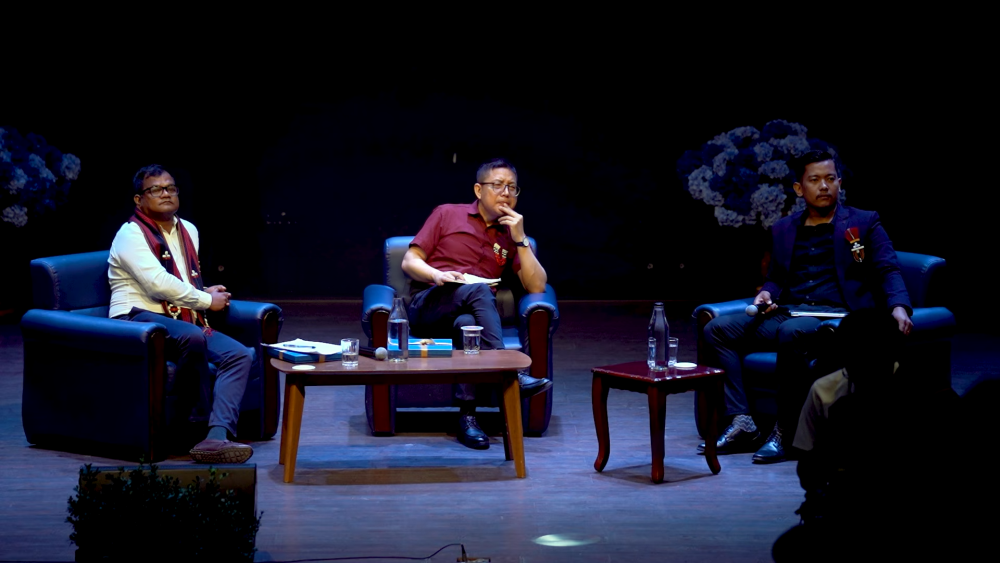
(Left to Right) Samuel Beech, Al Ngullie and Toka V during the panel discussion held at Tetso College, Chümoukedima, on November 5. (Morung Photo)
Morung Express News
Chümoukedima | November 5
Media professionals have stressed the importance of credibility, institutional accountability and ethical journalism in shaping narratives about Nagaland, cautioning that the ability to control a story does not necessarily establish its credibility.
The observations were made during a panel discussion at the 3rd Dr PS Lorin Education & Media Conclave 2026-2027, titled “Who Tells Nagaland’s Story? Rooted in Heritage, Ready for the World,” held at Tetso College, Chümoukedima, on November 5.
Addressing students from different colleges, Al Ngullie, Associate Editor of Hornbill TV, highlighted the distinction between social media content and verified journalism.
“Nowadays, every one of us can tell a story. You’ve got a phone, you take it out, you go to YouTube, and you tell the story,” Ngullie said, adding that “narrative control is not the same as narrative credibility.”
Ngullie maintained that established media organisations follow standards of verification and accountability that distinguish their reportage from unverified online commentary. He referred to the reliance of legal institutions, including the Supreme Court of India, on established media reporting rather than opinions circulated by individuals on digital platforms.
“If your intention to tell the story is not guided by accountability and self-awareness of what your story is going to do to the people, then your intention will always be guided by bias. Your goal will always be about yourself, not the society,” he said.
He identified accountability, credibility and accreditation as essential pillars of responsible storytelling.
Subsequently, Samuel Beech, Sub Editor of Nagaland Post, spoke on the importance of preserving indigenous cultural narratives, particularly through traditional music and oral history. Recalling his earlier engagement at Tetso College, Beech observed that songs have historically served as an important medium of communication and knowledge transmission in Nagaland and the Northeast.
“A Nagaland folk song is not merely a piece of entertainment; it is an archive without paper,” he said, describing folk songs, chants, oral stories and traditions as repositories of community histories.
He cited the Li Chokri of the Chakhesang tribe, which speaks of love and agricultural life, and the Mezokhwe of the Rengmas, a traditional weeding song, alongside ballads recounting bravery and battlefield valour.
Beech urged young people to learn, preserve, and document their cultural heritage, cautioning that dependence on external accounts and unverified digital narratives could result in the misrepresentation of local histories.
“People from other states may be able to take our stories to the world, but there is nothing quite like hearing from someone who has lived through the experience first-hand,” he said.
Beech also pointed out that regional media coverage remains concentrated largely in commercial centres such as Dimapur and Kohima, calling for greater coverage of developments across all 17 districts, including Mon, Tuensang and Longleng.
During the panel discussion, Ngullie explained the considerations behind editorial decisions and the selection of front-page stories.
He said editorial prominence was determined by factors such as credibility, national or regional significance, systemic impact and information from institutional or authoritative sources. Local and district-level developments, he explained, were often accommodated on supplementary pages.
Clarifying the media’s role in society, Ngullie said journalists were recorders and messengers rather than arbitrators of public affairs. He added that legal bodies and institutions relied on accredited media formats because of their professional standards.
Beech stressed that professional ethics and objectivity must remain central to journalism, irrespective of personal interests or institutional pressures. He said credible reporting must objectively record events and provide public-interest information that enables people to make informed decisions and navigate contemporary challenges.
The session concluded with a call for aspiring media professionals to strengthen both oral communication and written reportage skills to preserve the integrity of regional narratives and present Nagaland’s stories responsibly to wider audiences.