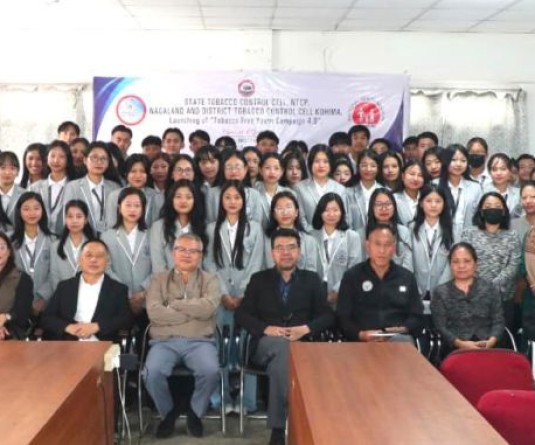
Dignitaries and others during National Seminar at Don Bosco College, Kohima.
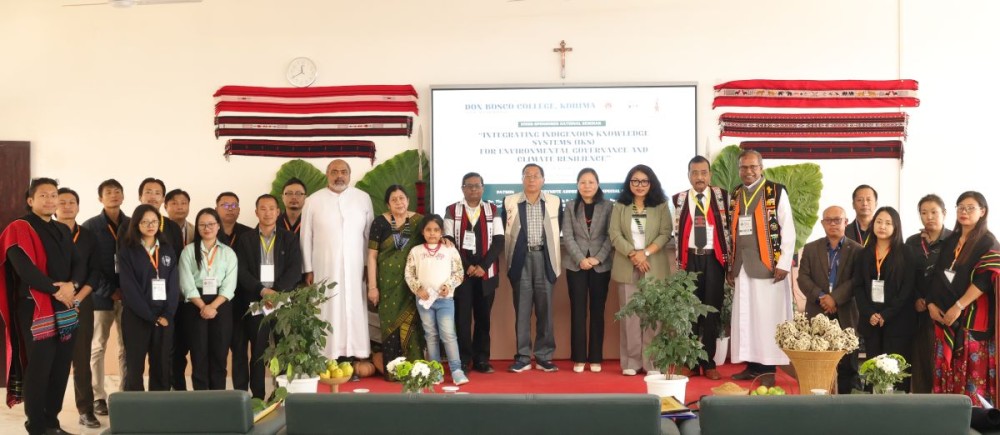
Don Bosco College, Kohima hosts ICSSR-sponsored National Seminar
Our Correspondent
Kohima | October 28
The Department of Sociology, Don Bosco College, Kohima, hosted a two-day ICSSR-sponsored National Seminar on “Integrating Indigenous Knowledge Systems (IKS) for Environmental Governance and Climate Resilience” on October 27–28. Held in hybrid mode, the seminar provided a platform for interdisciplinary discussions on indigenous knowledge, environmental conservation, sustainable development and climate resilience.
Special invitee Rezulule, NPS, Superintendent of Police (Special Branch), INT, emphasised community participation, environmental awareness and effective law enforcement in protecting forests and wildlife. She also highlighted the role of indigenous knowledge, customary institutions and intergenerational learning in conservation and sustainability.
Prof Dinesh Baishya, Director of the Centre for Indian and Indigenous Knowledge System, Assam Don Bosco University, Guwahati, and former Vice-Chancellor of Krishnaguru University, delivered the keynote address. Prof Xavier P Mao, Professor and Head, Department of Philosophy, NEHU, also delivered a keynote on Indian Knowledge Systems and their relevance to contemporary social and environmental challenges.
Resource persons included Prof Dinesh Baishya; Prof Subhash C Arya (Electronics and Communication Engineering, NEHU); Prof Ranu Baishya (Music, ITEP, Assam Don Bosco University); Prof B Panda (Sociology, NEHU); Prof Xavier P Mao (Philosophy, NEHU); Prof L Bishwanath Sharma (Philosophy, Manipur University); and Dr Arpana Ramchiary (Philosophy, Kumar Bhaskar Varma Sanskrit and Ancient Studies University, Assam).
The inaugural session was chaired by Dr Jarani Mao, Dean of Academics, Don Bosco College, Kohima, while Fr Dr Tious Varghese, Principal, invoked God’s blessings. Prof Ranu Baishya and Dr Abel Kavahru, Convener of the Organising Body, delivered welcome addresses; Sanihe Ariijii, Head of the Department of Sociology, gave the vote of thanks. Fr Dr Xavier Mattam, Rector and Advisory Committee member, also graced the session. Dr Lanukumla Ao (History, DBCK) and Bendang Jamir (Political Science, DBCK) chaired the session, moderated by PG Sociology students Petevilie Pienyu, Mengutuonuo Solo, Athenba L Sangtam and Takalepla.
Prof Subhash C Arya presented “Integrating (Indian) Knowledge Systems from Past, Present, and Future through the Technology Landscape,” and Dr Arpana Ramchiary presented “Indigenous Knowledge Systems and Bodo Culture: A Critical Appraisal of Epistemology, Identity, and Sustainability.”
28 presenters explore indigenous knowledge
The seminar brought together 28 paper presenters whose research covered diverse aspects of indigenous knowledge and its contemporary relevance.
Papers addressed traditional Naga architecture and cultural heritage, indigenous healing systems, women’s roles in traditional society, tribal agricultural practices, indigenous food security, sacred plants, community-conserved areas, reforestation, spring rejuvenation, environmental governance, waste management, sustainable livelihoods, and the preservation of indigenous knowledge through education. Technical sessions also examined the challenges of integrating traditional knowledge with modern scientific approaches.
Open round-table discussions on both days allowed resource persons, presenters, faculty, researchers, and participants to exchange views on cultural continuity, community priorities, environmental governance, and climate policy. Discussions emphasized protecting indigenous knowledge, strengthening community participation in conservation, and promoting collaboration among local communities, research institutions, and policymakers.
The seminar aimed to highlight how indigenous knowledge can inform practical approaches to environmental protection and public policymaking. It also underscored the role of educational institutions in documenting traditional knowledge, encouraging dialogue between elders and younger generations, and creating opportunities for indigenous communities to share their experiences.
The seminar sought to encourage continued academic and community engagement so that indigenous knowledge could inform future conservation initiatives, environmental policies, and climate-resilience strategies in Nagaland, Northeast India, and beyond.