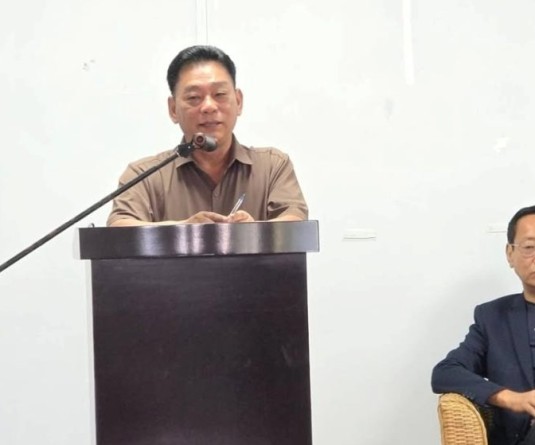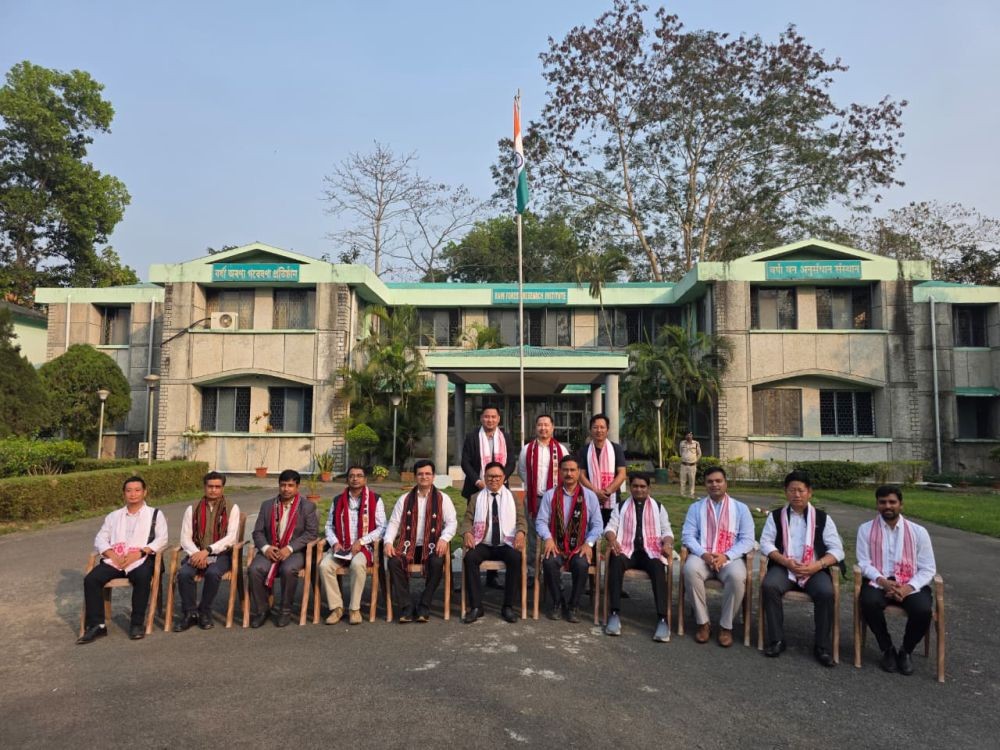
Kohima/Jorhat, March 7 (MExN): A delegation from the Department of Environment, Forests and Climate Change (DEFCC), Government of Nagaland, visited the Rain Forest Research Institute (RFRI), Jorhat on March 6 to explore avenues for scientific collaboration in sustainable forest management and the cultivation of economically important tree species such as agarwood and teak.
The eight-member delegation led by Principal Secretary Y Kikheto Sema was received by RFRI Director Dr Nitin Kulkarni along with a team of scientists heading various divisions of the institute.
As per a Department release, the visit included discussions on research collaboration, extension activities, and a tour of the institute’s facilities including the Bambusetum and museum. RFRI functions under the Indian Council of Forestry Research and Education (ICFRE) and focuses on forestry research in Northeast India.
During the discussions, Sema highlighted the potential of agroforestry in Nagaland, particularly as an alternative to shifting cultivation (jhum), which he noted is increasingly becoming ecologically unsustainable and economically unviable. Referring to the state’s large agarwood resources, he said the species offers significant economic potential as almost every part of the tree can be commercially utilised.
He informed that the Government of Nagaland is working towards formulating a comprehensive policy for the conservation, cultivation and trade of agarwood in the state. With neighbouring states such as Assam and Tripura making rapid progress in agarwood cultivation and trade, he stressed that Nagaland must also adopt scientific and policy-driven approaches to harness its potential.
Sema also raised concerns over the limited export quota allocated to Nagaland for agarwood chips, powder and oil, which currently accounts for a small share of the national quota despite the state possessing substantial natural resources.
He indicated that the state government would take up the matter with the Botanical Survey of India and the Government of India for review.
The discussions also explored integrated plantation models combining agarwood with crops such as coffee, which is being promoted in the state. Sema urged RFRI to support farmers through technical inputs such as quality planting material, improved spacing, artificial inoculation techniques and appropriate intercropping models.
RFRI scientists informed the delegation about an indigenous inoculation technology called “Sashi,” which can induce agarwood formation within two years. Sema suggested that the institute assist farmers in Nagaland in adopting such technologies.
Other areas discussed included the development of improved teak clones with shorter rotation periods, bamboo cultivation for bio-ethanol production, and capacity building for forest officials and farmers.
Both sides agreed to collaborate on key areas including resource mapping of agarwood in Nagaland, expansion of cultivation, development of species suited to local agro-climatic conditions, and training programmes for growers and officials. It was also agreed that an MoU would be signed between the Government of Nagaland and RFRI to formalise the collaboration.
The delegation accompanying the Principal Secretary included senior forest officials from Nagaland such as Sidramappa Chalkapure, Chief Conservator of Forests (Development & Planning), and officers from Wokha, Dimapur and Chümoukedima forest divisions.