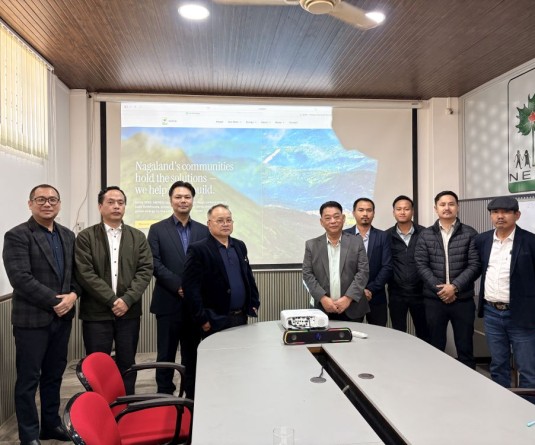
Principal Secretary and Development Commissioner Y Kikheto Sema along with department officials at the inaugural session of the two-day workshop on Mitigation of Forest Fires in Nagaland at the Forest Office Complex in Dimapur November 13. (Morung Photo)

Morung Express News
Dimapur | November 13
Principal Secretary and Development Commissioner Y Kikheto Sema said that the forest department should put prevention, fire-prone area mapping, and community outreach first, while adding that the department alone cannot tackle forest fires.
Sema made the comment at the inaugural session of a two-day on Mitigation of Forest Fires in Nagaland at the Forest Office Complex in Dimapur November 13. The workshop was organised jointly by the State Environment and Forestry Training Institute (SEFTI) and the Department of Environment, Forests and Climate Change.
“The Forest Department alone cannot do it. Whether it is biodiversity, whether it is wildlife, whether it is forest fire, we should coordinate with all the line departments,” Sema said. He asked officers to shift from firefighting to prevention, pair traditional practices with Forest Survey of India satellite alerts and Nagaland’s GIS and Remote Sensing unit, and work with village councils, VDBs, youth and women’s groups, district administrations, Disaster Management, and Fire and Emergency Services.
Citing the state’s rigid land-holding system, he said that land belongs to individuals and communities under Article 371A, leaving the government with less than 5 percent of the state’s total area. He reminded that the state lost 795 sq km of forest between 2013 and 2023, roughly 5 percent of its geographical area, making it one of the highest declines in India. He named jhum cultivation, besides hunting, as main causes of fires, warning that unsystematic burning hurts soil, water conservation, food security, and livelihoods.
In her keynote address, Conservator of Forests (RPU) Lhinghoikim Touthang said the best way to fight a forest fire is not to start one, as damage to life, property, biodiversity, and infrastructure is already done once a fire spreads.
While fires sparked by lightning cannot always be stopped, she said that containment depends on terrain and slope. She called for vulnerability mapping, early warning systems, fire lines, firefighting tools, community participation, and public awareness. Recalling the 2014–15 Dzükou Valley fire, Touthang said that she had only seen videos of Dzükou bamboo grass in summer green or winter golden-yellow before arriving to find everything black, with burning branches rolling downhill to start fires elsewhere. Seeing communities protect the valley showed her how public involvement and cooperation between departments ease hurdles on the ground, she said.
SEFTI Director Rampaukai said the workshop was organised keeping in mind the approaching dry season, when most forest fires happen. Funded under the Mitigation of Forest Fire Risk Management scheme implemented by the State Disaster Management Authority and the Department of Environment, Forest and Climate Change, the two-day programme aims to give fire management skills to field officers, who in turn can train communities at their places of posting.
“The significance of today’s workshop is to capacitate the field officers with the technical knowledge and the skill of mitigating forest fires and forest fire management in their line of duties, and also to enable the field officers to go back to their various places of posting and be able to train the communities and the people in your own places of posting,” the SEFTI Director said.