Nagaland ranks 27th in investment friendliness; regulatory ease, governance stand out
• State placed sixth among NE and hilly states
• Infrastructure, human resources and digital connectivity weak spots
Morung Express News
Dimapur | July 18
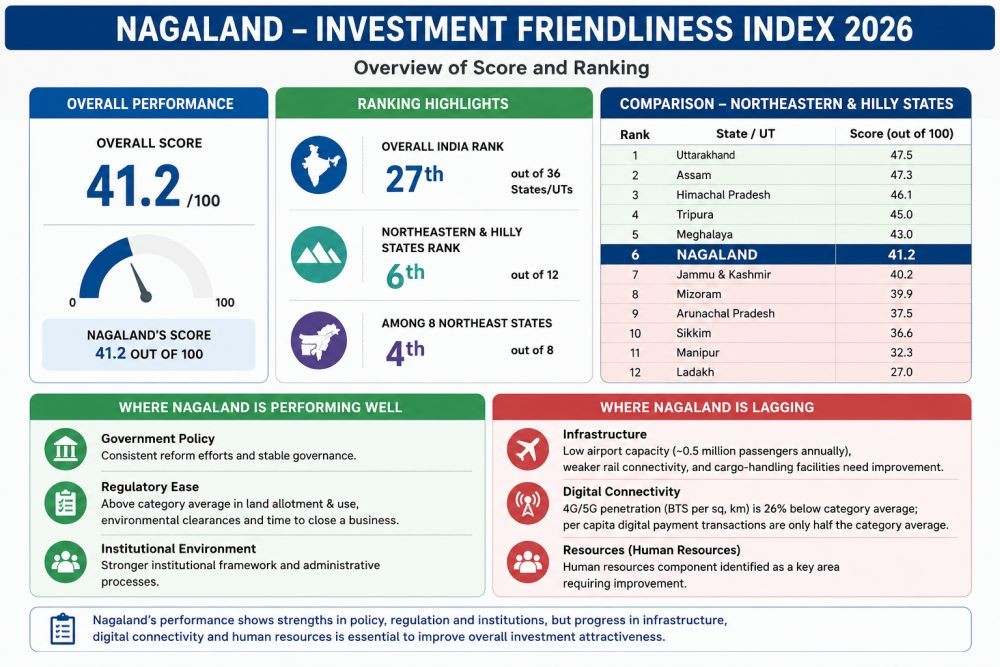
Nagaland has emerged as a relatively strong performer in regulatory ease and institutional environment but continues to be held back by infrastructure, human resources and digital connectivity gaps, according to NITI Aayog's Investment Friendliness Index 2026.
The State scored 41.2 out of 100, placing it 27th among 36 States and Union Territories assessed nationally and sixth among the 12 northeastern and hilly States. Its overall score was at par with Bihar and marginally below West Bengal and Jharkhand, both of which scored 41.3.
Within the northeastern and hilly category, Nagaland trailed Uttarakhand (47.5), Assam (47.3), Himachal Pradesh (46.1), Tripura (45.0) and Meghalaya (43.0). It, however, performed better than Jammu & Kashmir (40.2), Mizoram (39.9), Arunachal Pradesh (37.5), Sikkim (36.6), Manipur (32.3) and Ladakh (27.0).
At the national level, Gujarat topped the Index with 56.6, followed by Maharashtra at 53.7 and Tamil Nadu at 53.3. The Index assessed 36 States and UTs.
Key performing areas
Nagaland's strongest showing came from its government policy, regulatory ease and institutional environment pillars, which the report attributed to "consistent reform efforts and stable governance."
The State also recorded a five-year GSDP growth rate of 4.84% between 2019 and 2024, marginally above the national average of 4.8%.
Another positive indicator was capital expenditure incentive disbursement relative to total industrial capex, which stood at 18% in Nagaland, compared with the national average of 11% and the category average of 17%.
Nagaland also stood out in women's participation in the workforce. The report placed its female workforce participation rate at 59% in fiscal 2024, against a national average of 40%.
On the regulatory front, investor perceptions of Nagaland were comparatively favourable in several areas.
The State scored nine points above its category average for land allotment and use, eight points higher for environmental clearances, and 10 points higher on the average time taken to close a business.
These indicators suggest that, despite its relatively low overall ranking, Nagaland's investment environment has strengths in areas directly linked to administrative and regulatory processes.
Infrastructure remains a major constraint
The gains, however, appear to be offset by persistent infrastructure limitations.
The report identified airport capacity, cargo-handling facilities and rail connectivity among areas requiring improvement. Dimapur Airport, the State's principal aviation gateway, was cited as having a capacity of around 0.5 million passengers annually, while Nagaland's rail density was lower than that of six other States in its category.
Digital infrastructure is another weak link. According to the report, Nagaland's 4G/5G penetration, measured in base transceiver stations per square kilometre, was 26% below other States in its category.
Per capita digital payment transactions were also only half the category average, pointing to a digital adoption and connectivity gap that could constrain the development of a more integrated business ecosystem.
Overall, the report specifically identified the resources and infrastructure pillars, particularly the human resources component, as notable areas requiring improvement in Nagaland.