Dignitaries and others during Seminar on “Navigating a World in Conflict” at CIHSR on August 12.
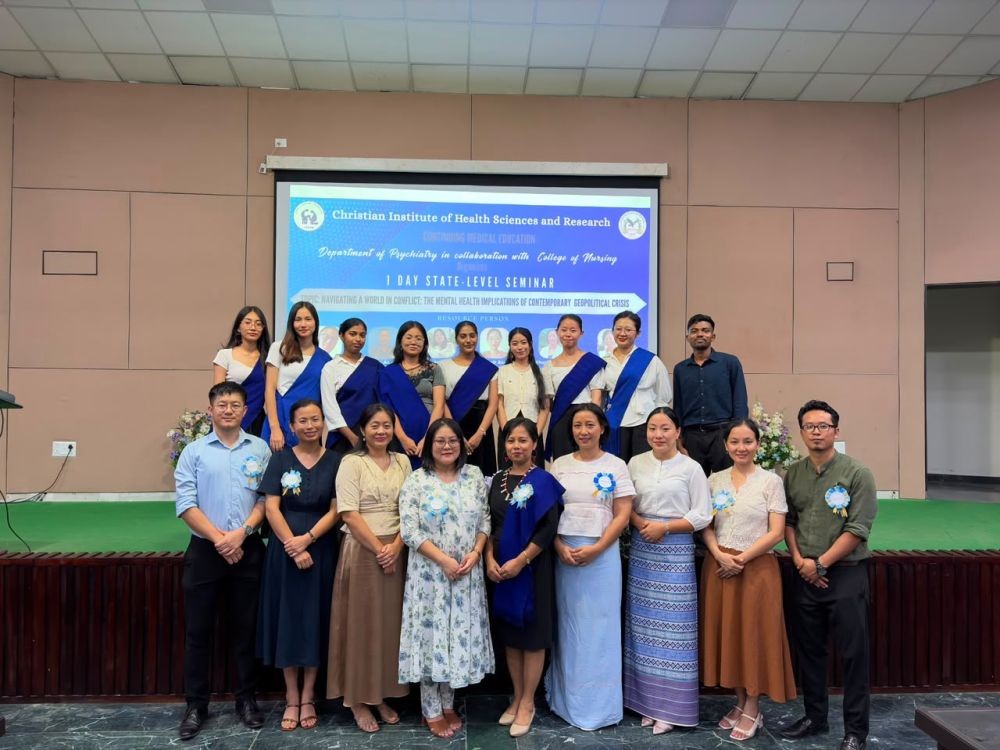
Kohima, August 14 (MExN): A one-day seminar was organised by the Department of Psychiatry in collaboration with the College of Nursing, Christian Institute of Health Sciences & Research (CIHSR) on the topic, “Navigating a World in Conflict: The Mental Health Implications of the Contemporary Geopolitical Crisis,” on August 12 at CIHSR.
It was the first-ever combined CME-CNE programme and the first state-level seminar organised by the Department of Psychiatry, CIHSR.
Health professionals from different districts and students from various colleges, including students from the MSW and Psychology departments, participated in the programme.
The programme began with a prayer by Toshi Sanglir, followed by the welcome address delivered by Dr. Takum Mokholee, Head of the Department of Psychiatry, CIHSR.
The special address was delivered by Dr. Clement Momin, former Superintendent and Head of the Department of ENT, CIHSR.
The panel of speakers included two psychiatrists, Dr. Senilo Magh, Senior Psychiatrist, NHAK, and Dr. Rajendran Akambadiyar, Psychiatrist, Assam Rifles Composite Hospital, Sukhovi.
Imlibenla Mongro, Clinical Psychologist, CIHSR, Inaholi Asumi, Nursing Tutor, College of Nursing, NHAK and Professor Nukshijungla Ao, College of Nursing, CIHSR also participated in the panel discussion.
The first session introduced the participants to the concept of geopolitics and explored how conflict and war have existed throughout history, while also highlighting how the nature and dynamics of contemporary warfare are changing. The speaker pointed out how the very essence of trust within communities is increasingly being fractured, along with the continuing uncertainty and instability experienced across the world.
The importance of providing treatment beyond diagnosis, hospital settings, and conventional therapy spaces was also emphasized. The session further highlighted how individual factors can influence a person’s experience of distress, even when individuals are exposed to the same conflict situation.
The speaker also highlighted recent statistical evidence demonstrating the increasing mental health concerns in conflict-affected areas, including the ongoing war in Ukraine and the conflict in Gaza. The growing need for mental health services and the existing mental health service gap in conflict-affected populations were also discussed. Towards the end of the session, emphasis was placed on the importance of the human touch, along with the involvement of different professionals, in supporting communities affected by conflict. The session also highlighted that trauma can have a pathway towards recovery and resilience.
The following session provided insights into the experiences of individuals and communities living in conflict-affected areas, where there is often a breakdown of identity, social support, and community structures. The participants were encouraged to reflect on the need to intervene in the cycle of violence, particularly when community stability becomes fractured amidst conflict.
The session emphasized that interventions can be creative and based on individual and community perspectives and do not necessarily require sophisticated technical tools or materials. Storytelling was highlighted as an important cultural tool that is commonly shared within the Northeast Indian context and can also be used as a meaningful mode of psychological and community-based intervention.
The changing dynamics of the Northeast from the colonial era to the present, along with its unique geographical characteristics, were discussed in relation to the challenges posed by conflict. The transition has also contributed to the emergence of a drug-based economy in the region, with significant mental health consequences. The session further highlighted certain policies and programmes in Northeast India that can, in different ways, serve as forms of intervention. The need for micro-level changes was emphasized, with the understanding that even a small change can lead to significant and far-reaching outcomes.
The unique challenges faced by the Northeast, including ethnic violence, taxation, and the implications of AFSPA, were also discussed. These challenges highlight the need for context-specific interventions and an approach that recognizes the people of Northeast India as an integral part of the wider Indian population, rather than treating the region as something separate or different.
The role of nursing professionals in conflict situations was also highlighted, as they often have relatively easy and direct access to individuals experiencing distress in such settings. This provides an important opportunity for early identification, support, and intervention. The session discussed different strategies for providing interventions according to various age groups. At the same time, while addressing mental health concerns, the speakers emphasized the importance of not overlooking the immediate needs and priorities of different populations living in conflict-affected situations.
Finally, a panel discussion was held on the topic “Social Media Misinformation and Psychological Distress During Geopolitical Crisis,” led by Prof. Khumjanbeni Murry.
The panellists discussed psychological distress associated with misinformation, possible intervention strategies, and the roles that different professionals and community members can play in addressing these concerns. The discussion also addressed who can provide mental health services and support during such situations, thereby responding to the queries raised by the participants.
Observer feedback from the Nagaland Nursing Council was delivered by Imliyangla.
Participants from Mount Mary College and NEISSR College also shared their experiences and reflections from the programme.
The session concluded with a vote of thanks by Watitola Longkumer, Psychiatric Nurse, Department of Psychiatry, CIHSR.