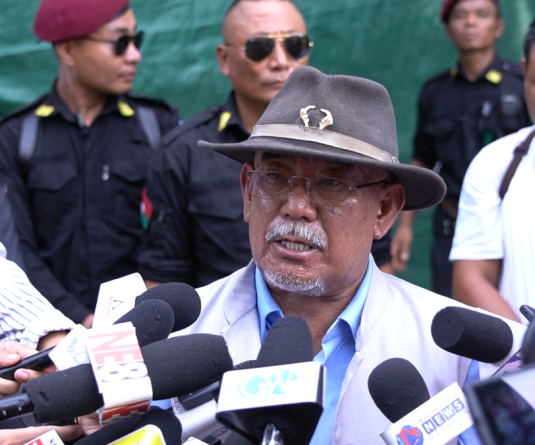
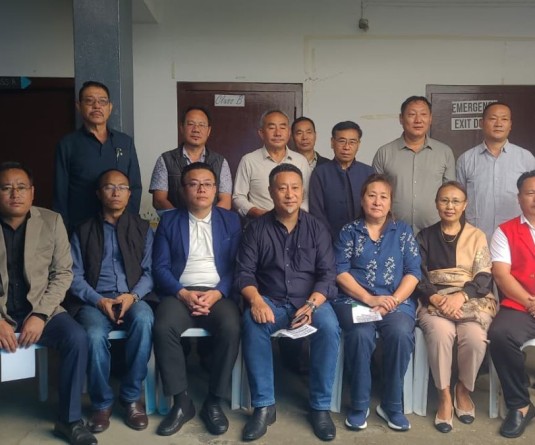
Participants of the Social Welfare Department’s programme on the occasion of the International Day for the Elimination of Violence against Women in Kohima on November 25.
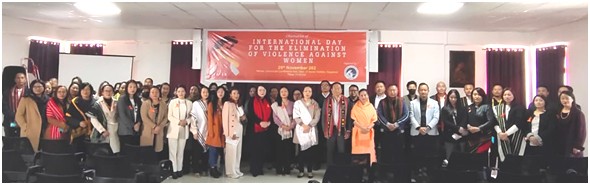
Dimapur, November 25 (MExN): In commemoration of the International Day for the Elimination of Violence against Women, the Department of Social Welfare observed a special programme with the theme ‘Unite! Activism to End Violence against Women and Girls’ on November 25 at the conference hall of the Directorate of Social Welfare, Kohima.
Juliana Medom, Supervisor, Nagaland State Social Welfare Board (NSSWB) pointed out that health, nutrition, education and economic development cannot progress without addressing women empowerment; and women empowerment cannot happen without addressing gender based violence. She added that elimination of violence against women will not happen overnight or after the 16 days of activism, but it is through awareness that society can amplify the voices of women affected by violence.
Keynote speaker, K Mhathung Tsanglao, Joint Secretary, Department of Social Welfare and Secretary, NSSWB said that the rising number of crimes against women could be due to the type of violence deeply rooted in the social, cultural, and structural norms and values in society that are often perpetuated by the culture of denial and silence; and that men’s agreement with patriarchal society and hostile attitudes are also causes.
He further noted that aggressive and violence supportive behaviour among men is not called out in certain societies due to which it is considered okay for men to be violent towards their partner. He added that, apart from gender normative behaviours that lead to crime against women, low socio economic status, poverty and unemployment have also been identified as causes of hate crime against women and girls. Alcohol, substance abuse and personality traits are also contributing factors.
Tsanglao pointed out that violence against women constitutes a large share of human rights violations and is perpetuated by the power imbalances between men and women, and that it affects women’s health and stops them from effectively executing the social roles, which in turn results in loss of opportunities. He said that violence against women is prevalent among all socio economic structures of society.
He urged the participants to be sensitized with the laws, schemes and programmes on women provided by the government to protect and empower women. Tsanglao stated that the idea to promote elimination of violence against women is to give a more dignified meaning of life to women; to promote gender equality.
He called for a balanced approach so that the empowerment of women should not lead to a deviation of men from society. Tsanglao encouraged the participants to let children be aware that violence towards women is never okay, and to teach them about gender equality and positive attitudes toward women and girls.
Zakato Chishi, Legal Consultant, 181 Women Helpline Nagaland, sensitized the participants on the ‘Sexual Harassment of Women at Workplace (Prevention, Prohibition and Redressal) Act 2013,’ after which a question hour was opened to the participants.
Following this, a video was screened on various schemes, programmes and services that are available under the Department of Social Welfare. The program was chaired by Venedulu Vero, Research Officer, Social Welfare. Vote of thanks proposed by Rokokhrielie Senuo, Program Officer, State Child Protection Society (SCPS), Mission Vatsalya.
Participants included various stakeholders under the Social Welfare Department, including the Nagaland State Social Welfare Board, State Hub for Empowerment of Women, the 181-Women Helpline, Sakhi-One Stop Centre Kohima, Child Care Institutes, Juvenile Justice Board, Swadhar Greh, State Child Protection Society, Mission Vatsalya and various NGOs.
It may be mentioned that any woman facing violence or anyone on her behalf may seek help at the Women Helpline (Dial 181/ 9485239098) or Sakhi-One Stop Centres which are set up in 11 districts of the state.
.png)