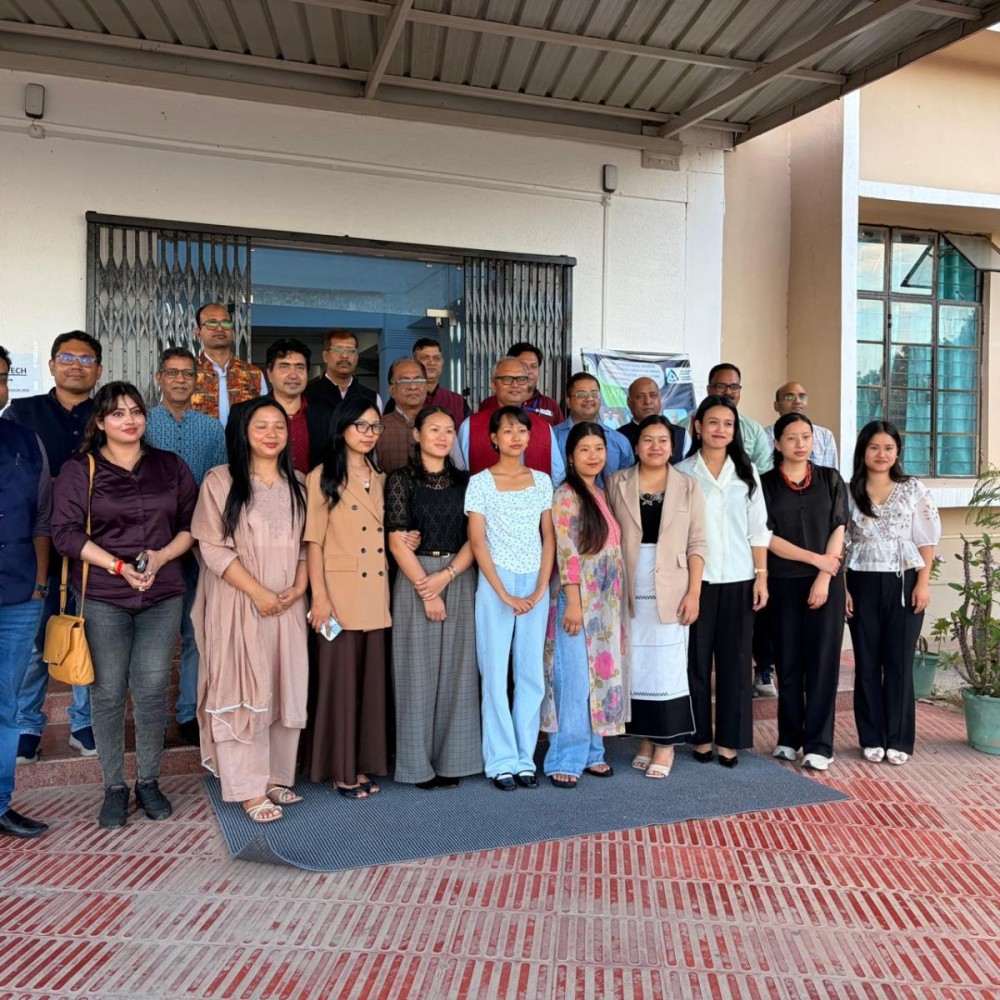
Dignitaries and others during the second day of the international seminar on “Artificial Intelligence for Green Sustenance” at Nagaland University on August 11.
Our Correspondent
Kohima | August 11
The two-day International Seminar AIGS–2026, themed “Artificial Intelligence for Green Sustenance: Collating Agriculture, Environmental Humanities and Pedagogy,” concluded at the School of Engineering & Technology, Nagaland University (NU), Kohima Campus, Meriema on August 11.
Sponsored by the Anusandhan National Research Foundation (ANRF), Government of India and Nagaland University, the hybrid seminar brought together academicians, scientists, researchers, faculty members and young scholars from India and abroad. It was convened by Prof Prabhakar Sharma, Dr Subhashis Banerjee and Dr Prasenjit Pal.
The seminar explored AI beyond conventional technological applications, examining its intersections with environmental sustainability, agriculture, education, humanities, ecology and responsible development.
The first plenary session featured Prof Shyam S Phartyal of Mizoram University speaking on “Citizen Science in the Age of Artificial Intelligence: Bridging Science, Humanities, and Education for Green Sustenance,” and Prof Nigamananda Das of Nagaland University on “Environmental Impact of AI.” The session highlighted both the potential of AI and the need to examine its ecological implications.
Parallel sessions covered Science & Technology and Education, Humanities & Social Science. Topics included greenhouse-gas emissions from hydropower reservoirs, environmental monitoring, AI in chemical research, Bio-AI convergence, AI-assisted food-waste reduction, smart agriculture, ecosystem restoration, agro-ecotourism, spiritual ecology, competency-based learning and NEP 2020.
The seminar also featured international perspectives. Prof Pierre Girard of the Federal University of Mato Grosso, Brazil, discussed AI-based monitoring of microplastics in water, while Dr Subhajyoti Samaddar of Kyoto University, Japan, addressed climate resilience. Other presentations examined microplastic pollution and ecosystem stewardship.
A poster session showcased research on solar-powered agricultural machinery, AI-enabled smart hydroponics, organic nitrogen management, soybean cultivation, indigenous plant materials, indigenous pest-management knowledge and biological control.
On the second day, international contributors including Prof Manish Kumar of Tecnológico de Monterrey, Mexico; Dr Prakash Kumar Jha of Mississippi State University, USA; and Dr Rakesh Kumar of Auburn University, USA, presented research on PFAS contamination, AI and smart technologies for sustainable agriculture, biochar and nutrient transport, and sustainable food packaging.
The Humanities and Social Science sessions explored AI and learning, green pedagogy, decolonisation, spiritual ecology, Northeast Indian poetry, indigenous pedagogical discourse, ancestral medicinal-plant knowledge, AI in education and sustainability education in tribal schools.
Other technical sessions covered sustainable pineapple production in Nagaland, agricultural ergonomics, solar-powered biomass technology, watershed assessment, microplastics, groundwater dynamics, biodegradable packaging, the Doyang River Basin, flood-risk assessment, soil erosion, sustainable Curcuma cultivation and climate-resilient agriculture.
The Agriculture & Social Science track brought together international and regional perspectives on microplastics, hydropower potential, indigenous ecological knowledge and climate-resilient water sustainability, including contributions from Dr Aviram Sharma and Dr Poonam Pandey of the University of Vigo, Spain.