Resource person along with the faculty and students of NECU during a special lecture series in Dimapur on May 30.
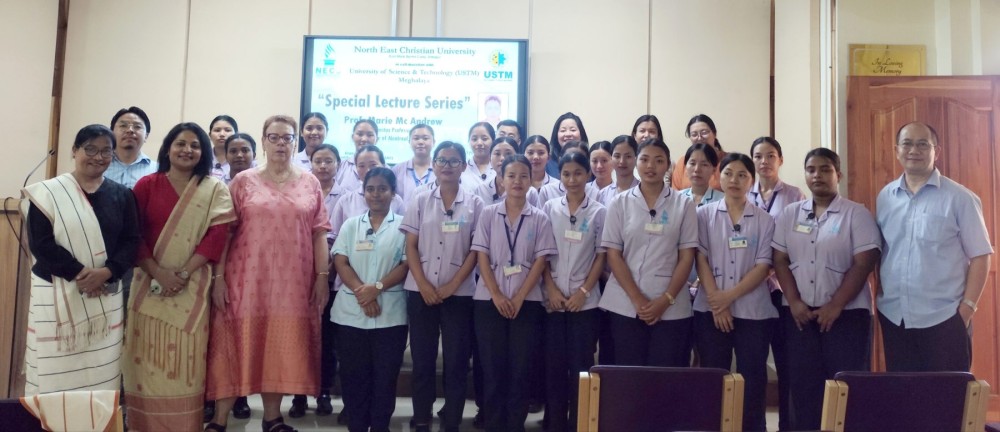
Dimapur, May 30 (MExN): The Internal Quality Assurance Cell (IQAC) of North East Christian University (NECU), in collaboration with the University of Science and Technology Meghalaya (USTM), organised a special lecture series featuring noted academic Marie Mc Andrew, Emeritus Professor at the University of Montreal.
The programme was chaired by Dr Chibenthung Yanthan, Coordinator, IQAC, while the welcome address was delivered by Prof Dr Darlando T Khathing, Pro-Chancellor of NECU.
In her first lecture, titled "Taking into Account Linguistic and Cultural Diversity: A Tool in the Development of Inclusive Schools", Mc Andrew discussed the importance of effectively managing ethnocultural diversity in higher education.
She examined how key diversity markers such as language, religion and origin influence contemporary campuses and reshape institutional mandates. Educational institutions, she said, have a critical role in either perpetuating or reducing socio-economic inequalities and cultural prejudices.
The scholar stressed that universities must go beyond enrolment figures to ensure the retention, academic success and social inclusion of minority students. She also highlighted the University of Montreal's Equity, Diversity and Inclusion (EDI) Action Plan, which seeks to eliminate systemic barriers in educational, working and living environments, counter harassment and promote diverse perspectives in scientific research.
According to Mc Andrew, fostering an inclusive campus environment enhances a university's ability to attract talent, prepare students for a globalised world and strengthen international recognition.
In her second lecture, "The Management of Ethnocultural Diversity in Higher Education", she described linguistic and cultural diversity as valuable assets for educational systems.
Drawing on UNESCO frameworks, she said inclusive education should extend beyond classroom access to ensure equal benefits for all learners and reduce marginalisation. Culturally sensitive curricula, she noted, improve academic performance, strengthen students' sense of belonging and build trust between schools and minority communities.
She highlighted institutional measures such as zero-tolerance policies against discrimination, language integration through flexible coursework and translation services, and the use of diverse learning materials reflecting minority knowledge systems.
At the same time, she pointed to continuing challenges, including balancing common curricula with minority perspectives, avoiding cultural stereotyping and equipping educators to become student-centred facilitators and reflective practitioners.
Her final lecture, "Aboriginal People in Quebec: Myths and Reality", focused on the experiences of 11 Indigenous nations in Quebec.
Mc Andrew outlined three distinct linguistic and cultural groups — Sedentary Iroquoian, Nomadic Algonquin and Nomadic Nordic Eskaleut (Inuit) — and traced the historical transformation of Indigenous communities from sovereign allies to wards of the state under the 1876 Indian Act.
She noted that the legacy of these policies continues to contribute to socio-economic disparities. Citing 2019 data, she said unemployment among Indigenous populations stood at 15.5 per cent compared to 7.2 per cent among non-Indigenous citizens, while only 8.9 per cent of Indigenous people held university degrees.
The presentation also highlighted efforts towards reconciliation in recent decades, including grassroots economic initiatives, bilateral treaties and revised history curricula. Mc Andrew said modern equity action plans and land acknowledgements are important measures in advancing meaningful systemic reconciliation.