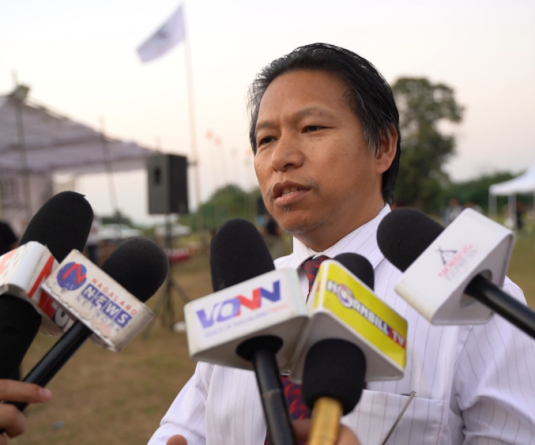
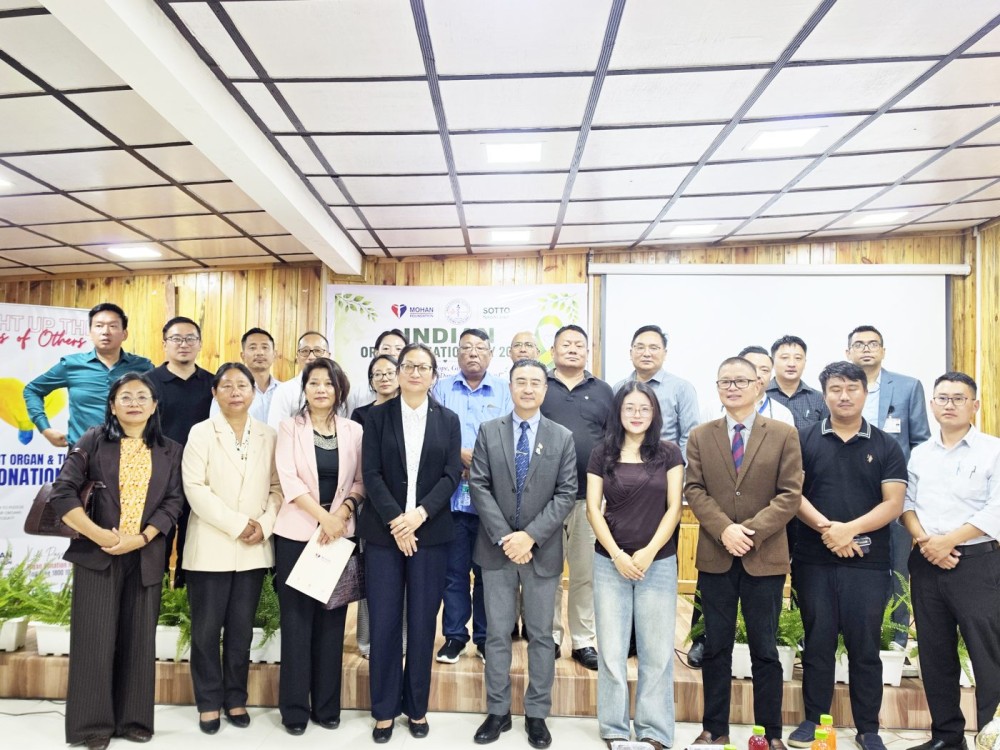
Dr Mereninla Senlem, Principal Director, Directorate of Health & Family Welfare (4th from R), Dr Vikieo Khroumo, Nephrology, NHAK (R), Neibalie Rio (M), Colo Mero (3rd from R), Tekhe (4th from R) seen with other Officials during the Indian Organ Donation Day at NHAK on August 3.
Morung Express News
Kohima | August 3
Marking an important milestone towards improving access to advanced healthcare for citizens, Naga Hospital Authority Kohima (NHAK) has initiated the process of obtaining required registration and licensing for organ transplantation. This was announced by Dr Mereninla Senlem, Principal Director, Directorate of Health and Family Welfare during the observation of Indian Organ Donation Day organised by MOHAN Foundation in association with NHAK and State Organ and Tissue Transplant Organisation (SOTTO), Nagaland at NHAK Auditorium on August 3.
In Nagaland state, she said, “we are beginning at an important stage in our journey towards strengthening organ donation and transplantation services.” While transplantation services are not yet available within the state, she said that significant efforts are underway to build the necessary systems, infrastructure and capacities for the future.
She commended the MOHAN Foundation for its valuable partnership and continued commitment towards strengthening organ donation and transplantation efforts in Nagaland. Beyond creating public awareness, she highlighted that the foundation has been working closely with NHAK, SOTTO Nagaland and the Department of Health & Family Welfare in supporting capacity building initiatives, stakeholder engagement, professional training and efforts aimed at enhancing institutional readiness for organ transplantation services.
Further acknowledging NHAK, SOTTO Nagaland, Healthcare professionals and all stakeholders who continue to work towards a shared vision, she underlined that their commitment and collective efforts are helping lay the foundation for a stronger and more responsive organ donation and transplantation programme in Nagaland.
However stating that the success of organ donation programmes depends not only on healthcare institutions and government agencies, but also on the participation of every citizen, she underscored, “awareness must begin within the families, communities, educational institutions, workplaces and places of worship.”
“We must encourage open conversations about organ donation, dispel myths and misconceptions and promote informed decision-making”, she asserted.
As a government, she said, “we remain committed to strengthening healthcare systems, supporting the development of organ donation and transplantation services, building the capacities of healthcare professionals and increasing public awareness across the state. “Through collaboration among government departments, healthcare institutions, civil society organisations, community leaders, faith based organisations and development partners, we can create an environment where organ donation is understood, supported and embraced as an act of humanity,” she affirmed.
750 Patients depend on regular dialysis in Nagaland
Stating that the burden of kidney disease is increasing across the world, Dr Vikieo Khroumo, Nephrology, NHAK on Monday stated that more than 670 million people are living with Chronic Kidney Disease (CKD) globally.
In India, he highlighted that nearly 100 million people are affected by CKD, and many progress to kidney failure every year. However, asserting that the need for organs is far greater than the number available, he pointed out that, “nearly 90,000 patients in India are currently waiting for an organ transplant, while about 20,000 organ transplant were performed in 2025.”
Across Northeast India, he said that nearly 5,000 patients are on regular hemodialysis with about 750 patients depending on regular dialysis in Nagaland alone.
Stating that patients who need a kidney transplant must travel outside the state because Nagaland does not yet have a kidney transplant programme, he further highlighted that “while dialysis sustains life, kidney transplantation offers the best chance for a longer, healthier, and more fulfilling life.”
He also maintained that organ donation is one of the noblest acts of humanity, and transforms the sorrow of one family into hope for many others by giving the gift of life.
As a nephrologist, he shared how he has witnessed the courage and resilience of these patients every day, and added that, “behind every dialysis session is a family waiting and hoping for the gift of a kidney.”
Paying his heartfelt tribute to organ donors and their families on the occasion of Indian Organ Donation Day, he expressed that, “their selfless decision brought hope, healing, and a second chance at life to countless people.”
“Let us make organ donation a conversation in every home. Let us spread awareness, remove myths, and encourage more people to pledge to donate organs. Together, we can give hope those waiting for a transplant and save many more lives. One donor can save many lives. Let us all be a part of this life-saving mission,” he urged.
The Indian Organ Donation Day that was held under the theme, “Stories of Hope, Gifts of Life: Promoting Organ Donation in Nagaland” also featured testimonies on Organ Transplant Journeys by Neibalie Rio, Colo Mero and Tekhe, Living Organ Donor & Transplant Recipients.
Highlights of the programme included ‘Screening of Manipur Donor Family Testimonial Video,’ Invocation by Kashito S Sumi, Chaplain, NHAK, vote of thanks by Lirenthung N Kithan,
Project Lead, MOHAN Foundation, Nagaland while the programme was chaired by Dr Bernard Amer, Senior Specialist, NHAK & Convener, Organ Transplant Committee.