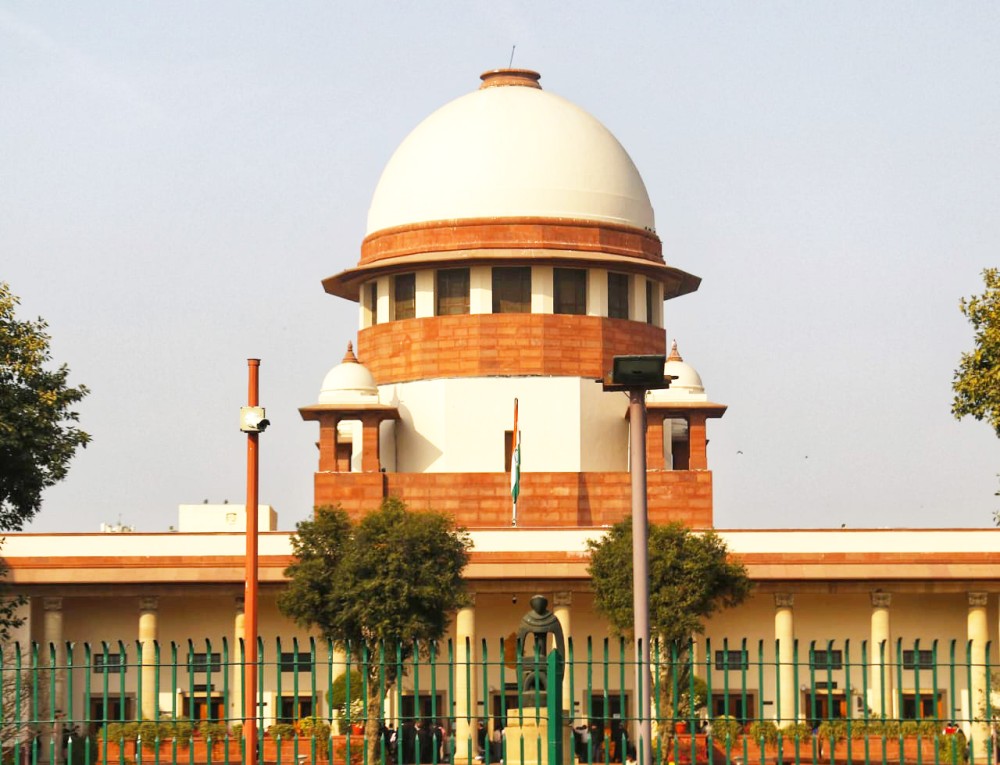
Supreme Court of India. (IANS Photo)
Morung Express News
Dimapur | May 30
The Supreme Court has dismissed a Special Leave Petition (SLP) filed by IAS officer Reny Wilfred upholding a December 12, 2025 judgment of the Gauhati High Court, Kohima Bench, which had refused to quash criminal proceedings and a chargesheet against him in connection with allegations of sexual harassment at the workplace.
“We are not inclined to interfere with the impugned order passed by the High Court. The Special Leave Petition is, accordingly, dismissed,” stated the order issued by Justices MM Sundresh and Nongmeikapam Kotiswar Singh on May 27.
The case stems from a complaint lodged by the Chairperson of the Nagaland State Commission for Women (NSCW) on March 17, 2025, alleging sexual and mental harassment of women employees at the Investment and Development Authority of Nagaland (IDAN), where the officer was serving as Joint Secretary.
Based on the complaint, the State Crime Police Station registered a case under Sections 74, 75(2), and 79 of the Bharatiya Nyaya Sanhita (BNS), 2023 on April 2, 2025.
During the pendency of the proceedings, a chargesheet was filed on June 30, 2025, prompting the petitioner to seek quashing of both the complaint and the subsequent criminal proceedings.
Petitioner challenges NSCW's authority
Before the High Court, the petitioner’s principal contention, among others, was that the NSCW lacked the authority to initiate criminal proceedings or challenged how the First Information Report (FIR) ‘has been set in motion’ consequently.
The petitioner argued that the complaint to the police was filed by the NSCW Chairperson and not by any of the alleged victims while none of the women concerned had submitted written complaints either before the NSCW or before an Internal Complaints Committee (ICC) constituted under the Sexual Harassment of Women at Workplace (Prevention, Prohibition and Redressal) Act, 2013 (PoSH Act).
The petitioner also maintained that allegations of workplace sexual harassment should first be addressed through the mechanisms prescribed under the PoSH Act and that the criminal proceedings initiated on the basis of the NSCW complaint were therefore illegal and liable to be quashed.
State, NSCW defend proceedings
The State Government and NSCW opposed the petition, stating that ten women employees had reported repeated incidents of sexual harassment and that the Commission acted within its statutory mandate under Sections 5 and 6 of the Nagaland Women Commission Act, 2006.
The Sections empowers the Commission to summon witnesses, record statements and conduct inquiries relating to the welfare and protection of women.
They further argued that remedies under the PoSH Act and criminal law are not mutually exclusive and may operate simultaneously.
The respondents also informed the Court that IDAN had not constituted an Internal Committee until March 2025, leaving the women without an effective internal forum for redress at the relevant time.
It was further submitted that the police did not register the case solely on the basis of the NSCW complaint.
A preliminary inquiry was first conducted, statements of victims and witnesses were recorded, and only after prima facie evidence of cognisable offences emerged was the FIR registered.
The subsequent investigation led to the filing of a chargesheet under provisions of the BNS and the Scheduled Castes and Scheduled Tribes (Prevention of Atrocities) Act.
Court’s conclusion
Justice Mitali Thakuria held that the NSCW acted within its statutory powers under Sections 5 and 6 of the Nagaland Women Commission Act, 2006, which empower it to inquire into complaints affecting women, summon witnesses and record statements.
The Court noted that after receiving verbal complaints from women employees, the Commission conducted an inquiry and forwarded its findings to the police.
The Court clarified that the NSCW neither functioned as a criminal court nor conducted a criminal investigation. It further held that proceedings under the PoSH Act do not bar criminal prosecution where the allegations disclose offences under the BNS.
Referring to the Supreme Court's ruling in State of Haryana vs Bhajan Lal which established seven definitive guidelines quash a FIR or criminal proceedings, the Court held that the case did not fall within the limited categories.
It noted that the FIR was registered only after a preliminary inquiry found prima facie evidence of cognisable offences and that the subsequent investigation resulted in a chargesheet supported by sufficient material.
The Court also noted that the chargesheet invoked provisions of the SC/ST (Prevention of Atrocities) Act, as all the alleged victims belonged to Scheduled Tribe communities. Consequently, the writ petition was dismissed, allowing the criminal proceedings to continue.