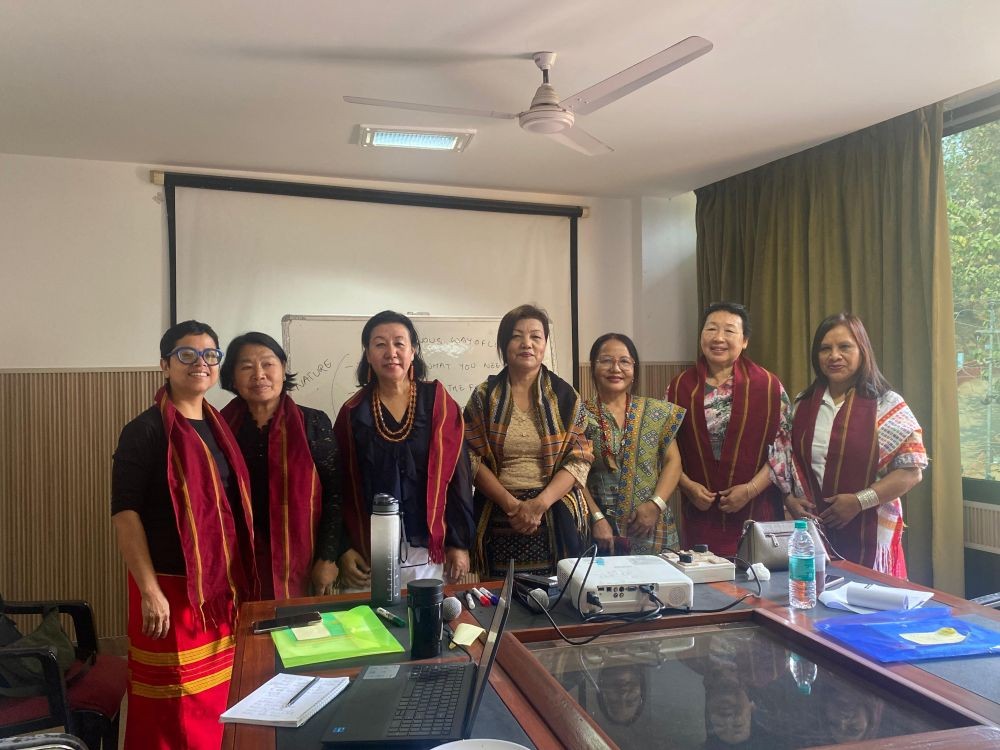
Women representatives from the Northeast region during the training on ‘Women leading climate justice & biodiversity’ held at DBIM, Kharguli, Guwahati from February 24 - 27. (Morung Photo)
IWFNEI holds training for women leaders from NE
Morung Express News
Guwahati | March 1
“It is as if climate change is not connected to our lives. Meanwhile the land, air, water and forests are all linked to this.”
With these words, facilitator Banamallika Choudhury opened a training for women leaders from across Northeast India in Guwahati, urging participants to recognise climate change as a lived and immediate reality.
Choudhury described climate change as a crisis confronting the entire world and warned that it is threatening the very existence of human life. Speaking during a session on climate justice and biodiversity, she explained that the crisis is affecting “land, air, water, food and forests,” what she termed as the “materials for life.” She stressed that the current crisis is not a natural process but the result of human activities.
The training, themed “Indigenous Women’s Action in Promoting and Preserving Biodiversity in Northeast India,” was held from February 24 to 27 at DBIM, Kharguli, Guwahati. It was organised by the Indigenous Women’s Forum of North-East India (IWFNEI) in collaboration with Prodigals’ Home and sponsored by PAWANKA.
Placing climate change within a broader political and economic framework, Choudhury described it as a systemic issue deeply linked to capitalism and patriarchy.
Exploitative development, overuse of natural resources and profit-driven systems, she argued, increase greenhouse gas emissions, leading to global warming and climate change. This, she said, results in the loss of the very “materials for life” that sustain communities.
“We are the custodians of all these materials for life,” she asserted, referring to Indigenous peoples. While Indigenous communities use resources judiciously, she said, capitalist systems seek to extract them for profit.
She stated that capitalists want people to believe climate change has nothing to do with their actions. According to her, these systems operate to retain power; and the more power they accumulate, the more control they exert over the resources of Indigenous communities. At the centre of capitalism, she said, is the greed for power.
“The impact of this serious situation is in all of our lives,” she noted, highlighting that women, children, Indigenous communities and other marginalised groups are the most affected by the climate crisis.
Choudhury cited examples of how climate change is impacting social environments, contributing to increased gender-based violence and forcing people into climate-induced displacement.
“The rich, powerful and greedy do not only include individuals but also countries,” she said, adding that powerful nations seek to maintain their lifestyles by manipulating land and resources belonging to Indigenous communities.
These realities, she said, reflect the deep injustice embedded in the current global system. “Justice will be the counter to injustice,” asserted the feminist researcher and writer engaged in women’s rights and climate justice work.
Touching on climate justice, she maintained that countries responsible for causing the climate crisis must take accountability and work alongside affected communities to find solutions.
She emphasised that impacted people, particularly Indigenous communities and women must be included in decision-making processes, noting that traditional knowledge systems are vital in addressing the crisis.
“The powerful do not need solutions because they do not benefit from them,” she added.
Participants from various states of the Northeast examined how government policies and land governance systems frequently exclude Indigenous and marginalised communities. Discussions questioned whether carbon markets and large-scale climate projects genuinely benefit local populations.
Some participants described such interventions as “false solutions,” particularly when they promote monocropping and weaken biodiversity.
“We cannot stop what is coming, but we can preserve what we have,” one participant reflected.
Indigenous way of life: Way forward
A strong focus of the training was the Indigenous way of life and its relationship with nature. The facilitator described the Indigenous lifestyle as rooted in balance, respect and collective responsibility, a system that does not separate people from nature. Its guiding principles include taking only what is needed, thinking about future generations and prioritising collective well-being.
These principles, she said, reflect a sustainable way of living where nature is cared for and, in turn, sustains the community.
In contrast, another participant described the capitalist approach as deeply individualistic where “you eat your own seed,” consuming today what should be preserved for tomorrow.
The training reiterated that strengthening community leadership, protecting biodiversity and supporting food and seed sovereignty are essential steps forward.
At its core, the Indigenous way of life affirms that human well-being depends on collective care for land, air, water and forests.
The training was attended by representatives from Tiwa Women Association, Rabha Women Association, Lai Women Association, Tura Mother’s Union, Naga Women Union Manipur, Naga Indigenous Women Network and Borok Women’s Forum Tripura.