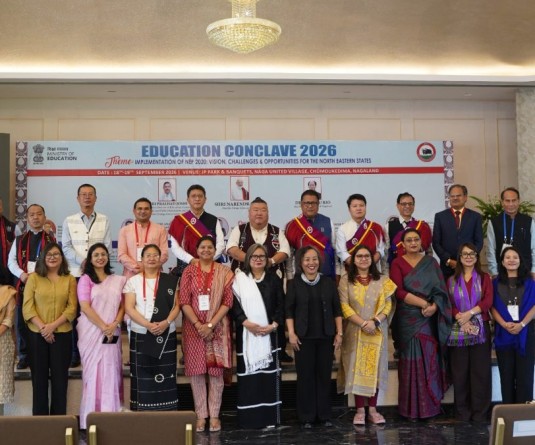
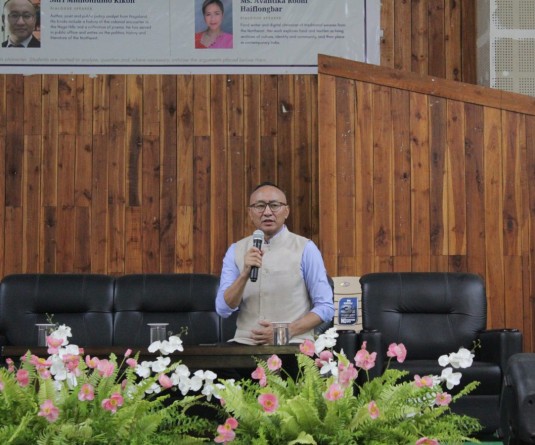
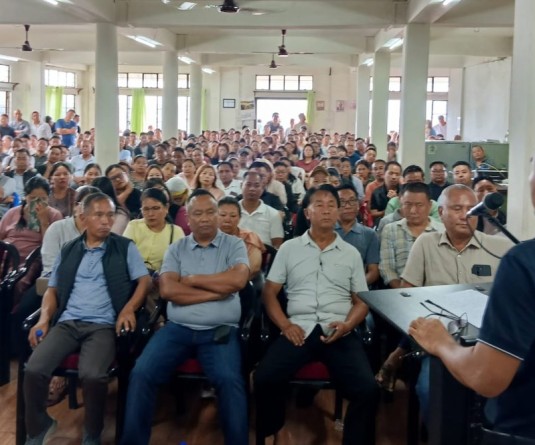
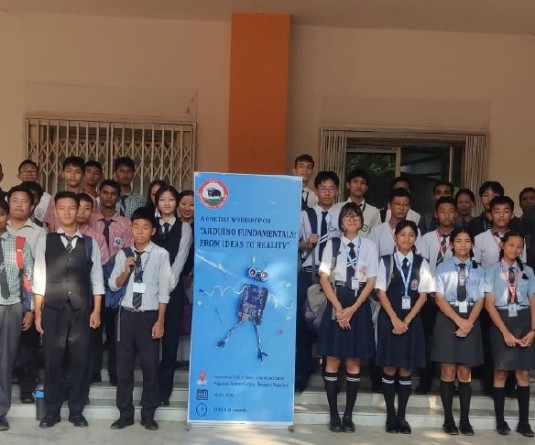
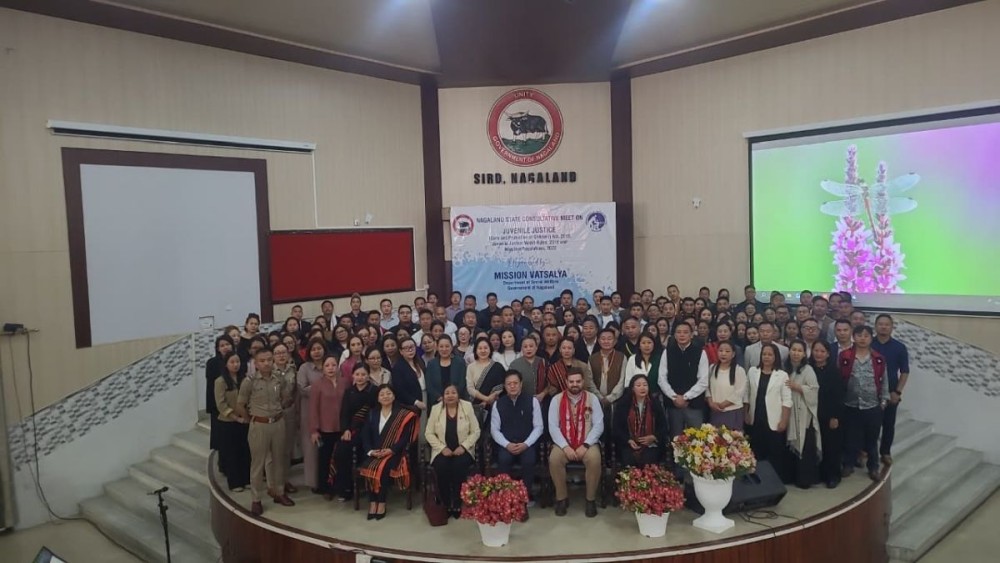
Dignitaries and participants of Nagaland state consultative meet on Juvenile Justice Act in Kohima on May 19. (Morung Photo)
Nagaland Social Welfare Secretary on Juvenile Justice Act implementation
Our Correspondent
Kohima | May 19
Nagaland Social Welfare Department Secretary Limawabang Jamir today maintained that Nagaland has always possessed strong community-based systems of care through its families, clans, village councils, churches and tribal institutions.
“These social structures have protected vulnerable children for generations and remain one of the greatest strengths of Naga society,” Jamir said while addressing Nagaland State Consultative Meet on Juvenile Justice (Care and Protection of Children) Act, 2015, Juvenile Justice Model Rules, 2026 and Adoption Regulations, 2022 at SIRD Auditorium, Kohima on May 19.
However, in today’s evolving legal and administrative environment, it is equally important that such care mechanisms are supported by proper legal safeguards so that children are fully protected in matters relating to identity, inheritance, education, welfare entitlements, and long-term security, he said.
The Juvenile Justice Act and the Adoption Regulations provide those legal safeguards, Jamir said who is also the state mission director of Mission Vatsalya.
“Our task, therefore, is not to dilute the law, nor to disregard our customs, but to implement these provisions in a manner that is practical, culturally sensitive and responsive to the realities of Nagaland,” he said.
Stating that the Juvenile Justice (Care and Protection of Children) Act, the JJ Rules, and the Adoption Regulations represent a highly progressive legal framework on paper, Jamir stressed on the need to see that these rules are effectively adapted and implemented.
In all honesty, he said, the formal legal framework assumes a specific social structure- which assumes seamless digital connectivity for adoption portals, standardized police handling, and that institutional care is the primary safety net.
What is the reality in Nagaland?
“Our reality is our customary laws and community governance. What makes Nagaland unique within the Indian Union is the constitutional recognition granted under Article 371A of the Constitution of India, which safeguards Naga customary laws, social practices, and traditional institutions,” Jamir said.
He said the reality includes customary forms of adoption deeply rooted in clan and village traditions- “done with good intentions, but increasingly leaving children legally vulnerable in a modern world.”
“Our reality includes deep digital divides in our newly formed and remote districts, making centralized online portals difficult to navigate. It is important to note that we cannot change our geography and topography. We should also not erase our culture,” he said.
Seeking views and suggestions from the stakeholders on how best they can bridge the gap between statutory mandates and unique ground realities, he said, “Every statistic we discuss today represents a real child in a Naga village, town, or colony who is relying on our collective wisdom for protection, safety and justice.”
We need to move forward with a unified strategy, he said adding, “the Social Welfare Department, the Judiciary, the Police, the Medical fraternity, the District Administrations, and our traditional tribal institutions no longer work in silos, but walk hand in hand.”
Quoting a phrase often used by State Adoption Resource Agency (SARA) as “Adoption is an act of love, but the process must come from law,” Jamir said the exact same principle applies to all acts and regulations.
“We do not need to rewrite the federal law to suit Nagaland, nor do we need to abandon Naga culture to suit the law,” he said.
Together, let us build a child protection model that is legally airtight, yet distinctively Naga, he said and urged everyone to protect children-not just because the law demands it, “but because our entire future depends on it.”
Call for effective implementation of legal provisions
Nagaland’s social welfare department director Tosheli Zhimomi said that a strong tripartite legal framework (Juvenile Justice (Care and Protection of Children) Act, 2015, Juvenile Justice Model Rules, 2016 and Adoption Regulations, 2022) have been designed to act as a safety net for some of the most vulnerable members of the society.
“Together, these frameworks form the backbone of our child protection and adoption ecosystem,” she said adding that such frameworks not only provide legal safeguards “but also establish clear responsibilities, standards, and mechanisms to ensure that every child receives care, protection, rehabilitation, and opportunities for a dignified future.”
In Nagaland, the Juvenile Justice (Care and Protection of Children) Act, 2015 was notified on March 22, 2018, establishing our baseline statutory machinery and moving further toward tailored state governance, the Nagaland Juvenile Justice (Care and Protection of Children) Rules, 2024 was drafted and notified on December 2, 2025.
Zhimomi, who is also member secretary Mission Vatsalya, said that children who are orphaned, abandoned, vulnerable, or in need of care and protection depend greatly on the effectiveness, sensitivity, and accountability of our systems.
“Therefore, our collective responsibility goes beyond policy implementation-it extends to building a responsive, compassionate, and child-friendly ecosystem across the state,” she said.
Further, the Director called for strengthening institutional support systems, improving interdepartmental convergence and effective implementation of the legal provisions.
In his address, Junaid Ul Islam, Senior Consultant, Ministry of Women & Child Development, sought suitable inputs from the stakeholders in strengthening the child care and protection system in the country.
The business hours witnessed presentations from various stakeholders- Renchumi Imti, Programme Manager SARA, Akumla Longchari, member N- SCPCR, Kughakali Achumi, DCPO Niuland, Moamenla Yaden, Chairperson, CWC Dimapur, Vithazonu Elizabeth, member JJB Kohima, NT Kikon, Managing Director, Wondang- Ki Charitable Foundation and Department of Health & Family Welfare.
Organised by Mission Vatsalya, Department of Social Welfare, the consultative meet was attended by officials and representatives from Child Welfare Committee, Juvenile Justice Board, Child Care Institution, Police, media, National Legal Services Authority, Nagaland State Commission for Protection of Child Rights, District administration, social welfare and medial department.