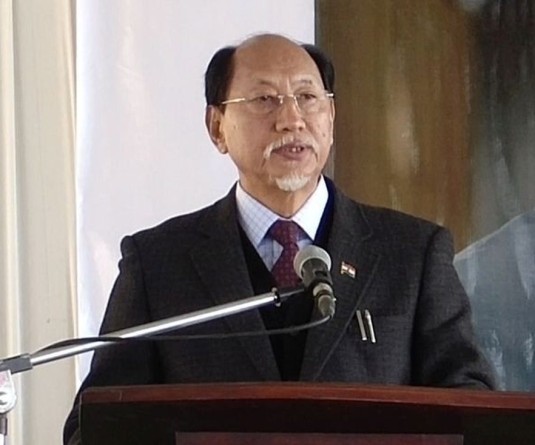
NPF Secretary General Achumbemo Kikon on September 17 cautions veterans against feeding misleading narratives to the youth, particularly those who did not experience the Indo-Naga political conflict firsthand. (Morung File Photo)
Morung Express News
Dimapur | September 17
Back in 1997, the then Prime Minister HD Deve Gowda had famously labelled the All India Congress President of the time, Sitaram Kesri “an old man in a hurry.” This was the context: Gowda was heading a rickety minority government, and at the mercy of the Congress, which ultimately withdrew support. Gowda’s less than 10-month old government crumbled and thus, his scathing jibe at Kesri, who was in his late 70s.
Today, NPF Secretary General Achumbemo Kikon referenced that dramatic chapter in Indian power politics to hit out at another admittedly veteran Congressman, Dr SC Jamir, over the latter’s recent remarks on the Naga political issue following his September 10 meeting with RSS chief Mohan Bhagwat.
According to Kikon, Nagaland is witnessing a similar episode in the shape of Jamir— “an old man in a hurry.” “I think that will be the best word (expression) to describe (Jamir),” he held.
Speaking at a party event, commemorating Prime Minister Narendra Modi’s 76th birthday, in Chümoukedima on September 17, Kikon cited what he claimed were old documents and news reports that pointed to Jamir standing in the way of resolving the Naga political issue on multiple occasions.
He cited a past interview where former Chief Minister, the late Vamuzo termed Jamir an “obstacle,” alongside a June 2002 news report that quoted congressman-turned-NPF-turned-congressman K Therie stating that Jamir was the main obstacle to the peace process.
Kikon also read out excerpts of a letter purportedly written by Jamir, when he was a Member of Parliament and Parliamentary Secretary to Jawaharlal Nehru, in March 1963 to the Chief Executive Councillor of the interim government P Shilu Ao.
In the letter, Jamir allegedly protested Prime Minister Nehru’s willingness to meet AZ Phizo, calling it a “political blunder” and a “double standard policy” that undermined the Naga People’s Convention. He held that Jamir had even threatened to withdraw his signature from the statehood pact.
Kikon recalled Jamir’s controversial booklet— Bedrock of Naga Society, which framed statehood as the final settlement. He posed why New Delhi signed a ceasefire on September 6, 1964, with the NNC/FGN and initiated Prime Minister-level talks between Indira Gandhi and Kughato Sukhai if the issue had been settled. Maintaining that statehood was merely a process that excluded key stakeholders, Kikon said, “For us, an honourable, inclusive, acceptable solution still awaits.”
Jamir’s “equi-distance” policy came under scathing criticism with Kikon claiming it shut off the public from the corridors of power. When the NPF took office in 2003 under Neiphiu Rio, Kikon said, the government replaced that stance with "equi-closeness," treating all Nagas, including “underground groups,” as one family.
In his written statement to Mohan Bhagwat, Jamir had suggested that the RSS should pressure the NDA government to place Nagaland under President's Rule. Kikon termed it “careless utterances” and “unbecoming of a seasoned leader,” who attained power through democratic elections.
Kikon also rebutted Therie labelling the NPF a stumbling block. Questioning Therie's political consistency, Kikon said that Therie called Jamir an obstacle in 2002 but now describes him as the tallest leader in Naga politics. He cautioned veterans against feeding misleading narratives to the youth, especially Generation Z, who did not experience the Indo-Naga political conflict firsthand.
.jpg)